Sinclair Launches New Channel to Stream Campaign Events Without Commentary — Is That Dangerous?

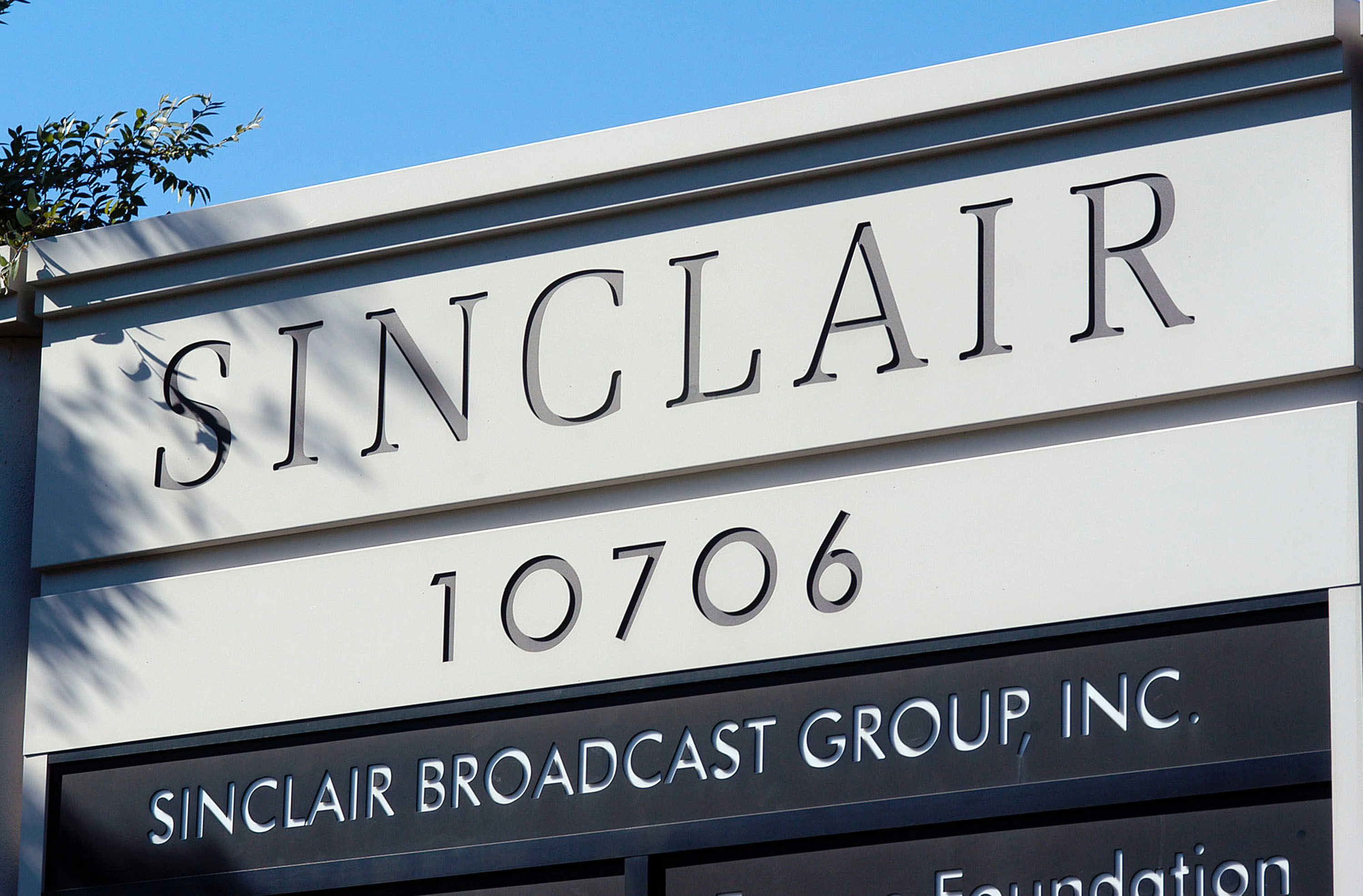
William Thomas Cain/Getty Images
Sinclair Broadcast Group announced yesterday that it is launching a new channel whose express purpose is to broadcast presidential campaign events around the country with no accompanying commentary or analysis.
The channel, “2020 Live,” launches this week and is part of STIRR, Sinclair’s year-old, over-the-top free streaming service. Sinclair boasted in a statement that the channel will give “viewers the most transparent, bias-free view into the campaign trail.” Its slogan, as reported by NBC News: “No analysis. No Spin. Just Live.”
The channel, as NBC points out, signals a move on the company’s part to de-emphasize political commentary. In December, the company eliminated commentary from two of its top analysts, Boris Epshteyn, a Republican political strategist who worked on the Trump campaign, and Ameshia Cross, a liberal commentator. At the time, Sinclair, a local TV juggernaut which operates 193 stations in 89 markets in the United States, cited the changes as part of a larger effort to focus more on investigative journalism.
Sinclair’s coverage has traditionally tilted right. Its executive chairman is David D. Smith, a vociferous supporter of Trump. In 2018, Sinclair found itself at the center of a media controversy when it was revealed that the company had mandated to local TV anchors that they dictate talking points that sounded like “pro-Trump propaganda,” as CNN’s Brian Stelter reported.
On first glance, it may be difficult to see much wrong with “Live 2020,” which experts say is likely to bring in coveted political ad dollars for Sinclair. There is a certain no-nonsense appeal to a streaming service that simply provides a continuous loop of campaign events sans punditry, given the glut of commentary that already exists on major news networks like Fox News, MSNBC and CNN.
Still, there is something strange about the channel. One big lesson broadcast networks took from the previous election was that providing unfiltered coverage of Trump’s rallies may not have been the highest form of journalism even if it led to higher ratings. Just before Trump was elected, CNN president Jeff Zucker characterized the decision to air so many of Trump’s rallies as a “mistake.”
And media experts say “Live 2020” raises some concerns about fair coverage, despite Sinclair’s stated devotion to “bias-free” streaming. Jane Hall, a media critic and an associate professor at American University’s School of Communication, told Mediaite that there is reason to be suspicious of Sinclair’s intentions because of the company’s pro-Trump history.
“Whose rallies are they going to carry?” she said. “Is every Democratic rally and every Trump rally going to be covered?”
The media scholar Robert Thompson doubts that “Live 2020” will be able to provide exhaustive coverage of campaign events, at least when there are so many candidates in the field. That means Sinclair will have to make editorial decisions around whose events to broadcast, introducing bias into the operation.
Ratios aside, though, the style of the coverage is the real problem, according to Thompson. If Sinclair chose to broadcast only Bernie Sanders rallies, “to do it straight without commentary ceases to be journalism,” he told Mediaite. “It’s simply providing access.”
In an interview with NBC News, Sinclair general manager Adam Ware likened the new channel to “C-SPAN without any anchors.” But Thompson rejected that analogy. C-SPAN, which mostly covers Congress, “is not following one person talking,” Thompson said. “It’s covering an important part of the political process in a democratic republic.”
A more apt analogy, Thompson mused, would be something like NBC’s infamous announcerless game, a football game between the New York Jets and the Miami Dolphins that was broadcast in 1980 by NBC and featured no sports commentators to provide play-by-play analysis. While the novelty of the concept attracted publicity, it proved to be unpopular and was never attempted again.
Daniel Hallin, a professor in the department of communication at University of California San Diego, told Mediaite that “Live 2020” may sound like a good idea, but there are underlying problems that could have consequences for American politics.
“While I think it’s good in principle to give people the option to watch campaign events for themselves, at length, rather than just seeing the soundbites journalists present,” Hallin said, “in the current state of American politics, with the polarization we have today, it might reinforce the tendency for people just to listen to one side that they identify with.”
It remains to be seen what kind of coverage “Live 2020” will provide, if it will be popular, or if it will sow any kind of division. The channel certainly has the potential to reach a wide audience, as STIRR now has 1.6 million downloads, according to Sinclair. A spokesperson for the group did not respond to requests from Mediaite for comment.
One thing is clear, though. Even if the new channel appeals to you — even if you, understandably, try to avoid TV commentary at all costs — “Live 2020” seems to be operating against the spirit of what Sinclair describes as a new agenda: focusing on investigative reporting. “Live 2020” is, in many ways, the opposite of that, requiring little to no work on the part of Sinclair. And that’s just lazy.
New: The Mediaite One-Sheet "Newsletter of Newsletters"
Your daily summary and analysis of what the many, many media newsletters are saying and reporting. Subscribe now!







Comments
↓ Scroll down for comments ↓