Samantha Power and the Liberal Internationalists Meet the Real World

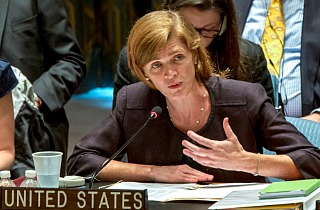 It was not long ago when United Nations Ambassador Samantha Power could do no wrong in the eyes of the internationalist left. Leaving aside the intolerable sin of having called Hillary Clinton a “monster” during the 2008 Democratic presidential primaries – a transgression for which she spent some months repenting — the lettered internationalist has finally secured her dream job: guiding American foreign affairs as President Barack Obama’s chief diplomat in the United Nations. But Power’s journey is a tragic one. Her story has become a parable, teaching a whole new generation to be careful what they wish for.
Today, the internationalist scholar and famous champion for the supremacy of multilateral institutions is learning that the challenges of governing appear far less complex when filtered through the narrow windows adorning Harvard’s Kennedy School of Government. Not long ago, Power championed humanitarian interventionism as a means of curtailing bloodshed and preventing genocides. She advocated for broad consensus building via international institutions and fretted that America’s unilateral actions in Iraq undermined the mission’s purpose. Today, opposed by the recalcitrant voices in Beijing and Moscow in the U.N., Power is pushing her own morally questionable and legally ambiguous war. In the process, she is learning about the intellectual limitations of “smart power.”
“How do you make American words mean something again?” Power once asked her students. “How do we prevent our stories from sounding like fairy tales?”
It was a good question, one which her intellectual brethren were eager to answer. In 2009, with Obama’s ascension to high office, they got their chance.
The author of the 2002 book, A Problem from Hell: America and the Age of Genocide, long ago became a beacon of promise for the intellectual left incensed by President George W. Bush’s dismissal of the relevance of multilateral diplomatic institutions. Though not a dove, (as a champion of the “responsibility to protect” doctrine, Power was a leading voice in the White House convincing Obama to intervene in the nascent Libyan civil war in 2011), Power could have aptly been described as a globalist.
As a champion of intervention, Power appeared to welcome the 2003 invasion of Iraq. However, she was vexed by the lack of international authorization for that invasion and reconstruction which would be conducted by Bush’s nearly 50-nation strong “coalition of the willing.”
“The issue, though, is whether the United States can be, in a sense, the unilateral guardian of human rights and whether the intervention itself won’t have destabilizing consequences,” Power told MSNBC host Chris Matthews in March, 2003. “Both in terms of our security, the very security in whose name we’re really launching this intervention, and in the name of international principles like human rights, international justice, international stability.”
In that interview, she worried that the semi-unilateral approach the United States was taking would foster the impression that the U.S. was a global desperado.
“It legitimates the go-it-alone approach and it sort of reinforces the impression of us as an outlaw nation,” Power insisted, “which is ironic because, of course, Saddam’s regime is far more an outlaw nation than ours.”
While some, including her friends and colleagues, noted that Power did not come to the position of America’s chief United Nations diplomat with “sharp elbows,” they speculated that she would sprout them while in office.
Today, it seems as though Power’s beveled elbows are not up to the task of marshaling support for an intervention in the Syrian atrocity. In spite of the fact that Bashar al-Assad flaunts international treaty and customary law by employing chemical weapons regularly and with escalating scope, Power is unable to even secure a condemning “press release” from the representatives of the globe’s distinguished powers.
On Monday, Power told National Public Radio that America’s coming attack on Syria was both “legitimate” and “necessary.” She could not say that it would be legal. Her frustration with America’s international partners was audible.
Not only is Power finding her persuasive abilities lacking when coaxing the great powers to acquiesce to an American attack on Syria, but she is also discovering that diplomacy has its limits with the rising powers as well. On Friday, The Washington Examiner revealed that Power, in conjunction with United Nations functionaries, sought to convince Iran to help impose an international inspections regime on its ally in Syria.
“Or, if not, at a minimum, we thought perhaps a shared evidentiary base could convince Russia or Iran — itself a victim of Saddam Hussein’s monstrous chemical weapons attacks in 1987-1988 — to cast loose a regime that was gassing its people,” she wrote.
Shockingly, Tehran – a 40-year adversary of the West with a vast human, capital, and political investment in Assad – rejected the request.
This is not merely naïve behavior. This is dangerous. It sends mixed signals, prompts international actors to doubt America’s resolve, and increases the likelihood that an American adversary may miscalculate and challenge the West in a way that would prompt an unforeseen response. Those miscalculations and the responses they incur have a tendency to spiral out of control.
Power is not encountering unanticipated resistance to American aims from the global community. This reaction was perfectly predictable. Naked self-interest, not altruism or reverence for international norms, necessitate opposition to U.S. actions abroad.
Power’s education in office is nothing to ridicule. While globalists like Power come to realize that the concept of “smart power” they used to bludgeon their political opponents in the last decade is not so sophisticated after all, American prestige and credibility suffers. As retrenchment ramps up next year, and the tempo of America’s withdrawal from the battlefields of Asia accelerates, America’s adversaries will seek to fill the vacuum.
The Syrian debacle, among so many foreign affairs failures of the Obama-era, has given them every reason to believe that they can test the perimeters of America’s global reach.
[Photo via AP]
— —
> >Follow Noah Rothman (@NoahCRothman) on Twitter
This is an opinion piece. The views expressed in this article are those of just the author.
New: The Mediaite One-Sheet "Newsletter of Newsletters"
Your daily summary and analysis of what the many, many media newsletters are saying and reporting. Subscribe now!







Comments
↓ Scroll down for comments ↓