Rubio, Noem Slapped With Lawsuit Over ‘War’ on Free Speech Amid Crackdown on Student Visa Holders

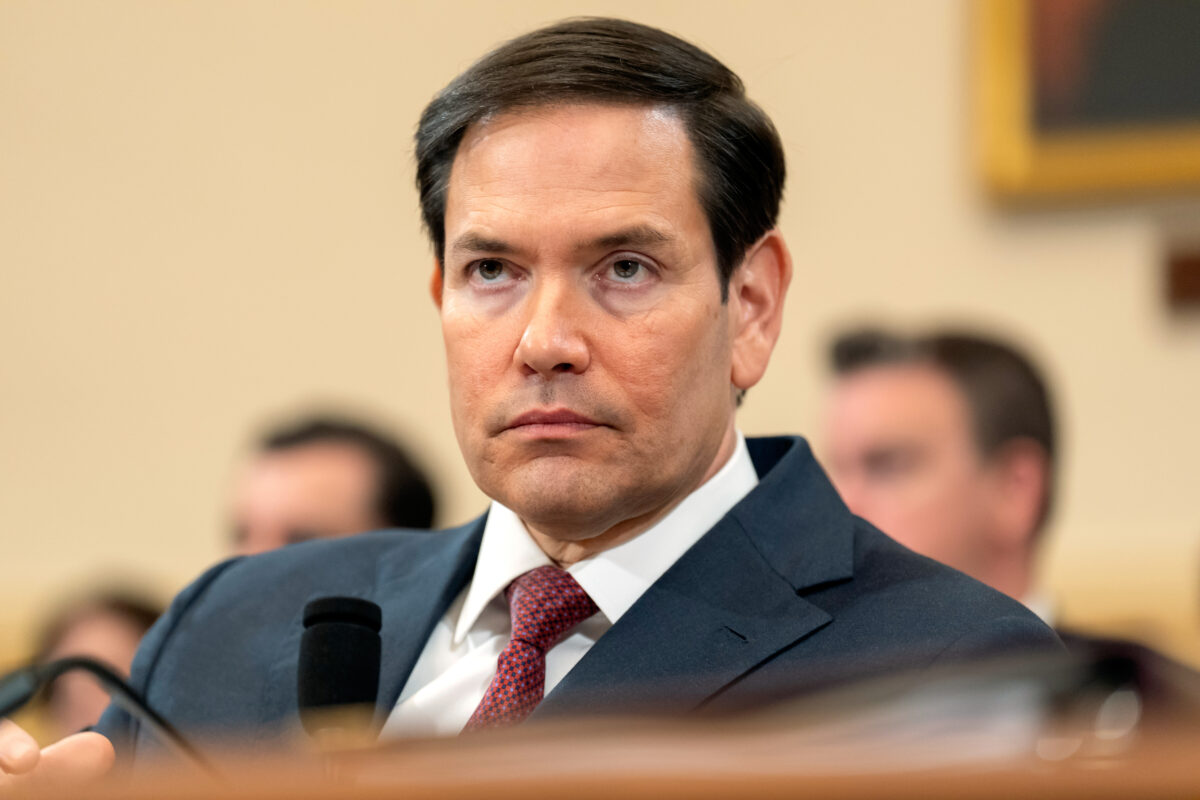
AP Photo/Mark Schiefelbein
The Foundation for Individual Rights and Expression (FIRE), a nonpartisan free speech advocacy nonprofit, has filed a lawsuit against Secretary of State Marco Rubio and Secretary of Homeland Security Kristi Noem over “the Trump administration’s war against noncitizens’ freedom of speech,” seeking to block the enforcement of two federal immigration law provisions.
President Donald Trump’s second term has featured a sharp crackdown on immigration, targeting not just the violent criminal illegal immigrants that were the centerpiece of his campaign messaging but those who have committed no crimes other than their lack of legal status, revoking temporary protected status (TPS) for hundreds of thousands of immigrants, and even detaining people who have shown up for their immigration court hearings. Many of the changes have been controversial, and polling shows a sharp reversal in support for the Trump immigration agenda, even among Republicans.
FIRE’s complaint, filed in the U.S. District Court for the Northern District of California, is brought by Stanford University’s independent, student-run newspaper, The Stanford Daily, and “Jane Doe” and “John Doe,” two legal immigrants with student visas who “engaged in pro-Palestinian speech and now fear deportation and visa revocation because of their expression.”
Neither student has been accused of violating any Stanford University rules, nor have they been charged with or convicted of any crime.
“There’s real fear on campus and it reaches into the newsroom,” said Greta Reich, editor-in-chief of The Stanford Daily, in a statement released by FIRE. “I’ve had reporters turn down assignments, request the removal of some of their articles, and even quit the paper because they fear deportation for being associated with speaking on political topics, even in a journalistic capacity. The Daily is losing the voices of a significant portion of our student population.”
“In the United States of America, no one should fear a midnight knock on the door for voicing the wrong opinion,” the complaint begins, because the free speech rights the U.S. Constitution “enshrines in the First Amendment” are “inalienable human rights” to “think as you will and to speak as you think.”
But the Trump administration is “trying to turn the inalienable human right of free speech into a privilege contingent upon the whims of a federal bureaucrat, triggering deportation proceedings against noncitizens residing lawfully in this country for their protected political speech regarding American and Israeli foreign policy.”
Rubio and Trump “claim to possess unreviewable statutory authority to deport any lawfully present noncitizen for speech the government deems anti-American or anti-Israel,” the complaint continues. “They are wrong.”
The complaint argues that the administration’s “war against noncitizens’ freedom of speech is intended to send an unmistakable message: Watch what you say, or you could be next,” and has created a “pall of fear [that] is incompatible with American liberty,” as Stanford Daily writers with student visas “are declining assignments related to the conflict in the Middle East, worried that even reporting on the conflict will endanger their lawful immigration status” and “self-censor[ing] because of their rational concern about the ongoing danger of deportation for expression Secretary Rubio deems anti-American or anti-Israel.”
The complaint asks the court to declare two provisions of federal law cited by the Trump administration in their immigration crackdown should be declared a violation of the First Amendment, Fifth Amendment, unconstitutionally void for vagueness, and enjoined from being enforced: 1) the “Deportation Provision,” under which Rubio has declared that lawfully present noncitizens are deportable for protected speech if he “personally determines” that their activities “compromise a compelling United States foreign policy interest, and 2) the “Revocation Provision,” which states that Rubio “may at any time, in his discretion, revoke such visa or other documentation.”
The lawsuit also seeks a temporary injunction to prevent the federal government from revoking visas and deporting immigrants under these provisions while the case is pending.
The Supreme Court has long held that free speech rights apply to all persons in the U.S., even if here illegally (which is not the case for the Doe plaintiffs in this lawsuit, legally here on student visas).
In the below clip from a 2014 event at the National Press Club, Justices Antonin Scalia and Ruth Bader Ginsburg are emphatic that constitutional rights apply to noncitizens.
“I think anybody who’s present in the United States has protections under the United States Constitution,” said Scalia. Bader Ginsburg agreed and pointed out that some provisions in other constitutions did refer to”citizens” but the relevant provisions in our Bill of Rights said “persons,” “and a person is every person who is here, documented or undocumented.”
This article has been updated with additional information.
New: The Mediaite One-Sheet "Newsletter of Newsletters"
Your daily summary and analysis of what the many, many media newsletters are saying and reporting. Subscribe now!





Comments
↓ Scroll down for comments ↓