Supreme Court Could Block State Laws Allowing Mail-In Ballots Arriving After Election Day

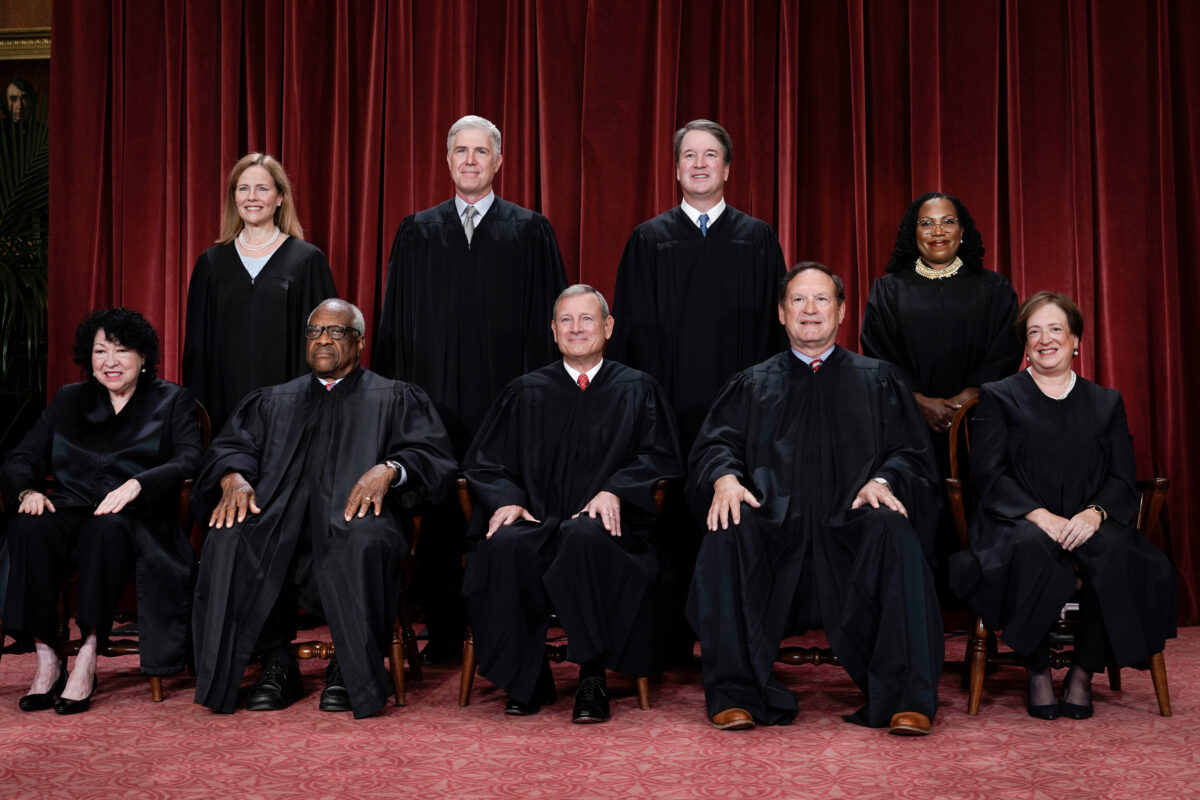
AP Photo/J. Scott Applewhite, File
The Supreme Court of the United States may end up blocking state laws that allow mail-in ballots that are postmarked on or before Election Day to still be counted if they arrive later, in a case that could have major impacts on November’s elections.
At issue in Watson v. Republican National Committee is whether the federal statutes that define “Election Day” preempt a Mississippi law that ballots to be counted for federal elections if they are received up to five business days after Election Day. President Donald Trump and other Republicans have vociferously attacked mail-in voting as susceptible to fraud, despite lacking evidence to support that assertion.
As Politico senior legal affairs reporter Josh Gerstein noted in his coverage of the case, in addition “about 30 states” have laws that allow ballots received after Election Day to still be counted, some only for overseas or military ballots and some for all mail ballots that are postmarked on or before Election Day.
During Monday’s oral arguments, the court was split along predictable partisan lines, with the six conservatives “expressing deep skepticism” with Mississippi’s defense of its law, reported The New York Times.
The three liberal justices pointed to laws authorizing states to establish their own election laws during their questioning of attorneys from the RNC and Trump administration, expressing concerns invalidating these state laws could impair the ability of overseas military members and their families to cast their votes, as well as banning early voting.
Voting by mail is also crucial for remote and rural communities. An AP report over the weekend highlighted the situation in small towns in Alaska where “residents rely on weekday flights for mail and many of their basic supplies, from groceries to Amazon deliveries of everyday household items” and some areas where in-person voting is not even offered.
But the six conservative justices have a clear majority, and their pointed questions to the attorneys on Monday were widely viewed as signaling they were looking to strike down the Mississippi law by finding the federal definition of “Election Day” to be preemptive and restrictive.
The lawyers representing Mississippi have argued that overturning its law “would require scrapping election laws in most states” and could have “destabilizing nationwide ramifications” coming just months before the next federal election this fall. In its briefs, Mississippi argued that the “plain meaning” of the term “election” refers to a voter’s act of filling out and submitting a ballot by Election Day, not necessarily the physical receipt of that ballot by election officials in the mail.
“So when do I know whether or not a choice is final?” Justice Clarence Thomas challenged Mississippi’s lawyer.
“We are moving in this direction: We don’t have Election Day any more,” said Justice Samuel Alito. “We have election month or we have election months, early voting can start a month before the election. The ballot can be received a month after the election.”
He added that there were “lots of phrases that involve two words, the last of which, the second of which, is day: Labor Day, Memorial Day, George Washington’s birthday, Independence Day, birthday, and Election Day. And they are all particular days,” so if we “have nothing more to look at than the phrase ‘Election Day,’ I think this is the day in which everything is going to take place, or almost everything.”
Looking back at past years in which these laws were enacted, said Alito, “we can ask, what would people have thought on those days as meant by the phrase ‘Election Day’? Which of those should we choose? Which dates should we choose?”
Alito went further, seeming to be most closely voicing the Trump administration’s positions on the issue with a series of questions he posed to the litigants, commenting that, “Some of the briefs have argued that confidence in election outcomes can be seriously undermined if the apparent outcome of the election on the day after the polls close is radically flipped by the acceptance later of a big stash of ballots that flip the election.”
Still, as Gerstein noted in his analysis, the early voting issue may prove in the end to be the stumbling block for the court to actually strike down these laws, due to the concerns the justices voiced that such a move could “imperil early voting” as well.
While both the RNC and Trump administration’s attorneys “insisted” they were not arguing to end early voting, Gerstein assessed these arguments as not fully persuasive for the justices, including several of the key conservative votes.
Chief Justice John Roberts was not satisfied with the Trump administration’s arguments, wrote Gerstein, and suggested the lawyer “was making an arbitrary decision to treat early voting and late receipt of ballots differently,” and Justice Amy Coney Barrett had a similar take:
Justice Amy Coney Barrett jumped in with a similar question after the RNC’s lawyer, Paul Clement, said federal lawmakers involved in passing a uniform Election Day law in 1845 would have found it “unthinkable” to count ballots after Election Day
“Isn’t that true of early voting, too?” Barrett said. “Why is that permissible? If we’re just going to say historically it just needs to look like it always looked, how come those features fall out?”
A decision in the case is expected to come in late June.
UPDATE March 24, 2026: RNC Election Integrity Communications Director, Ally Triolo, sent Mediaite the following statement:
Watson v. RNC is about a simple principle: ballots must be received by Election Day. This prevents elections from dragging on for days and weeks after voters have cast their ballots, causing confusion and undermining our elections. 83 percent of voters agree ballots should be in by Election Day, and 78 percent say it makes elections more secure.
Watch the video above via C-SPAN (elevation section with Alito’s comments begins around the 1:16 mark).
This article has been updated with additional content.
New: The Mediaite One-Sheet "Newsletter of Newsletters"
Your daily summary and analysis of what the many, many media newsletters are saying and reporting. Subscribe now!








Comments
↓ Scroll down for comments ↓