
Trump Pressures NATO Allies to Boost Presence in Strait of Hormuz: ‘Maybe We Shouldn’t Be There at All’

President Donald Trump suggested “maybe” the United States “shouldn’t” police the Strait of Hormuz at all as he piled on pressure after warning NATO allies of a “bad future” if they responded cautiously to his request for help securing the vital global oil route, a key chokepoint since the Iran conflict began.
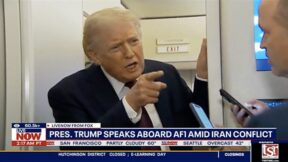
Speaking to reporters aboard Air Force One on Sunday night, the president said Washington had urged several countries to deploy naval assets to the strategic waterway, but acknowledged that some governments were reluctant to get involved. But his comments suggested those discussions remain uncertain.
“I’m demanding that these countries come in and protect their own territory, because it is their territory. It’s the place from which they get their energy, and should know and they should help us,” Trump said.
The president then floated the “case” that the obligation for securing the route lay not with the U.S. but with allies who rely more on the oil and gas from the region: “You could make the case that maybe we shouldn’t be there at all, because we don’t need it. We have a lot of oil.”
Specifically of NATO allies, he added: “In many cases, they’re NATO countries. We’re always there for NATO. We’re helping them with Ukraine. It’s got an ocean in between us, but it doesn’t affect us, but we’ve helped them. I’d be interested to see what country wouldn’t help us with a very small endeavor, which is just keeping the strait open.”
The remarks mark the latest shift in tone from the White House as the conflict with Iran continues to disrupt shipping through the narrow Gulf passage, which normally carries about one-fifth of the world’s traded oil.
Trump had previously revealed the U.S. was negotiating with multiple countries to jointly secure the strait and keep shipping lanes open. But after days of appeals, he indicated the response from partners had been uneven.
“They were contacted today and last night, but we’ve had some positive response,” he said. “We had a few that would rather not get involved.”
The Strait of Hormuz has effectively been closed amid escalating strikes between Iran and its regional adversaries, sending global oil prices sharply higher and raising fears of a wider economic shock.
In a social media post over the weekend, the president said he hoped that “other countries” would send ships “in conjunction” with U.S. forces, naming China, France, Japan, South Korea, and the United Kingdom as possible partners.
In an interview with the Financial Times published late Sunday, Trump laid out the argument more explicitly and warned resisting his request would be “very bad” for NATO: “It’s only appropriate that people who are the beneficiaries of the Strait will help to make sure that nothing bad happens there.”
He told the newspaper: “If there’s no response or if it’s a negative response, I think it will be very bad for the future of NATO.”
He noted that some allies have minesweepers and other vessels capable of clearing naval mines and protecting shipping traffic.
Watch above via YouTube.
New: The Mediaite One-Sheet "Newsletter of Newsletters"
Your daily summary and analysis of what the many, many media newsletters are saying and reporting. Subscribe now!




Comments
↓ Scroll down for comments ↓