Why CNN — Not Netflix — Is Home to the Best Kevin Spacey Politics Series Right Now

 Tonight at 3 a.m. ET, Netflix will release the fourth season of House of Cards, the cutthroat political drama starring Kevin Spacey as the depraved Frank Underwood. It’s a series that redefined web-based entertainment, ushering in a new era of scripted programming in the digital age, and helped propel Netflix as a premiere home of original content.
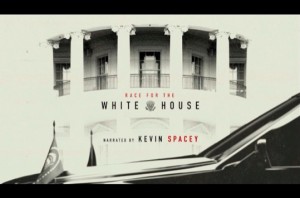
But over time, fans by and large have been disappointed with recent seasons; the “drama” part of the drama became stale and predictable, leaving viewers to cry in unison just how good the first season had been. Tonight’s dump of the next 13 episodes will be widely reviewed and watched, but it’s clear that from the ashes of House of Cards has emerged a new frontrunner from Spacey and his Trigger Street Productions shingle: CNN’s Race for the White House, set to debut Sunday night at 10 p.m. ET following the Democratic debate from Flint, Michigan.
The new CNN Original Series from Spacey and his production partner Dana Brunetti is set to replace, in this writer’s opinion, House of Cards as the best original and creative political content during the 2016 election year. The 6-part series is a gritty and revealing look at the dirtiest elections in U.S. Presidential history, complete with all the fixings of the behind-closed-doors deals that have shaped our Beltway landscape.
Race for the White House doesn’t have the bloated storylines of the Netflix series entering its fourth season, but manages to capitalize on all of the Kevin Spacey-calculous that viewers now equate with the Oscar winner. Spacey, who provides rasping narration and serves as the project’s Executive Producer, shows the stories that delve into the the only thing stranger and more entertaining than fiction: the twisted truths that have built our very nation.
“We love to think that he was above politics. But he wasn’t,” says former Obama strategist David Plouffe in the series about one of the most revered figures in American history: Abraham Lincoln. In the episode that chronicles the duplicitous 1860 election, we see how Abe wasn’t quite so Honest as we would expect; after all, his team printed 5,000 counterfeit convention passes to pack the Chicago hall with Lincoln supporters, edging his competitors in a dirty political ploy to earn the Republican nomination. Sure, we may remember Abe as the Springfield son who freed the slaves, but as Spacey reveals in pulverant fashion, Lincoln would never have gotten the opportunity without the games of manipulation behind the abrasive tactics of his hefty campaign organizer David Davis.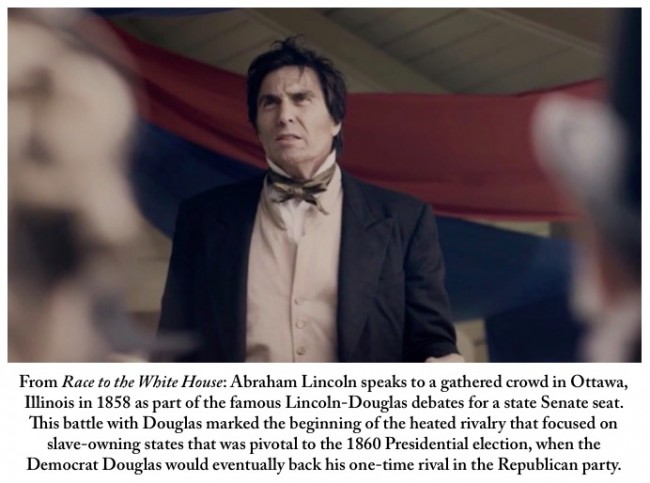
Watching House of Cards, you’re often left thinking to yourself, “Well that would never happen”; watching Race for the White House however, you’re reminded that the wretched ploys not only did happen, but serve as the precursor to our modern politics. In a moment that serves perhaps as an all-too-real foreboding to the nominating conventions coming up this July, former Clinton aide Sidney Blumenthal says at one point, “They are like sporting events; commanding a convention hall is crucial”.
And as for how New Jersey Governor Chris Christie could so easily turn on a dime to support the Trump candidacy? Look no further than Stephen Douglas, who pivoted to support his longtime rival when it was politically advantageous, declaring in 1860, “There is no more thorough or bolder Republican on the continent, not one of more sturdy integrity or of more unflinching purpose.”
In the 2016 race, Texas Senator Ted Cruz has been decried for his dirty campaign tricks, but as Race for the White House suggests, perhaps Cruz is right in line with some of the most back-stabbing — and successful — minds in political history. The CNN series shows, through equal parts reenactments (with eerily-similar casting choices, by the way) and modern interviews, how even a beloved son of Americana like John F. Kennedy swindled his way into calling for the release of Martin Luther King Jr. from prison in October of 1960 purely for political gain. The move encouraged black Americans to view the Democratic party favorably, as opposed to the nervous Richard Nixon, who failed to secure the release of King, forever altering the demographic’s political allegiance.
“I understand from very reliable sources that Senator Kennedy served as a great force in making the release possible,” says Dr. King in historical footage in Race for the White House‘s third episode.
But, as Pat Buchanan points out with a big laugh, “There’s no doubt that Bobby and John F. Kennedy exploited that brilliantly. Jack Kennedy was no Civil Rights hero.”
And this is the sort of dishonest double-dealing that Race for the White House aptly reveals. The series covers the following elections in engrossing detail:
Andrew Jackson vs. John Quincy Adams, 1824
Abraham Lincoln vs. Stephen Douglas, 1860
Harry Truman vs. Thomas Dewey, 1948
John F. Kennedy vs. Richard Nixon, 1960
George H.W. Bush vs. Michael Dukakis, 1988
Bill Clinton vs. George H.W. Bush, 1992
The docu-series comes from the same department of CNN that has provided programming like Anthony Bourdain: Parts Unknown, as well as the hilariously shocking United Shades of America from comedian W. Kamau Bell, due out in April. It’s clear that this show will eclipse House of Cards as the best Kevin Spacey creative political content on television, and just in time to show us the roots of the absurdity, two-timing, and win-at-all-costs viciousness for the rest of this landmark 2016 election.
—
J.D. Durkin is the Senior Editor of Mediaite. You can follow him on Twitter @jiveDurkey.
This is an opinion piece. The views expressed in this article are those of just the author.
New: The Mediaite One-Sheet "Newsletter of Newsletters"
Your daily summary and analysis of what the many, many media newsletters are saying and reporting. Subscribe now!




Comments
↓ Scroll down for comments ↓