
Four Hard Truths About the Tragic Minneapolis ICE Shooting

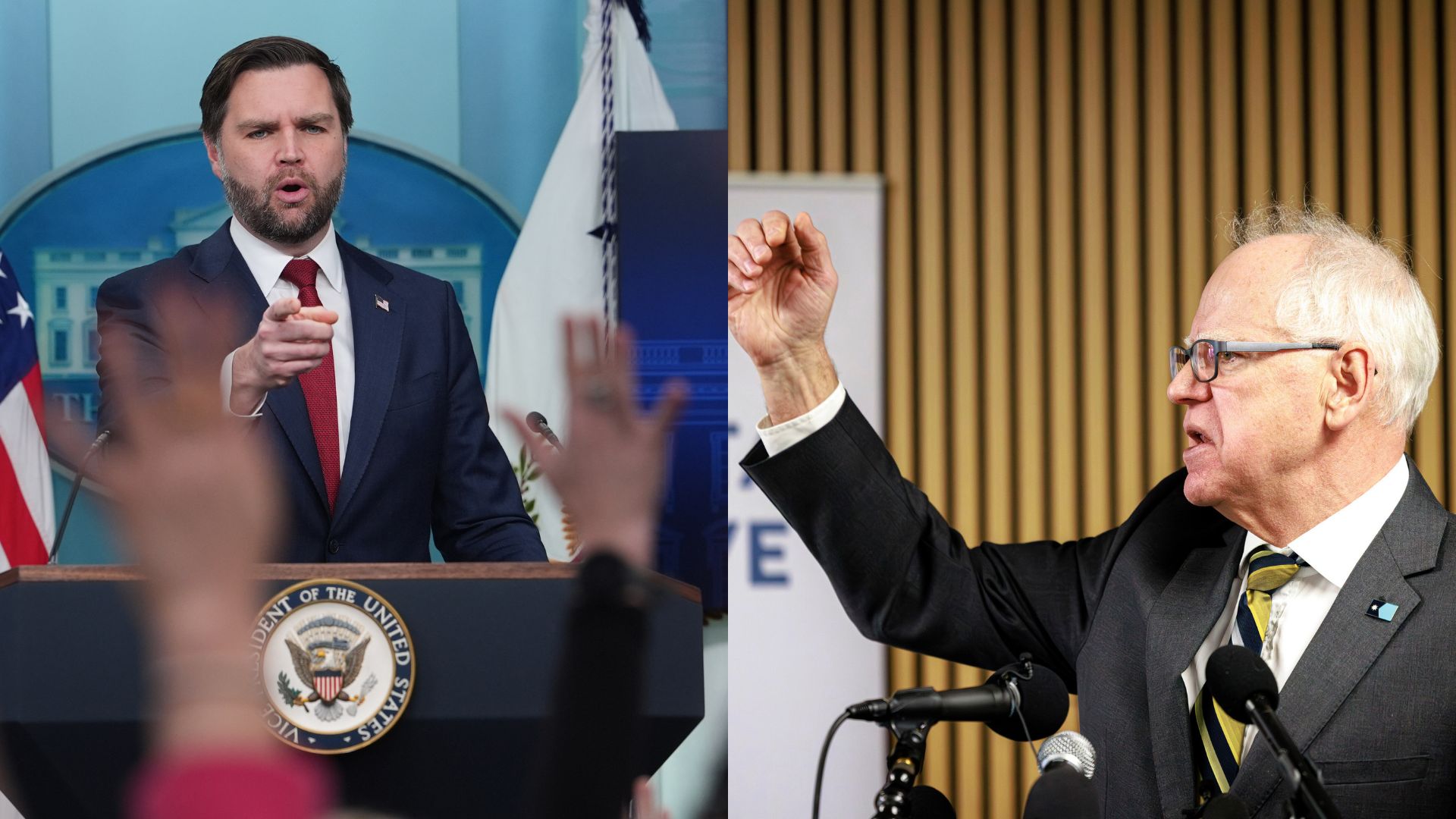
LEFT: JD Vance (AP Photo/Evan Vucci) RIGHT: Tim Walz (Kerem Yücel/Minnesota Public Radio via AP)
The tragic death of 37-year-old Renee Good after a confrontation with ICE officers in Minneapolis on Wednesday served as yet another Rorschach test for a divided nation.
Various videos of the incident circulating online depict the same basic sequence of events. Good’s car sits stationary in the middle of the road, an ICE officer standing behind it. With a protester recording him at a close distance, he begins walking around the car to stand in front of it. Two more officers pull up in a truck, exit their vehicle, and approach Good’s. One of the officers from the truck attempts to open Good’s driver-side door. Good reverses briefly, then accelerates forward toward the officer in front, but while attempting to turn down the road. That officer fires several shots. Good’s car goes screaming ahead and slams into another one parked on the side of the road.
Some witnessed a murder, others saw self-defense.
Without opining on the legal issues at play, and with the knowledge — or at least the hope — that a full, fair investigation will uncover more pertinent facts that may exonerate or indict the involved parties, here are four hard truths about the incident and the political moment in which it occurred.
One, Good’s behavior does not appear defensible. If a law enforcement officer asks you to exit your vehicle, you should comply with immediate effect. Should you refuse — and Good’s hesitance is perhaps understandable, though not excusable, given the aggressive approach of the officer who pulled on her door — you should under no circumstances attempt to flee the scene, especially if said flight requires you put your foot on the gas of a large SUV and accelerate in the direction of an officer.
Perhaps there is more context to what happened to explain her actions. But failing to comply with law enforcement’s orders and behaving in the erratic matter in which she did leads to escalatory action and mistakes. That doesn’t mean Good was deserving of anything within a thousand leagues of what happened to her, but beware anyone who would recommend her approach to others.
Two, in retrospect, the officer who fired on and killed Good likely misinterpreted what was happening. Vice President JD Vance revealed at a Thursday afternoon briefing that the same officer had sustained injuries while being dragged by a suspect’s vehicle just six months ago. To have a hostile party drive their vehicle toward you at close range — even with the intent of turning, as Good appears to have had, but the officer had no way of knowing — would be terrifying for anyone, much less someone who had previously been injured in such a manner.
That being said, the officer fired several shots, including while facing the side of Good’s vehicle after it appeared — at least at first glance — to have cleared him. So while his actions may be pardonable on a human level and unworthy of prosecution according to legal experts like Andy McCarthy, it’s difficult to watch video of the incident without feeling that his response was overkill.
Three, the Trump administration’s response to this tragedy has been abominable. Shortly after the shooting occurred, Homeland Security Secretary Kristi Noem declared that Good had “proceeded to weaponize her vehicle, and she attempted to run a law enforcement officer over,” adding that “This appears as an attempt to kill or to cause bodily harm to agents, an act of domestic terrorism.”
But that just doesn’t pass the smell test. Again, while the officer may not have been able to discern this in the moment, it appears as though Good was attempting (unlawfully) to flee the scene rather than inflict damage on his person. And although The New York Post‘s reporting about Good’s activism may add color to our understanding of what occurred, it is far from a vindication of the domestic terrorist label, or even Vance’s assertion that Good’s actions constituted an “attack.” It is entirely reasonable that the administration, pending an investigation, would stand by the officer. But its hyper-partisan, knee-jerk posture has been beneath contempt.
Four, the far-left helped create the conditions that led to Good’s death. It is no crime to oppose ICE; indeed, even some immigration hardliners might object to some of its recent practices. But progressives’ long-running effort to paint a law enforcement agency charged with the relatively anodyne task of removing illegal entrants into the country as America’s Brownshirts has proven destructive.
Minnesota Governor Tim Walz (D) referred to ICE as “Trump’s modern-day Gestapo” during a commencement address last May. When you identify a group as Nazi enforcers, you can’t feign surprise when others take action against said enforcers. The Left and its allies in the media understand this broader principle intuitively as it pertains to the January 6 Capitol riot. Trump told his followers that the presidential election had been rigged, and American democracy had thus been toppled. So when his most fervent fans treated the certification of Joe Biden’s victory as an existential event, it was Trump who bore responsibility.
There’s a direct line to be drawn between Democrats’ reckless rhetoric, the surge of disgusting violence — much of which goes uncovered by the press — against ICE personnel, and tragedies like that which occurred on Wednesday.
That’s what it was: a tragedy. And only when America’s political elites start treating it as such, rather than an opportunity to gloat, slander, spin, and profit, will we learn the right lessons from it.
This is an opinion piece. The views expressed in this article are those of just the author.
New: The Mediaite One-Sheet "Newsletter of Newsletters"
Your daily summary and analysis of what the many, many media newsletters are saying and reporting. Subscribe now!





Comments
↓ Scroll down for comments ↓