
NY Times Publisher: AI Is Using Our Reporting Without Paying For It

Screenshot
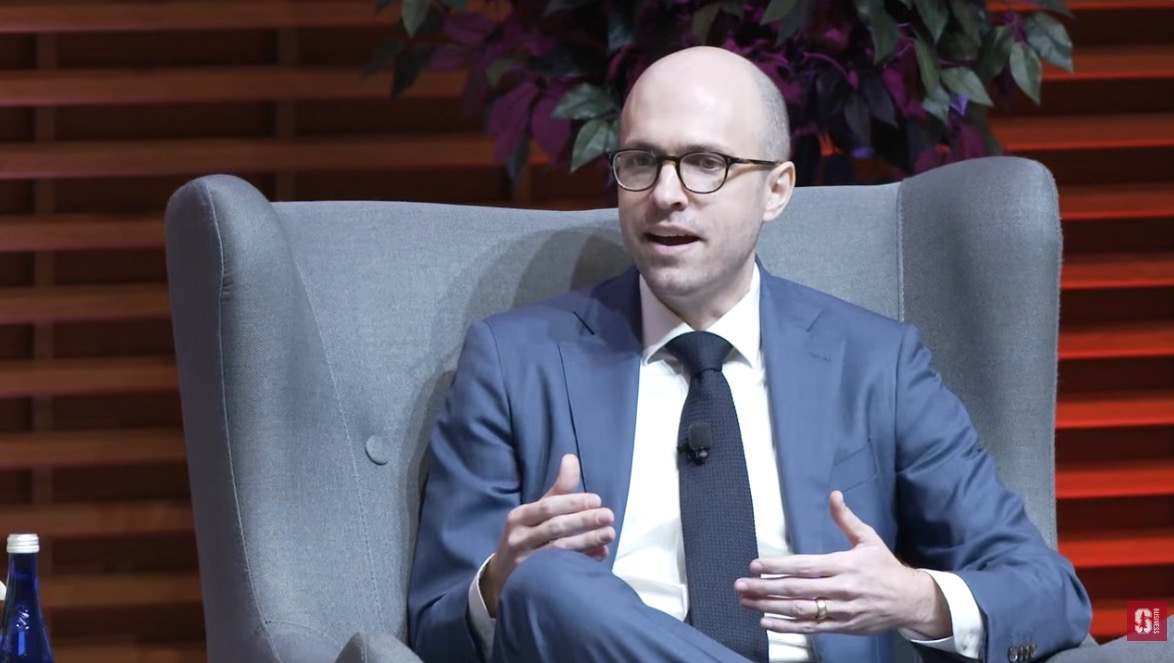
A.G. Sulzberger went to Stanford last week to argue that journalism can survive the age of artificial intelligence. More precisely, he went to argue that fact-based journalism can still be owned, saying “we own the copyright to our news reporting and journalism.”
That argument now sits at the center of a much larger conflict. AI systems are already trained on journalism. They increasingly function as information sources themselves. That creates a problem. If the business model for producing original reporting collapses, what reliable information will future AI systems train on? Sulzberger believes that question has an answer: legal enforcement of intellectual property rights. Silicon Valley disagrees.
Sulzberger is the publisher of the New York Times and the fifth generation of his family to run it. He was speaking at Stanford’s business school, in the middle of Silicon Valley, to an audience of future executives, investors, and technologists. This is where large language models are built and scaled. This is where information is treated less as property and more as input.
His message was direct. The New York Times sees itself as infrastructure. Its reporting underwrites trust across politics, markets, and public life. That work costs money, produces intellectual property, and deserves protection. (The full video of his interview can be viewed on YouTube.)
“Our message is we just need to keep our head down and just keep doing the work,” Sulzberger said. “Follow the facts where they lead, approach every story with an open mind, an empty notebook, and be completely unafraid to push through the pressure that we’re gonna get from powerful forces to bring that to the public.”
Those forces now extend far beyond government. Platforms shape attention. Capital shapes incentives. AI systems require enormous volumes of reliable information. Sulzberger was describing an institution built to absorb pressure from all sides while continuing to produce original reporting.
He framed the Times’ value to business leaders in practical terms. “The integrity of the systems we all rely on,” he said, “not just democracy, but capitalism and markets, rely on the type of transparency and accountability that the press provides.”
That claim points to a specific role journalism plays. Markets already rely on filings, pricing data, analyst research, terminals, and enforcement actions. Investigative reporting operates elsewhere. It surfaces conduct designed to stay hidden from formal systems.
Enron collapsed after reporters exposed accounting practices regulators missed. Theranos unraveled once scrutiny punctured a carefully managed illusion. FTX fell apart when reporting caught up to what internal controls and celebrity endorsements concealed. These moments did not fine-tune markets. They forced resets. Journalism’s value shows up when other mechanisms fail.
That role still exists, even as markets move faster and information circulates instantly. Reporting intervenes episodically, with consequences that ripple outward. Sulzberger was describing that function rather than daily market plumbing.
Scale complicates the argument. Sulzberger noted that the Times once served mostly the New York metropolitan area. Today it has more subscribers in California than in New York. Texas and Florida are close behind. Growth is strongest in the South and Midwest. Millions of readers live abroad.
That reach reflects success and strain. Much of the Times’ recent growth came during periods of political intensity, especially during Donald Trump’s presidency. That energy built scale. Sulzberger now wants the institution to operate as infrastructure, a posture that depends on durability and trust across ideological lines rather than political mobilization.
The sharpest tension sits inside the business model. The Times does not fund its newsroom primarily through investigations. It funds it through bundles of apps: Cooking. Games. Wirecutter. Audio. Lifestyle products that keep households subscribed even when they disengage from the news.
That model sustains the newsroom and exposes the contradiction. The investigative capacity sits at the center of Sulzberger’s argument. The bundle supplies the money that keeps it alive. The brand, the crossword, and the recipes create habit and cash flow. The reporting converts that revenue into accountability.
Whether subscribers experience the Times that way remains unclear. Many arrive for Cooking and Wordle and tolerate the news as part of the package. Sulzberger is asserting infrastructure status for the function the bundle subsidizes, even as consumer behavior suggests the subsidy often matters more than the product it supports.
“Data powers the algorithms,” Sulzberger said. “And there’s another word for data. It’s called copyrighted content.” He put the principle plainly. “If you are spending a lot of time and money to create intellectual property, you have the legal right to determine where and how that’s used and to set a market value on it.”
Silicon Valley’s counterargument is equally clear. Facts cannot be owned, only their expression can. Information wants to circulate. Artificial scarcity through copyright slows beneficial innovation. New verification systems will emerge that do not depend on expensive legacy newsrooms. That worldview is coherent. It collides directly with Sulzberger’s.
AI systems scale by treating information as abundant. Journalism exists because information is scarce, expensive, and risky to obtain. When payment disappears, newsrooms cut staff, shrink beats, and launch fewer investigations. Aggregation expands. Summaries multiply. Errors compound.
Sulzberger is arguing that fact-finding remains a distinct, ownable activity in an economy built to remix what already exists. The systems now shaping information may reject that premise.
In an AI-driven world, the unresolved question is whether facts can belong to anyone at all.
This is an opinion piece. The views expressed in this article are those of just the author.
New: The Mediaite One-Sheet "Newsletter of Newsletters"
Your daily summary and analysis of what the many, many media newsletters are saying and reporting. Subscribe now!









Comments
↓ Scroll down for comments ↓