
Oh the Irony: Trump Leads ‘Board of Peace’ While US Carrier Groups Mass Near Iran

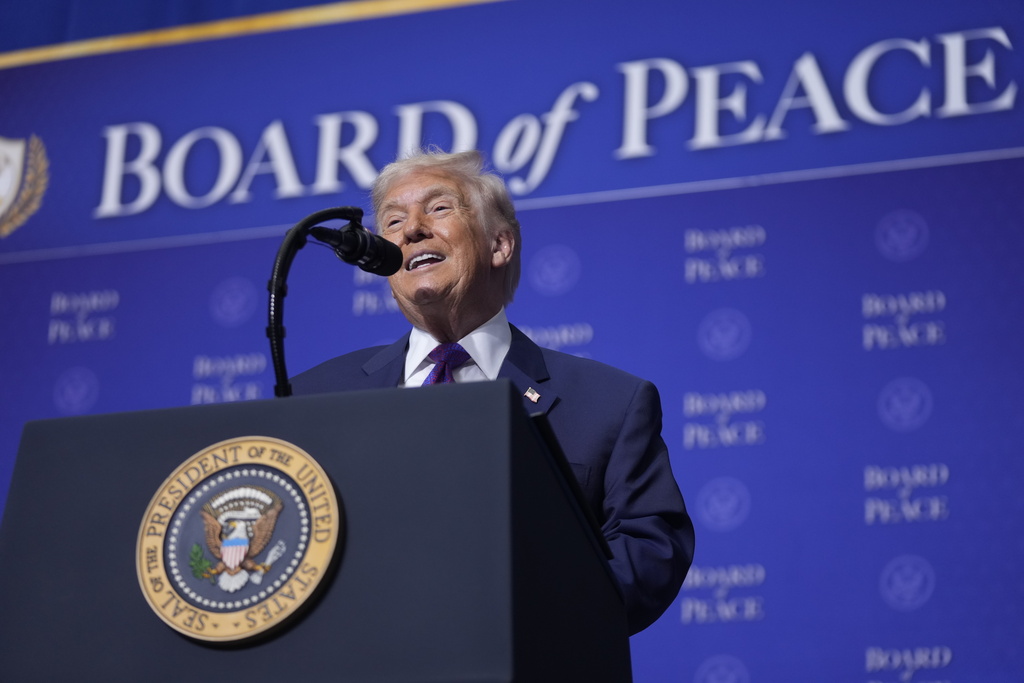
(AP Photo/Mark Schiefelbein)
President Donald Trump’s “Board of Peace” is convening with a carefully curated guest list: Gulf monarchies with deep pockets and regional clout, smaller European allies without the baggage of Berlin or Paris, governments comfortable operating through executive channels and direct bargains. The agenda is stability, normalization, reconstruction. The optics are intentional.
So is what’s happening offshore.
While the Board meets, the Pentagon has repositioned carrier strike groups into the Persian Gulf, added thousands of troops, fighter aircraft, and guided-missile destroyers. Satellite imagery shows F-15E Strike Eagles and electronic warfare jets at Jordanian air bases where none existed weeks ago. Reuters reports U.S. officials are preparing for potentially weeks-long sustained operations against Iran — not a one-off strike, but a campaign. The same officials expect retaliation and extended exchanges. Trump, speaking at Fort Bragg, put it plainly: “Sometimes you have to have fear.”
A Board of Peace convenes with communiqués and handshakes. A carrier strike group arrives with a different vocabulary. Both are aimed at the same region. Both are meant to be seen.
Early coverage has defaulted to a frame that was probably written before the summit began. America’s longest and closest allies are all taking a pass: Britain declined. France, Germany and Canada all declined.
Progressive outlets emphasize the snub to democratic allies. Conservative outlets frame it as Trump finally breaking free from a sclerotic consensus. Both reactions are predictable. Neither is wrong, exactly. But both manage to miss the most obvious detail in the story: that the United States is simultaneously massing carrier strike groups, fighter squadrons, and guided-missile destroyers while the peace summit takes place.”.
The aircraft carrier offshore rarely makes that lede. That tells you something about how reflexively the press covers Trump’s foreign policy — and how little room remains in the coverage for anything that doesn’t confirm what each side already believes.
The structure being assembled matters more than who declined the invitation. The Board reflects an effort to construct a parallel legitimacy framework built on leverage rather than institutional pedigree. The warships offshore are not a contradiction of that framework. They are the hard edge of it.
The composition reveals the theory. Gulf states bring capital, intelligence networks, airspace, and influence over armed actors. They can finance reconstruction, broker back channels, and apply pressure in ways Western European capitals often cannot. Smaller allied governments add diplomatic breadth without procedural friction. This is a coalition designed to move quickly.
But several of the governments in that room have spent years lowering tensions with Tehran. The UAE has stated it will not allow military operations from its territory. Saudi Arabia has publicly called for diplomatic resolution. These are not minor caveats. They are the stated positions of countries being asked to legitimize a peace initiative while Washington prepares for sustained strikes against their neighbor.
They will live with Iran long after any U.S. carrier group sails home.
The ask is stark: stand beside us for peace while we prepare for war — and do it publicly.
For decades, American diplomacy relied on institutional depth to anchor agreements. The Good Friday Agreement endured because it was embedded in layered British, Irish, and American commitments that extended beyond personalities. By contrast, ad hoc coalitions assembled for Libya fractured once immediate objectives were met, leaving instability no loose alignment could manage.
A leverage-driven coalition can accelerate progress. It can also magnify contradictions. Middle Eastern peace involves security guarantees, territorial arrangements, domestic political constraints, and long-term enforcement. Durability requires alignment that survives stress.
Trump is betting that concentrated power — money, access, and visible military backing — can generate its own legitimacy. The fleet in the Gulf ensures everyone understands the leverage behind that bet.
If this coalition produces results under these conditions, it reshapes how American legitimacy is built. If it splinters under pressure — if partners hedge, distance themselves, or quietly disengage once escalation begins — then the photo ops will age quickly.
The Board of Peace. The fleet offshore. Allies signaling they won’t host strikes from their soil.
All of it unfolding at once.
That’s the test.
This is an opinion piece. The views expressed in this article are those of just the author.
New: The Mediaite One-Sheet "Newsletter of Newsletters"
Your daily summary and analysis of what the many, many media newsletters are saying and reporting. Subscribe now!





Comments
↓ Scroll down for comments ↓