The Trumpian Right Declares Ukraine a New ‘Forever War’ After Mere Months

Not so long ago, letting the words “forever war” escape your lips was a giveaway as subtle as starting an argument with “I was watching Maddow last night and…” Progressives, almost exclusively, used it to pejoratively describe the U.S. military presence in Iraq and Afghanistan.
Later, Donald Trump, in the tradition of a small group of paleoconservatives who opposed those conflicts, railed against “endless wars” while cutting a deal with the Taliban to pull U.S. troops out of Afghanistan. In 2021, his successor, President Joe Biden, haphazardly followed through on Trump’s promises, resulting in the deaths of 13 American servicemen during a bungled evacuation. For perspective on the extent of the “forever war” the U.S. was engaged in, consider that the military recorded a similar number of fatalities in each of the previous five years preceding the pull out.
Still, even after the failure of the Trump-Biden surrender in Afghanistan, the forever war framing has only grown in popularity on the right, which has taken an inaccurate term and applied it in an even more imprecise manner to the war in Ukraine, which began on February 24 of this year when Russian forces rolled across its neighbor’s borders.
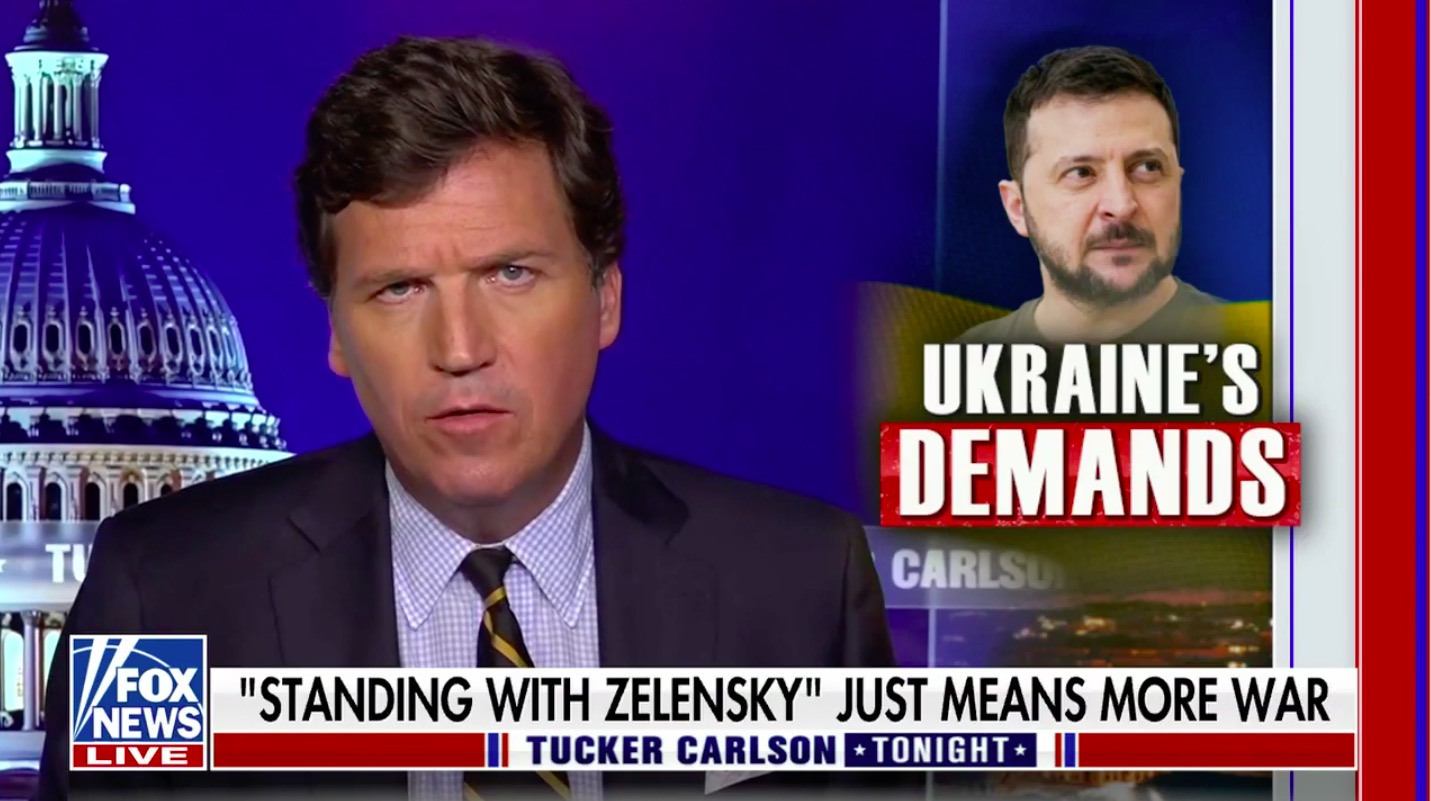
Tucker Carlson says it’s been “designed” to bring about regime change in Russia , despite the fact that the invasion was initiated by Vladimir Putin himself.
At The Federalist, John Daniel Davidson has been beating the forever war drums since its start. Less than a month into the war, Davidson already declared it had become a “war of attrition,” suggesting the U.S. take action to bring about a negotiated peace — without offering a single condition the Russian government should meet in order to bring one about.
“The White House’s strategy, such as it is, seems to be to keep the war going by whatever means possible,” asserted Davidson.
In July, less than four months after the Russian invasion commenced, Davidson’s boss, Mollie Hemingway, tweeted “welcome to your new forever war, America! Led by the same woke generals and politicians who gave you and mismanaged the other ones.”
“[Volodymyr] Zelensky is the defense industry’s Sam Bankman-Fried” complained John Cardillo after the Ukrainian President delivered a speech before a joint session of Congress last week. “It’s a massive Ponzi to enrich the defense industrial complex which then funnels cash back to endless war Dems and NeoCons.”
Senator-elect J.D. Vance summed up this view more articulately in September, when he told a local Ohio outlet that it was time for the U.S. to cut off aid to the Ukrainians.
“We cannot fund a long-term military conflict that I think ultimately has diminishing returns for our own country,” stated Vance, after six months of fighting.
Once upon a time, “forever war” — as deceptive as the term was even then — at least described conflicts in which American troops toiled for years. Now the modern phrase has come to mean those in which American dollars are spent for any amount of time.
Its resurrection as a political cudgel, this time by a faction of the Republican Party, is a descriptive failure either made intentionally to draw a connection between the poorly remembered wars in Iraq and Afghanistan, or simply a reflection of its users’ lack of historical knowledge and/or inability to think beyond the next six months. Wars take time, and the U.S. has a strong strategic interest in ensuring that its geopolitical opponents know that the price for attempted expansionism will be heavy. China, with one eye on Taiwan, is watching Ukraine with the other.
In either case, the use of forever war rhetoric places blame for the continuation of the conflict squarely on the United States. According to this chorus, every day that fighting goes on is a blight on the American record. Somehow, American aid is being misinterpreted as the cause of the war, rather than one of its effects.
Perhaps it’s true that if the U.S. and its allies had never involved themselves, the war would have ended much earlier, with Russian victory. Perhaps it’s true that peace could be achieved sooner, with significant concessions to the Russians, if aid to Ukraine was cut off in short order. Or perhaps not — no one can honestly say they know for sure.
The fact remains that the only man with the power to end the war at any moment is the one who launched it. No one in the White House yearned for war, much less designed the one still unfolding. No one yearns for it to drag on for years to come.
Whether they realize it or not, those accusing their fellow Americans of supporting a “forever war” are unjustly and unpersuasively shifting the blame for the lives lost and economic damages wrought by it onto their own country. Inherent to their arguments is an assumption of American responsibility, and irresponsibility, that cannot be evidenced through any honest survey of the events leading up to or during it.
Every war has its end, but only at rare opportunities are specific actors able to bring it about, much less under favorable conditions for the just side. No such opportunities have yet presented themselves to any American leader, and until they have, the only way those chattering about forever wars put America first are by blaming it first.
This is an opinion piece. The views expressed in this article are those of just the author.
New: The Mediaite One-Sheet "Newsletter of Newsletters"
Your daily summary and analysis of what the many, many media newsletters are saying and reporting. Subscribe now!






Comments
↓ Scroll down for comments ↓