
Trump Put His Name on the Kennedy Center in 24 Hours. This Is What Authoritarianism Looks Like.

(AP Photo/Jacquelyn Martin)
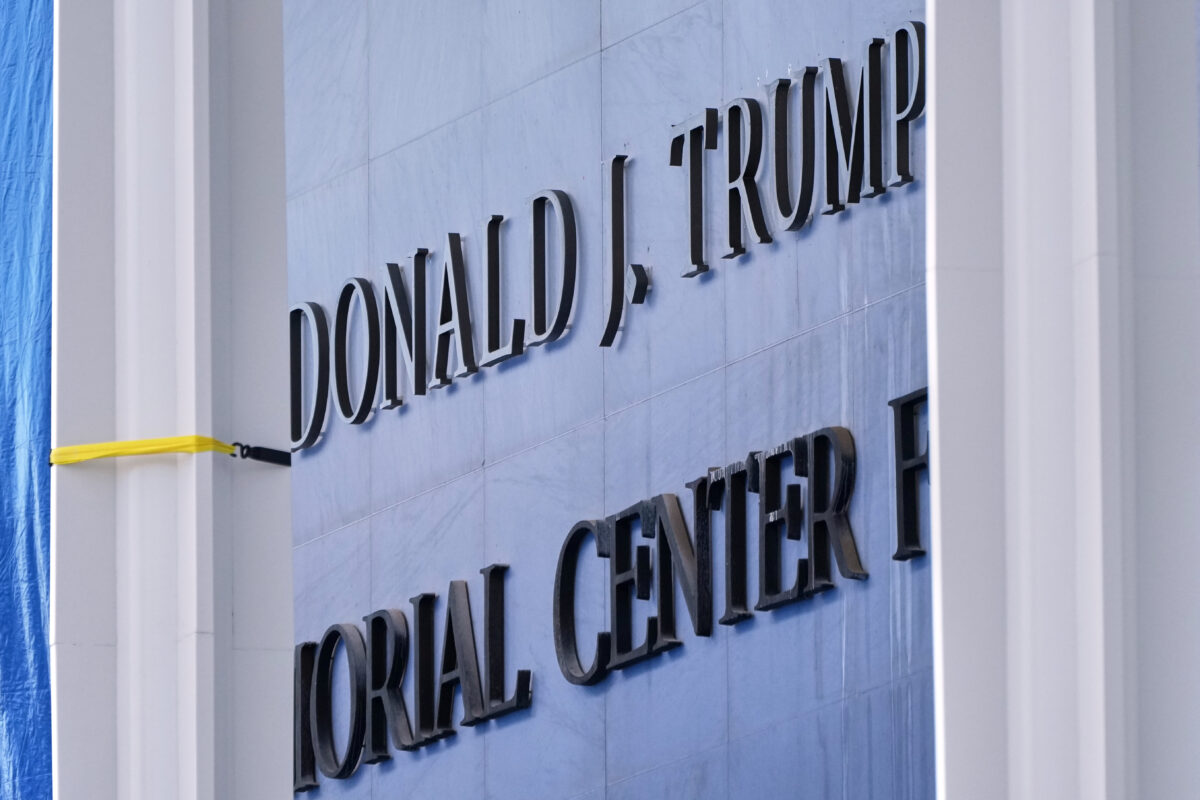
President Donald Trump’s name appeared on the Kennedy Center within 24 hours of the board’s unanimous vote. The speed is the point.
Not because it was flashy or provocative, but because it was treated as ordinary. The system did not pause, consult, or legitimate itself. It moved as if the answer were already known. That is the escalation. Not louder, but faster. Not more brazen, but more casual.
In my previous column, I argued that the Trump-Kennedy Center renaming revealed power that no longer pretends to need justification. This follow-up matters because it shows what happens next when that lesson sinks in. Power stops explaining itself and begins acting as though explanation is a disadvantage.
The Kennedy Center was built as a living memorial to John F. Kennedy, and its name has long been understood to fall under congressional authority. Congress has not acted. There was no vote, no debate, no formal consultation. Yet Trump’s name was added to the building anyway, almost immediately, as if congressional prerogative were a suggestion rather than a boundary. The New York Times reported this plainly, noting both the memorial status of the institution and the absence of congressional action. Read together, those facts describe not a dispute, but a bypass.
This is not about speed for its own sake. The speed is evidence of learning. Institutions now move as though they already know there will be no consequence for ignoring process. Once that knowledge takes hold, delay feels unnecessary and caution begins to look like weakness.
Ric Grenell’s role in this phase of the episode makes that clear. Grenell, a senior Trump aide and chair of the Kennedy Center board, spent much of Thursday night on X responding to critics who questioned the legality of the move. When journalist Yashar Ali asked how adding Trump’s name to memorial signage could be legal without congressional authorization, Grenell did not respond with statute or precedent. He accused Ali of spreading “fake news,” mocked his motives, and asserted flatly that “the memorial isn’t impacted.”
That response is not meant to persuade. It is meant to shut things down. Grenell is not engaging a legal question. He is demonstrating that asking legal questions is now treated as bad faith.
Grenell matters here not because he is uniquely shameless, but because he is functionally fluent in this style of governance. He understands that the job is no longer to argue legitimacy, but to normalize outcomes. His defense of the renaming has been transactional and unapologetic. Trump raised money. Trump pleased donors. Trump delivered results. Therefore Trump deserves the honor. In that framing, the Kennedy Center ceases to be a memorial or a civic institution. It becomes an asset, and assets are branded by those who control them.
Even conservative critics saw it. Erick Erickson described the move as “third-world African kleptocracy,” observing that one could swap out Trump for Mugabe and recognize the same behavior. The point was not rhetorical excess. Kleptocracies are defined by the personalization of public institutions and the routinization of obedience among intermediaries who no longer believe restraint is part of their role.
This is what authoritarianism looks like once it stops performing and starts administering. There are no dramatic decrees or emergency speeches. There are boards, votes, signage, and online enforcers insisting nothing meaningful has changed even as an institution’s purpose is quietly rewritten. The system does not ask the public to believe an ideology. It asks them to accept that process is optional and that questions themselves are suspect.
The Commemorative Works Act likely applies here. Whether it does or not, the people acting have made clear they do not care. They are not behaving like actors worried about legality or legitimacy. They are behaving like actors who have learned that legitimacy can be replaced with momentum, and that mockery can substitute for explanation.
That is the real lesson of the overnight signage. Not that a rule was broken, but that breaking it has become easy. Not that authority was challenged, but that it was bypassed so smoothly it barely registered.
This is not about a name on a building. It is about what becomes routine once power learns it doesn’t have to wait for permission—or justify why it stopped asking.
This is an opinion piece. The views expressed in this article are those of just the author.
New: The Mediaite One-Sheet "Newsletter of Newsletters"
Your daily summary and analysis of what the many, many media newsletters are saying and reporting. Subscribe now!





Comments
↓ Scroll down for comments ↓