
Trump Vowed to ‘End Inflation’ — His Voters Are Growing Impatient

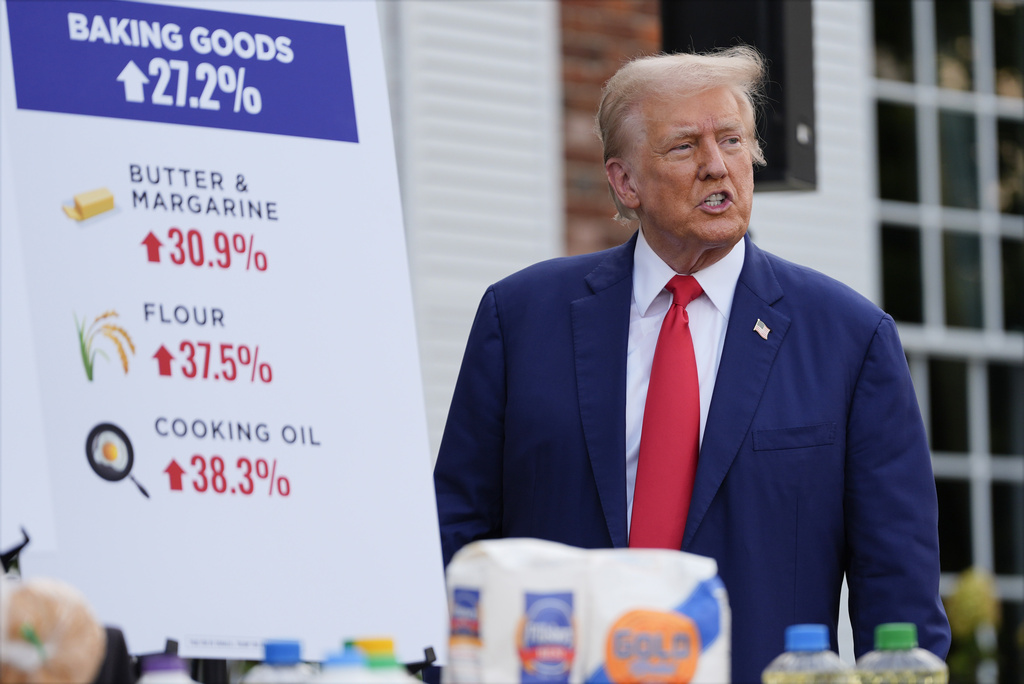
(AP Photo/Julia Nikhinson)
President Donald Trump entered office in January with a signature vow: he would “end inflation on Day One” and “bring prices way down.” These were not vague gestures toward policy direction. They were explicit, repeated guarantees that the economic squeeze of the Biden years would ease quickly under his watch.
Nearly a year later, those promises are colliding with stubborn economic reality.
According to the latest Consumer Price Index, headline inflation is up 3.0% year-over-year, roughly the same level as Biden’s final months. The food index is up 3.1%, and “food at home”—the grocery aisle category—has risen 2.7% year-over-year, compared to about 1.8% during most of 2024. Milk, eggs, chicken, and ground beef are all incrementally more expensive than they were a year ago. Rent continues to climb at an annual rate of 5–6%. Gasoline prices have fluctuated but remain essentially flat.
As families head into the holiday season, that gap between promise and reality becomes harder to ignore. Thanksgiving dinner costs are up roughly 4% from last year. Christmas shopping budgets are strained by the same stubborn prices Trump vowed to eliminate. These aren’t policy abstractions—they’re the moments when economic anxiety stops being background noise and becomes a seat at the table.
None of this is catastrophic. But none of it resembles the immediate relief Trump promised.
And to be fair, no president can flip the direction of price levels overnight. Supply chains adjust slowly. Housing shortages persist. Energy markets respond more to global shocks than domestic speeches. Trump’s ever evolving rounds of tariffs—with higher rates for China—will add some upward price pressure, but not instantly. They are one contributor among many, not the driver of the current inflation plateau.
The more interesting story isn’t causation. It’s the explicit expectation from eager Trump voters who believed the promises.
Trump is now facing the first major economic test of this particular promise—the test of whether his supporters will continue to believe he can personally shield them from economic forces beyond any president’s control. For years, Trump’s political power has rested on a kind of narrative omnipotence: the idea that he, uniquely, could impose his will on institutions that frustrate ordinary voters. When he said he would end inflation “immediately,” his base didn’t hear a policy roadmap. They heard a guarantee of protection.
Inflation is immune to that kind of assurance. It’s experienced not through cable news, but in grocery aisles and monthly rent payments. It affects the people who took Trump’s promises most literally in ways that cannot be mediated by rhetoric or reframing.
So far, there is no polling collapse among his base. Trump’s support among Republicans remains solid. But there are early hints of strain—focus groups describing prices as “still high,” voters telling local reporters they’re “waiting for the relief we were promised,” small frustrations surfacing on talk radio and in comment sections that used to be uniformly defensive of Trump.
The disconnect is stark enough that even Trump’s allies are noticing. “Everyone around Trump, and everything he is seeing on TV and on his phone, is telling him that he’s right,” a close Trump ally recently told Jonathan Lemire for The Atlantic. “But poll after poll suggests that Americans believe Trump is now getting it wrong and has lost focus on what got him elected. People voted for him to lower prices, to bring manufacturing back, to stand up to those taking advantage of them. They didn’t vote for him to build a damn gilded ballroom. He’s not hearing them.”
These are not defections; they are friction. And friction matters.
Unmet expectations don’t necessarily change partisan loyalty, but they can soften enthusiasm, depress turnout, and narrow the margin of political forgiveness. They make voters less willing to give the benefit of the doubt, and more open to alternative explanations—whether from rivals, media, or economic reality itself. They also force Trump into narrative contortions: blaming the Federal Reserve one week, global instability the next, “Biden holdovers” the week after that.
This is the political risk: not that supporters abandon him wholesale, but that the emotional contract he built—“I alone can fix it”—becomes harder to sustain when the evidence in household budgets contradicts it month after month. Trump’s power has always depended on the idea that he can bend reality. Inflation is reality that bends for no one.
What happens next is predictable. Trump will likely intensify the blame-casting, accuse institutions of sabotage, and frame stubborn prices as the lingering residue of Biden’s policies or global unrest. Some supporters will accept that explanation; in fact, many may. But the test will persist, as long as higher prices persist.
Trump promised immediate affordability. The data does not yet show it. Whether his voters ultimately hold him accountable remains uncertain, but the expectation gap is widening—and unlike political narratives, economic facts accumulate quietly, receipt by receipt.
In the end, inflation may prove to be the rare force in American life that cannot be bullied, branded, or wished away. And that makes it one of the few opponents Trump must confront on reality’s terms, not his own.
This is an opinion piece. The views expressed in this article are those of just the author.





Comments
↓ Scroll down for comments ↓