Who’s Winning Trump’s Gulf War? Depends on Which Channel You’re On.


(AP Photo/Fars News Agency/Ebrahim Noroozi)
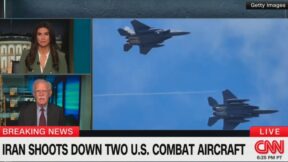
An American fighter jet was shot down over Iran on Friday. The pilot ejected and is still missing. Iranian state media released footage of another pilot parachuting to the ground before his plane crashed. The Pentagon called it an isolated incident. Iranian officials called it a victory. Critics of the war called it what it looks like: evidence that this conflict, sold as swift and decisive, is neither.The question of who is winning has been running alongside the actual war since the first strikes. The downed jets and the missing pilot have just made it harder to change the subject.
The pro-Trump case isn’t wrong on its face. The U.S. military has dominated this fight. Pete Hegseth’s briefing numbers: an 86% drop in Iranian missile launches, a 73% drop in drone attacks, effective control of the airspace. They get handed to reporters pre-formatted and land in coverage almost unchanged, because they fit the medium perfectly. Laura Ingraham said it plainly on Fox in late March: U.S. and Israeli forces have “done a lot of damage” and Iran “cannot win militarily.” On those terms, it’s a rout.
Early critics who questioned whether this was an optional war with no clear objective or exit strategy got accused of rooting for America to lose. It was an effective attack. It also changed the subject.
The Strait of Hormuz is effectively closed to normal commerce. Shipping insurers have repriced risk so dramatically that cargo routes are being rerouted entirely. Gas has crossed four dollars a gallon nationally. And it’s not just oil. Fertilizer, raw materials, supply chains that run through that passage and touch industries most Americans ignore until the prices show up. Iran figured out early that you don’t beat the United States military. You survive it, and while you’re surviving it, you make the whole thing expensive enough that the other side eventually starts doing the math.
Which is why that Ingraham segment is worth sitting with. In the same breath where she declared military dominance, she warned that Iran is trying to “inflict maximum economic pain on the global economy.” She didn’t connect those two things. Most of the coverage hasn’t either. The war and its consequences still run on separate desks, as if they’re different stories.
Now even some of the loudest interventionists are losing patience. The tell is the mantra: two to three more weeks. It has been two to three more weeks for a while now. That’s not a timeline. That’s what you say when you’re stymied and can’t admit it.
Trump will claim victory. He’d claim victory if it ended tomorrow or in a year, and his media operation would run with it. But claiming victory and achieving the original objective are different things. Regime change was the implied goal, or at least the hoped-for outcome. It’s not happening. An internal uprising, the other scenario hawks floated in the early weeks, isn’t happening either. Ground troops, the only option that might actually force a resolution, are deeply unpopular and almost certainly not coming.
So look at what the realistic endgame actually is. A fundamentalist regime still standing. Nuclear facilities degraded but not destroyed. And Iran controlling the Strait with leverage over global shipping it didn’t have in February. Not just oil but the full range of commodities that move through that passage. A country that entered this war as a regional irritant could come out of it with something like veto power over a critical artery of the global economy, even with its military gutted.
The people who opposed this war from the start weren’t worried about losing on the battlefield. They were worried about this: paying a significant price in lives and dollars and economic disruption, and ending up somewhere worse than where we started. That got called defeatism. It’s looking more like the actual forecast.
The Pentagon is winning on every line it wrote itself. The question is whether those are the right lines.
This is an opinion piece. The views expressed in this article are those of just the author.
New: The Mediaite One-Sheet "Newsletter of Newsletters"
Your daily summary and analysis of what the many, many media newsletters are saying and reporting. Subscribe now!






Comments
↓ Scroll down for comments ↓