ONE SHEET: Hegseth’s End Run, the $580M Iran Bet, Bari Weiss’s Rough Quarter

The Big Picture
The Pentagon is defying a federal court. CBS News is losing viewers at a historic rate. Prediction markets are under fire for suspected insider trading tied to White House war announcements. The race to lead Politico has lost its frontrunner. Hollywood’s merger anxiety is deepening as the Paramount-Warner Bros. deal faces mounting opposition from lawmakers, Wall Street, and California’s attorney general. And Bari Weiss, whose CBS News overhaul is drawing sharp scrutiny over a new round of ratings data, turns 41 today.
Today’s sources: CNN Reliable Sources | Status | Axios | The Bulwark | The Ankler | Breaker | The Rebooting | To the Contrary | The Free Press | Michael Tracey | Page Six Hollywood | Feed Me | CJR | Poynter | Newsbusters
Top Story
HEGSETH’S END RUN: PENTAGON CONTINUES HIS FIGHT AGAINST THE PRESS
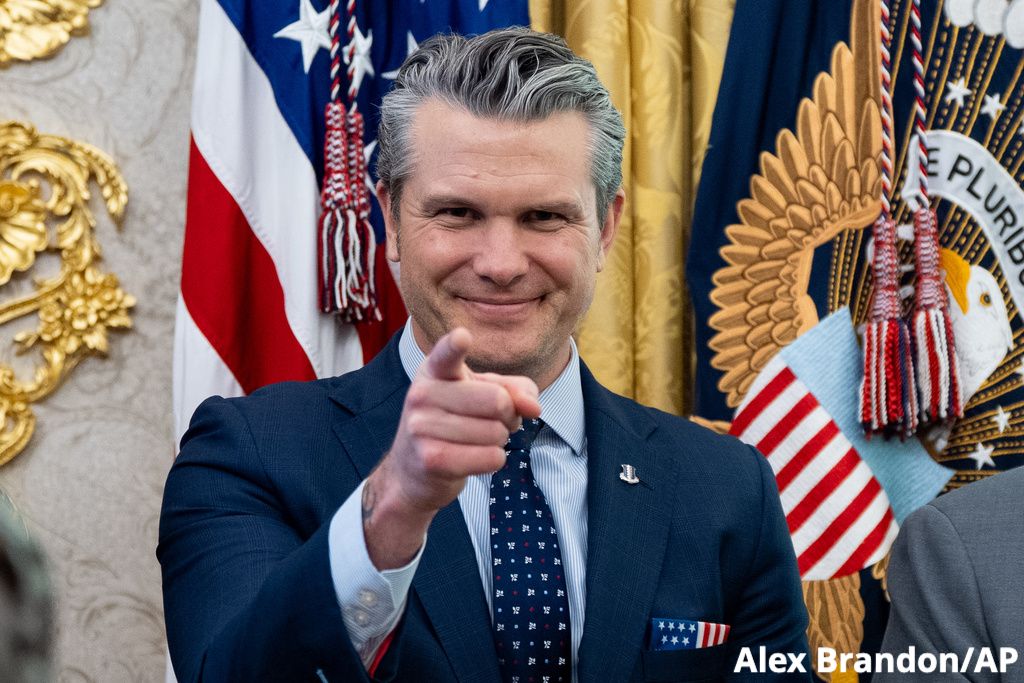
When a federal judge ruled last week that the Pentagon had violated the First Amendment by restricting press access, Pete Hegseth‘s team didn’t comply. It maneuvered.
On Monday night, the Defense Department announced it was shuttering the “Correspondents’ Corridor” — the workspace inside the Pentagon where journalists have operated for decades — and would eventually relocate press to an annex facility outside the building. The New York Times, whose lawsuit produced the original ruling, said in a court filing it was “a thinly veiled attempt to flout this court’s ruling,” and said it would return to court. The Pentagon Press Association called the changes “a clear violation of the letter and spirit” of the judge’s order.
CNN’s Brian Stelter framed the broader pattern: the Pentagon has held only six press briefings since U.S. strikes began, broadcast booths inside the building have been shuttered since last year, and now the physical workspace that allows reporters to maintain regular contact with military officials is gone. “Independent reporting on the U.S. military is not optional,” the National Press Club said.
Axios‘ Sara Fischer added important context: the White House has run a parallel playbook, removing wire services from its pool rotation after losing a lawsuit over AP access, then granting access to photographers while continuing to exclude some reporters. The pattern is consistent — lose in court, reorganize around the ruling.
Pentagon spokesman Sean Parnell invoked “security considerations” seven times in his announcement post. Aaron Mehta of Breaking Defense pushed back, noting that journalists have always been screened for badges and that Parnell’s framing mischaracterized the judge’s ruling. Washington Post deputy national security editor Andrew deGrandpré called the move an “end run” on the order.
The Pentagon press fight isn’t even the only First Amendment clash at the Defense Department this week. Status reported that a federal judge, reviewing the Pentagon’s designation of AI company Anthropic as a “supply chain risk” — a label previously reserved for foreign adversaries — said on the record that it looks “like the Pentagon is punishing Anthropic for trying to bring public scrutiny to this contract dispute, which of course would be a violation of the First Amendment.” Same department, same week, same pattern: use institutional power to punish entities that create unwanted scrutiny.
The administration’s press fight also extends well beyond the Pentagon. Status and Poynter both covered a new lawsuit from VOA journalists alleging that Kari Lake, the Trump ally installed to run the U.S. Agency for Global Media, has turned Voice of America broadcasts into pro-Trump propaganda — censoring Iran war coverage, republishing White House talking points as news, and “disseminating images of President Trump in the style of Dear Leader Kim Jong-Il,” according to the complaint. A federal judge had just ordered more than 1,000 terminated VOA journalists reinstated before the new suit landed.
The Trump administration’s press-related legal record remains poor. And the docket keeps growing.
TAKEAWAY: The Pentagon press crackdown is the most visible front, but the same logic is running across the administration simultaneously — punish Anthropic for seeking scrutiny of a Pentagon contract, turn VOA into a state mouthpiece, reorganize around court losses rather than comply with them. The newsletter class has been covering each of these as separate stories. They’re the same story.
Three Takes
THE $580 MILLION QUESTION: WHO KNEW WHAT BEFORE TRUMP’S IRAN POST?
Minutes before Trump posted on Truth Social Monday morning that U.S.-Iran talks had been “very good and productive,” oil futures and S&P 500 e-Mini futures recorded a sharp, isolated volume spike. The Financial Times estimated traders placed roughly $580 million in oil bets in that narrow window. Iran denied the talks happened. The market moved anyway.
Charlie Sykes in To the Contrary connected additional dots. Citing Paul Krugman, Sykes argued the trades fit a clear pattern: someone close to Trump knew what he was about to post and exploited that information for profit. He noted that Trump-installed officials at the SEC are actively blocking the enforcement division from investigating insider trading tied to the Trump family — and that Transparency International just gave the U.S. its lowest corruption score ever.
The Free Press editors called it unambiguous: “Investigate the trades — and prosecute any leakers who turn up.” The editors framed it as one of several suspiciously timed trades tied to Trump war announcements, and argued the White House waving away allegations of impropriety isn’t sufficient.
Emily Sundberg in Feed Me offered the Fintwit read: observers noticed that heavy military action tends to occur when markets are closed, while hints of diplomacy surface when markets are open. She highlighted a widely-shared post from analyst Mike Bird, who argued that military action and major announcements in this era now appear to be timed around market open and close times — a pattern he called one of the most “fascinating and telling tidbits” of the moment.
TAKEAWAY: What makes this moment different from past White House corruption stories isn’t the behavior — it’s that the corrective has been removed. The SEC won’t investigate. The DOJ won’t act. The normal accountability loop has been cut. The newsletter class is very good at documenting the trades. It’s less clear what happens next when documentation alone doesn’t lead anywhere.
📰 Top Reads 📰
STATUS | OLIVER DARCY
NEW RATINGS DATA PUTS CBS NEWS UNDER PRESSURE IN WEISS’S FIRST YEAR Worth noting upfront: Oliver Darcy has been one of Bari Weiss‘s most persistent critics, and his CBS News coverage should be read with that context in mind. That said, the Nielsen data he obtained is real. CBS Evening News with Tony Dokoupil is averaging 4.3 million viewers this quarter, down 7 percent year-over-year, with the 25-54 demo down 18 percent. CBS Mornings is averaging 1.8 million viewers, down 13 percent, with its demo down 28 percent. ABC and NBC are posting gains in the same period — ABC’s World News Tonight averages 8.7 million viewers. Broadcast news has been declining industrywide for years, and six months is a short window to assess a turnaround. But the gap between CBS and its competitors is notable, and Darcy’s anonymous sources are pointed. … QUOTE (Veteran TV news executive): “They haven’t seen how far they will fall when a person who never even owned a TV is put in charge of a storied TV news brand.” … QUICK TAKE: The numbers deserve scrutiny — but so does the source. Darcy has covered Weiss with undisguised hostility since before she took the job. The data is the data; the framing is Darcy’s.
BREAKER | LACHLAN CARTWRIGHT
SPIEGEL OUT OF POLITICO EIC RACE; BLANCHARD’S PLAYBOOK FUTURE IN QUESTION Peter Spiegel, Washington Post managing editor and considered a frontrunner for the Politico editor-in-chief job, has taken himself out of the running, Breaker reports exclusively. He’s staying at the Post after executive editor Matt Murray made a counteroffer. Part of Spiegel’s hesitation, per Breaker, was uncertainty about how much influence co-founder John Harris would retain in a new “chairman’s” role. Meanwhile, Playbook writer Jack Blanchard missed both Monday and Tuesday’s editions, fueling internal speculation he may be moved off the flagship newsletter. Status separately confirmed both developments. Blanchard returned for Wednesday’s edition — but his long-term future on Playbook remains uncertain. … QUOTE (Politico insider): “People across the newsroom have known for a long time that the Jack experiment just isn’t working out, and it seems like the C-suite is waking up to that reality.” … QUICK TAKE: The Politico EIC search has now burned through most of its marquee candidates without a hire. Meanwhile the flagship product is visibly wobbling. Whoever takes the job inherits both problems at once.
THE BULWARK | JOE PERTICONE
POLYMARKET’S DC POP-UP BAR WAS A COMPLETE DISASTER Prediction market company Polymarket hosted a “Situation Room” pop-up bar near the Bulwark’s D.C. office over the weekend, billed as a coming-out party for the Washington press corps. The WiFi didn’t work. The TV screens were blank. Reporters waited in the rain for 40 minutes before being let inside. A light fixture flickered, a bouncer knocked over a fake plant, and a Jeep covered in rubber ducks laid on its horn while black SUVs clogged the street. When a paid crypto influencer eventually posted a recap making the event look like a great time, it was labeled as a paid promotion. Polymarket spends $90,000 a quarter on D.C. lobbying, has Donald Trump Jr. on its advisory board, and updated its rules to supposedly prevent insider trading the Monday after the pop-up’s lackluster weekend. … QUOTE (Neal Kumar, Polymarket chief legal officer): “We view this as our real coming-out party in D.C.” … QUICK TAKE: The bar for a “coming-out party” is, at minimum, working WiFi. The rule changes the morning after suggest the real audience for the event wasn’t the press — it was Congress.
THE REBOOTING | BRIAN MORRISSEY
THE PHILADELPHIA INQUIRER GREW REVENUE FOR THE FIRST TIME IN 20 YEARS CEO Lisa Hughes joined Morrissey’s podcast to discuss a genuine local news turnaround story. The Inquirer — operating as a for-profit entity under nonprofit ownership — posted its first revenue growth in two decades last year, along with an operating profit of several million dollars. The model: 70 percent consumer revenue, hyperlocal newsletter expansion powered by an AI tool called Scribe that monitors school board meetings, and a deliberate pivot away from “enterprise to nowhere” stories toward content evaluated on three pillars: useful, revealing, responsive. Hughes is expanding from four suburban newsletters to 14 by year’s end, and over 30 by 2027. … QUOTE (Hughes): “We don’t need New York telling us where to eat in Philly. We need Philly telling us where to eat in Philly.” … QUICK TAKE: Most local news turnaround stories are about survival. This one is about expansion. The difference is the ownership structure — once you remove the shareholder pressure to extract profit, “useful, revealing, responsive” becomes an actual editorial strategy instead of a slogan.
CJR | CAROLINA ABBOTT GALVÃO
ANTITRUST EXPERT: THE SYSTEM HAS BECOME A POLITICAL TOOL In an interview for CJR, competition policy expert Diana Moss of the Progressive Policy Institute offered a blunt assessment of what the Nexstar-Tegna approval actually represents. The merger creates a company controlling 265 television stations reaching 80 percent of U.S. households — more than double the 39 percent national audience cap. But her deeper concern is structural: companies seeking mergers now make their first stop the White House, not the DOJ or FTC. The price of Paramount’s Skydance merger was eliminating all DEI programs. On the Warnamount deal, she flagged CNN as the live wire: political interference in the disposition of CNN from a Trump administration that would love to see it weakened is a genuine risk. … QUOTE (Moss): “It was purely a political concession.” … QUICK TAKE: The Moss interview names what most coverage dances around — this isn’t deregulation, it’s regulation by favor. The DEI concession detail is the clearest example yet of how the merger approval process has been repurposed.
AXIOS | SARA FISCHER
STATES AND DIRECTV ARE WRITING THE NEW ANTITRUST PLAYBOOK With federal regulators waving through big media mergers, antitrust enforcement is migrating to the states — and DirecTV is helping fund the litigation. Fischer reports that DirecTV coordinated with state attorneys general to file separate lawsuits seeking to block the Nexstar-Tegna deal just before it officially closed last week. She zooms out: Sinclair is pursuing Scripps, Paramount-Skydance and Warner Bros. Discovery are merging, and Live Nation just settled its DOJ antitrust case for $280 million. Media publishers’ share of the top 25 advertising earners dropped from roughly 28 percent in 2016 to about 7 percent in 2024, per WPP Media data. … QUOTE (Fischer): “Absent federal scrutiny, antitrust enforcement is moving to the states.” … QUICK TAKE: The interesting wrinkle here is that DirecTV isn’t a disinterested public advocate — it’s a competitor with its own pricing grievance. The states-as-antitrust-enforcer model only works if you’re comfortable with the funders picking the fights.
THE ANKLER | RICHARD RUSHFIELD
THE PARAMOUNT-WARNER DEAL IS STARTING TO UNRAVEL Rushfield argues what most of Hollywood has been unwilling to say: the Warnamount merger isn’t inevitable — it’s fragile. His case spans ten reasons, from Wall Street’s cold reception (BofA Securities slapped the deal with an “underperform” rating) to California AG Rob Bonta‘s visible presence at a Congressional hearing where The Pitt star Noah Wyle and former CNN anchor Jim Acosta testified about the deal’s threats to production labor and journalism. Rushfield’s broader argument: the Ellisons made this political by cosying up to Trump so publicly that they’ve handed opponents a durable line of attack. … QUOTE (Acosta): “If this merger goes through, the guardrails are gone.” … QUICK TAKE: The Ankler has been the most consistent and aggressive voice challenging this deal. The California AG showing up to a Congressional hearing without saying much is the tell — when regulators attend without acting, they’re usually deciding.
POYNTER | TOM JONES
KARA SWISHER SAYS SHE’LL LEAVE CNN IF THE ELLISONS TAKE OVER Poynter’s Jones reports that Kara Swisher told a Syracuse University audience this week she would leave CNN if the Warnamount deal closes. “I don’t think they’ll be good owners,” Swisher said. “I refuse to work for an organization that doesn’t respect journalists.” Of Larry Ellison, she added: “He’s a terrible person.” Jones also covers the quiet shutdown of CBS News Radio — a nearly century-old division serving 700 affiliates, folded with little fanfare amid the broader Weiss coverage — and Trump’s claim that the media, not the war, is keeping the Iran conflict alive. … QUOTE (Swisher): “He’s a terrible person.” … QUICK TAKE: The Swisher quote is the sharpest public expression yet of what CNN staffers are saying privately. The CBS News Radio shutdown is the more significant story — 700 affiliates losing a legacy feed is a local news crisis hiding inside a cable news drama.
MICHAEL TRACEY | SUBSTACK
WAS MAGA EVER REALLY ANTI-WAR? Tracey makes a depressing argument: raw partisanship predicts war support better than ideology. Democrats’ support for the Iran War has collapsed to single digits; Republican support sits around 85 percent. The same dynamic played out in reverse with Ukraine two years ago, and with Iraq in 2003. Tracey argues that Tulsi Gabbard, RFK Jr., and the broader “anti-war MAGA” cohort were always performing a pose — and that RFK Jr.’s promise at the Madison Square Garden rally that Trump would “end the warfare state” now stands as one of the more embarrassing political statements of the era. … QUOTE (Tracey): “How could anyone applaud that insane line, when Trump had never stopped boasting how he’d ushered in record-setting military budgets in his first administration?” … QUICK TAKE: Tracey’s piece is most useful as a preemptive strike against the inevitable revisionism — the coming wave of podcasters and pundits who will claim they always knew Trump would do this. The receipts are now on record.
NEWSBUSTERS | ALEX CHRISTY
STUDY: LATE NIGHT COMEDY JOKES ABOUT AMERICA HAVE REACHED 97 PERCENT DURING IRAN WAR A new Media Research Center study finds that in the first week of the Iran war, late night comedians directed 94 percent of their jokes at the American side. By week three, that figure had climbed to 97 percent. Fox News’ Jesse Watters offered the conservative counter-read separately, arguing that U.S. media “instinctively trust Iran” over their own government. … QUOTE (Watters): “The U.S. media believes the Iranians.” … QUICK TAKE: The 97 percent figure will circulate on the right regardless of its sourcing. What matters editorially is whether late night is making a choice or following its audience — and the MRC study doesn’t ask that question.
THE FREE PRESS | NIALL FERGUSON
HISTORY SAYS AN ENERGY SHOCK THIS SIZE USUALLY ENDS IN RECESSION Ferguson makes the historian’s case that a recession is coming. Drawing on economist Tyler Goodspeed‘s new book Recession, he argues that energy shocks have contributed to roughly half of American and British recessions over 300 years — and that the current disruption to global oil supply is the largest of our lifetimes. Gulf states have cut output by 10 million barrels per day. Qatar’s Ras Laffan LNG plant has been shut since March 2, with repairs potentially taking five years. Even if a deal were struck tomorrow, The Economist estimates it would take four more months before markets normalized. Ferguson’s Nixon parallel is deliberate: both presidents were warned, neither listened. … QUOTE (Ferguson): “Energy shocks are part of the explanation for around half of American and British recessions — and that has been true for nearly 300 years.” … QUICK TAKE: The strongest part of the Ferguson piece isn’t the recession prediction — it’s the corrective on 2008. If the energy shock preceded Lehman, then the financial crisis was a second blow to a patient already down. That reframing matters for how we read what’s coming now.
🎬 SHOWBIZ 🎬
THE ANKLER: REEL AI | ERIK BARMACK
VAL KILMER WILL APPEAR IN A NEW FILM AFTER HIS DEATH — AND PRIVATE EQUITY IS PAYING ATTENTION The film As Deep as the Grave will feature Val Kilmer in a role he never filmed, reconstructed via generative AI trained on archival footage and voice replication, with his estate’s cooperation. Barmack argues the real story isn’t the film — it’s the business model it signals. Once actors become separable from their physical presence, they become IP. He draws a direct line to the music catalog boom: the same private equity logic that drove billions into song libraries is about to hit Hollywood. A star like Tom Cruise, he argues, could become a multi-billion-dollar annuity. The James Dean Finding Jack project, announced in 2019 but ultimately abandoned under actor backlash, looks in retrospect like a line that simply couldn’t yet be monetized. … QUOTE (Barmack): “The line between captured and constructed performance has blurred to the point of irrelevance.” … QUICK TAKE: The music catalog analogy is the right one. When the underlying asset can generate revenue indefinitely, someone will figure out how to securitize it.
PAGE SIX HOLLYWOOD | PETER KIEFER
NOMA LA’S A-LIST CLIENTELE DOESN’T CARE ABOUT THE CONTROVERSY The Noma pop-up in Silverlake — $1,500 a plate, fully booked despite ongoing protests — has become its own cultural test case. Kiefer reports that Mindy Kaling, BJ Novak, and Emily in Paris star Lily Collins have all dined there despite the demonstrations outside the Paramour Estate over abuse allegations against head chef René Redzepi. Corporate sponsors including American Express and Cadillac yanked support. One of the most viral abuse claims — involving a burned intern — has since been debunked by the Los Angeles Times, which tracked down the intern and obtained a different account. Over 50,000 people signed up for 5,000 available seats; there have been roughly a dozen cancellations since the New York Times exposé. Noma plans to open a retail store on Sunset next week. … QUOTE (Jason Ignacio White): “Rene is a master abuser & manipulator so I can’t be comfortable in this situation.” … QUICK TAKE: The A-list dining in silence while protesters bang pots outside is its own kind of story. Noma’s real test may be the retail storefront — harder to book a reservation, easier to picket.
THE ANKLER: THE WAKEUP | SEAN MCNULTY
ROW K IS BUCKLING AFTER ONE RELEASE Indie distributor Row K — which announced plans to release up to 10 films annually when it launched in August 2025 — is in serious trouble after releasing exactly one film. Its three principals are negotiating exits. Vendor and consultant bills are reportedly unpaid. Its next film, Maude Apatow‘s Poetic License, needs a new distributor after Row K never officially paid for it. The Cliffhanger reboot set for August is considered TBD. Parent company Media Capital Technologies’ financial relationship with MassMutual remains murky. The company still plans to attend CinemaCon next month. … QUOTE (Row K parent company): “We’ll see.” … QUICK TAKE: One movie. One miss. One meltdown. The telling detail is that Row K still plans to attend CinemaCon — which is either admirable stubbornness or a company that hasn’t told itself the truth yet.
👀 What Got Missed? 👀
This week’s stack covered the Pentagon press crackdown, the VOA propaganda lawsuit, the Anthropic retaliation designation, and MAGA’s trial balloon about deploying ICE to polling places as four separate stories on four separate beats. None of the newsletters connected them into the single argument they collectively make: that this administration is engaged in a systematic effort to dismantle the infrastructure of accountability — legal, journalistic, and institutional — simultaneously and by design. Yes, that’s a familiar macro argument, and the newsletter class can be forgiven for not wanting to repeat it every week. But not saying it starts to look different from knowing it. At some point, covering each maneuver in isolation — without acknowledging the pattern — is its own editorial choice.
🏆 Newsletter of the Day 🏆
Poynter | Tom Jones — While most of the stack treated the CBS News ratings story as a straightforward Bari Weiss verdict, Jones pulled back to ask what’s actually being lost in the broader CBS contraction. His edition covered the quiet shutdown of CBS News Radio — a nearly century-old division serving 700 affiliates, folded with little fanfare — alongside the Kara Swisher comments at Syracuse and Trump’s claim that the media, not the war, is keeping the Iran conflict going. Jones wasn’t just covering the ratings; he was covering the institution. That’s a different, more useful story.
The Bottom Line
Bari Weiss turns 41 today. The ratings data Status published is real, and the gap between CBS and its competitors is worth watching. But six months is a short runway, broadcast news has been declining for years, and Oliver Darcy’s hostility toward Weiss predates her tenure by a wide margin. The honest answer is that while it’s too early to know whether this is a Weiss problem, a CBS problem, or just the industry accelerating. What’s not too early to note: the newsletter class has largely accepted Darcy’s framing without much pushback. That’s worth asking about.
Get full access to premium content with a Mediaite+ subscription.



Comments
↓ Scroll down for comments ↓