
How An American Consulting Firm Tried To Give The U.S. Media A Warmer, Cuddlier Gaddafi

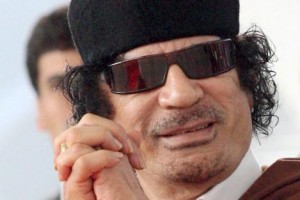 The U.S. press systematically refer to Libyan leader Muammar al-Gaddafi as a crazy, narcissistic despot whose people are suffering and whose country is in turmoil. But, for a brief slice of time in 2007, people reading through certain U.S. and British publications may have found themselves reading about a new or “changed” Gaddafi, a Gaddafi committed to paving the way for democracy in Libya.
There’s a reason for that.
On December 10, 2007,The New Republic published Harvard professor and author Joseph Nye‘s account of his visit to Libya. Titled “Tripoli Diarist: Big Tent,” Nye’s report detailed a “surreal” meeting with Gaddafi, the two drinking tea in a tent surrounded by camels, goats and the ruins of buildings bombed by U.S. aircraft in the 80s. In his article, Nye disclosed that he was in Libya, meeting with Gaddafi “at the invitation of the Monitor Group, a consulting company that is helping Libya open itself to the global economy.” While that was true, Nye didn’t present a totally complete picture of how the Monitor Group was able to convince “experts” from outside Libya to visit the country, or what the group’s ultimate goals happen to be. The New Republic has since, however, offered an additional, vital bit of disclosure in light of a recent report by Mother Jones on the aims and activities of the Monitor Group. “While the article discloses that Nye traveled to Libya at the invitation of the Monitor Group,” added TNR, “it should have also noted that he was acting as a paid consultant for the company.”
What TNR didn’t add, however, was the the Monitor Group hoped to do more than simply help Libya “open itself to the global economy.” The Boston-based group, which has ties to Harvard’s Business School, was also specifically tasked with changing the global perception of Gaddafi.
But don’t just take our word for it. Take a look at a letter to Libya from Monitor CEO Mark Fuller, via Mother Jones:
“The project is a sustained, long term program to enhance international understanding and appreciation of Libya and the contribution it has made and may continue to make to its region and to the world. It will emphasize the emergence of the new Libya and its ongoing process of change.”
During the course of the project a second important goal was introduced by the client. This goal is to introduce Muammar Qadhafi as a thinker and intellectual, independent of his more widelyknown and very public persona as the Leader of the Revolution in Libya.
Others who visited Libya thanks to Monitor include Princeton professor Andrew Moravcsik, who wrote about his trip for Newsweek International; British author Anthony Giddens, whose account appeared in The Guardian; author Benjamin Barber; and another Harvard professor, Robert Putnam, who wrote of his meeting with Gaddafi for The Wall Street Journal.
The men disclosed their association with Monitor to varying degrees (including denying any association whatsoever), despite Monitor documentation of their visits and cooperation.
For their part, the Monitor is keeping mum about their involvement with each of these writers, telling Mother Jones that the firm does not comment on the specifics of its work with clients.
The firm does not seem to have a client list on its U.S. website, but does offer an explanation about its goals and services:
Monitor serves corporations, governments, and non-profit institutions to help them grow.
We work across virtually all industries and in all parts of the world.
Our clients share an aspiration to lead in their fields and a desire to harness new ideas, unconstrained by conventional wisdom, for the benefit of their organizations.
h/t Mother Jones






Comments
↓ Scroll down for comments ↓