CNN’s Dr. Sanjay Gupta Talks To Mediaite From Havana On Covering The Cuban Health Care System

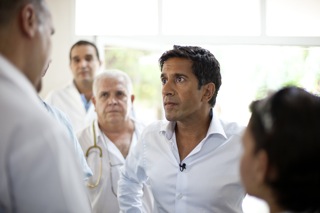 I hate to bring it back to politics, but it is somewhat inevitable with this topic: now that you’ve experienced the trip to Cuba, has it changed your opinion of whether Americans should have the option of going there on a regular basis?
As a doctor, when I do trips like this, it’s not for political purposes. Having said that, whatever the intent of the Helms-Burton Act is, I’m not sure that people here in Cuba, certainly people in the United States, see it as having the impact that it was originally thought to have, or designed to have. People here, they talk about it. They talk about the fact that products cannot be brought into the country, the United States, from Cuba, and it’s one of these things where I don’t think people here in Cuba really talk about it that much. Now, how much impact it has on the economy overall, how much impact it would have if the market of the United States would open to them—my sense is from talking to the foreign minister and others here that this is something that they think is simply going to go away over the next several years. The embargo the way that we know it and think of it is going to change, that’s the perception around here.
Do you think the medical field will have a role in that change over time?
Yes, I think so. Fidel Castro, he was big on the doctors for diplomacy program. If you look at estimates, anywhere from one fifth to one third of Cuban doctors actually practice overseas. That’s thousands of doctors. The purpose, at least the way it was written, was for humanitarian reasons. Now, if you dig a little bit deeper, you’ll find it’s a bit more complicated than that. If you look at Venezuela, for example, they’ve sent something like 14,000 doctors to Venezuela over ten years. The doctors there will work in areas in where there are not that many doctors, where there isn’t medical care. Now, for the doctors, it’s often a pretty good deal because they are paid better in Venezuela than they would in Cuba. The salaries for doctors in Cuba are not good, and that’s been a criticism, that the resources for doctors and hospitals are pretty inadequate. They operate on shoestring budgets. In Venezuela they get paid more, and the flipside of that is that Venezuela provides Cuba a large amount of oil—it’s unclear how much oil, but it’s in the millions of barrels. So there is a step beyond simple doctors for diplomacy, at least regard to with Venezuela.
But the medical school here has students here from dozens of countries around the world that get free tuition and are expected at the end of that time to provide service, to provide humanitarian work or to be out in communities here in Cuba or around the world doing work where doctors are not represented well.
From my experience in discussing the medical system with people here who fled Cuba to practice medicine here, it seems the two biggest problems they encountered is the difference in the rigor of the education there and the fact they didn’t have a choice in what they practiced. How much do you think the education makes a difference once they’re out there?
If you look at the numbers, more than 90% of the graduating physicians go into some sort of primary care field as supposed to a specialty. The whole system I think in Cuba in some ways could be considered opposite the United States in some ways in that there’s a lot of specialists in the United States and the compensation for specialists is often higher than in primary care fields. In Cuba, according to the people I was interviewing, the best students go into primary care, and they do have a requirement to spend years—sometimes up to six years—of service working in clinics where there aren’t enough doctors already represented. So graduating students are oftentimes told that the primary care specialty is where they should be going and that they need to work at pretty low salary clinics where there just aren’t enough resources. People here who have been to Cuba back and forth a bit say there are lots of doctors that take side jobs as even cab drivers to make ends meet because they’re simply not getting paid enough. That is a criticism of the system. The other criticism that people will level is that in the end patients who have complicated problems don’t fare as well. I don’t know that you can prove that if you look at numbers across the board. If you look at life expectancy and infant mortality rates are among the best in the world. In fact the infant mortality rate is lower than in the United States. Critics will say that this is because the abortion rates are higher in Cuba, so you can see how this argument can go back and forth and some of it is hard to prove. It is known, at least by international statistics that the abortion rate is higher in Cuba, but whether it is high enough to override the infant mortality rate is just not clear. There are a lot of pieces in putting it all together.
But with those numbers, what counts as an abortion versus a miscarriage or an infant death, and who is putting these numbers together Where are they coming from? It seems easy to fudge the numbers.
Even within Cuba, and certainly within Cubans who have left Cuba, that is the exact question they ask as well. Some will say, the abortion rates are not as high as you think, but others will say “it’s because you’re not counting the abortions the way World Health Organization standards are for counting abortions.” And often these numbers are given at the institutional level so hospitals themselves report these numbers, and one hospital can be different than another hospital. So it becomes harder to create a national number when you have so many disparate sources of reporting based on different definitions of what an abortion is.
NEXT: Race To Miami: Diana Nyad Makes A Splash Swimming Out Of Havana
This is an opinion piece. The views expressed in this article are those of just the author.
New: The Mediaite One-Sheet "Newsletter of Newsletters"
Your daily summary and analysis of what the many, many media newsletters are saying and reporting. Subscribe now!








Comments
↓ Scroll down for comments ↓