CNN Senior Legal Analyst Laura Coates Mocked for Hot Take on Derek Chauvin’s Defense Strategy: Does the ‘Junior Legal Analyst’ Know Less Than You?

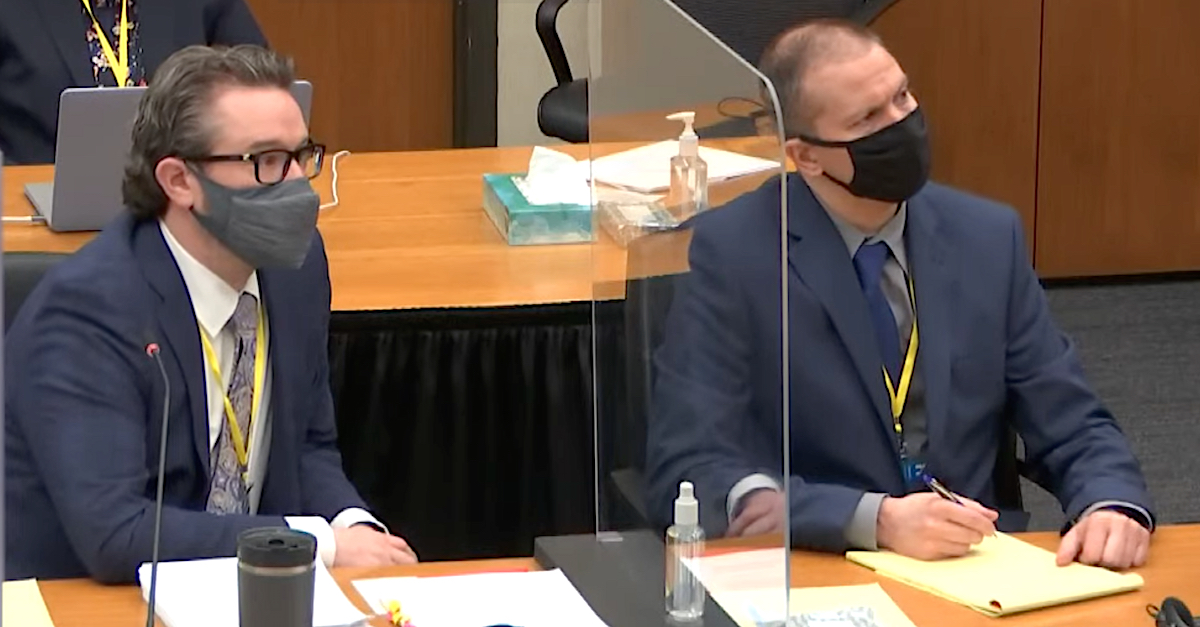
CNN Senior Legal Analyst Laura Coates drew a wave of criticism for a tweet she posted during the beginning of the defense’s closing argument during the Derek Chauvin trial, getting mocked for seemingly misunderstanding or misstating a basic legal principle.
“Defense begins the closing by defining reasonable doubt, not with why [Chauvin] is innocent,” wrote Coates. “Think about that.”
Defense begins the closing by defining reasonable doubt, not with why #DerekChauvin is innocent. Think about that. #DerekChauvinTrial#GeorgeFloyd
— Laura Coates (@thelauracoates) April 19, 2021
Without getting too far into the legal weeds, the standard for a criminal defense does not require that they prove “innocence.” In fact, under our legal system, the defense doesn’t have to prove anything at all; they merely have to argue that the prosecution failed to prove their case beyond a reasonable doubt.
It also wouldn’t make practical sense to try to argue “innocence” in this case. There is no question that Chauvin was there at the scene when George Floyd was arrested, and it is Chauvin who is seen in the multiple police body cams and bystander videos kneeling on Floyd’s neck for 9 minutes and 29 seconds. The defense has not disputed that he was there, or that he didn’t do what he did; they’ve argued that what Chauvin did was acceptable as a reasonable use of police force.
Twitter users swiftly pounced on Coates’ tweet, including several other attorneys, flabbergasted at her misrepresentation of a concept that is taught to 1Ls, first year law students.
Reasonable doubt is all what the defense needs to succeed at their job.
This is an irresponsible tweet by a “Senior Legal Analyst.” https://t.co/PzUNJVccgD
— Frank Luntz (@FrankLuntz) April 19, 2021
Seeing someone with “Former #DOJ” in their bio tweet this is really a terrifying commentary. https://t.co/oWylG6odWA
— Dan McLaughlin (@baseballcrank) April 19, 2021
This is literally the job of the defense. It happens in nearly every criminal trial.
— Ryan Kane (@rykane) April 19, 2021
Correct. Guilt is for the prosecutor to prove. Innocence is for the newspapers. Beyond a reasonable doubt is the only thing defense counsel cares about. (Beyond ethics considerations) I never ask my clients if they are guilty. Totally irrelevant question.
— Tommy Lonn (@tommylonn) April 19, 2021
Does your title of “Senior Legal Analyst” suggest that CNN has a Junior Legal Analyst who somehow knows less than you?
— Colin Duffy (@TheRightDuff) April 19, 2021
Some days I feel like “former inmate” would be less embarrassing than “former federal prosecutor.”
— AngloSaxonTraditionsHat (@Popehat) April 19, 2021
The stupidity of this take has left me dumbfounded. How are you a senior legal analyst if you don’t understand the basics of criminal law? https://t.co/kemSRe5twO
— Brandon (@Brandoniant) April 19, 2021
Uh…. this is like 1L level stuff…. https://t.co/wwokjTX1uQ
— RJ (@rjcaster) April 19, 2021
Let’s be clear about something: Laura knows better. She’s hoping you don’t. https://t.co/e6MKvAYIPu
— Sunny McSunnyface (@sunnyright) April 19, 2021
NB: Defendants have not borne an onus of proof [esp of their innocence] before a trier of fact, whether judge or jury, since at least Justinian https://t.co/3jK6zgVp0I
— Gray Connolly (@GrayConnolly) April 19, 2021
I just thought about it. When I did, I realized it’s what defense attorneys always do — and appropriately so, since the reasonable doubt standard is the cornerstone of the system. https://t.co/IWSLIYTbHe
— Patterico (@Patterico) April 19, 2021
New: The Mediaite One-Sheet "Newsletter of Newsletters"
Your daily summary and analysis of what the many, many media newsletters are saying and reporting. Subscribe now!







Comments
↓ Scroll down for comments ↓