Antisemitism Is Spreading — ‘Zionism’ Is Now a Political Media Trap

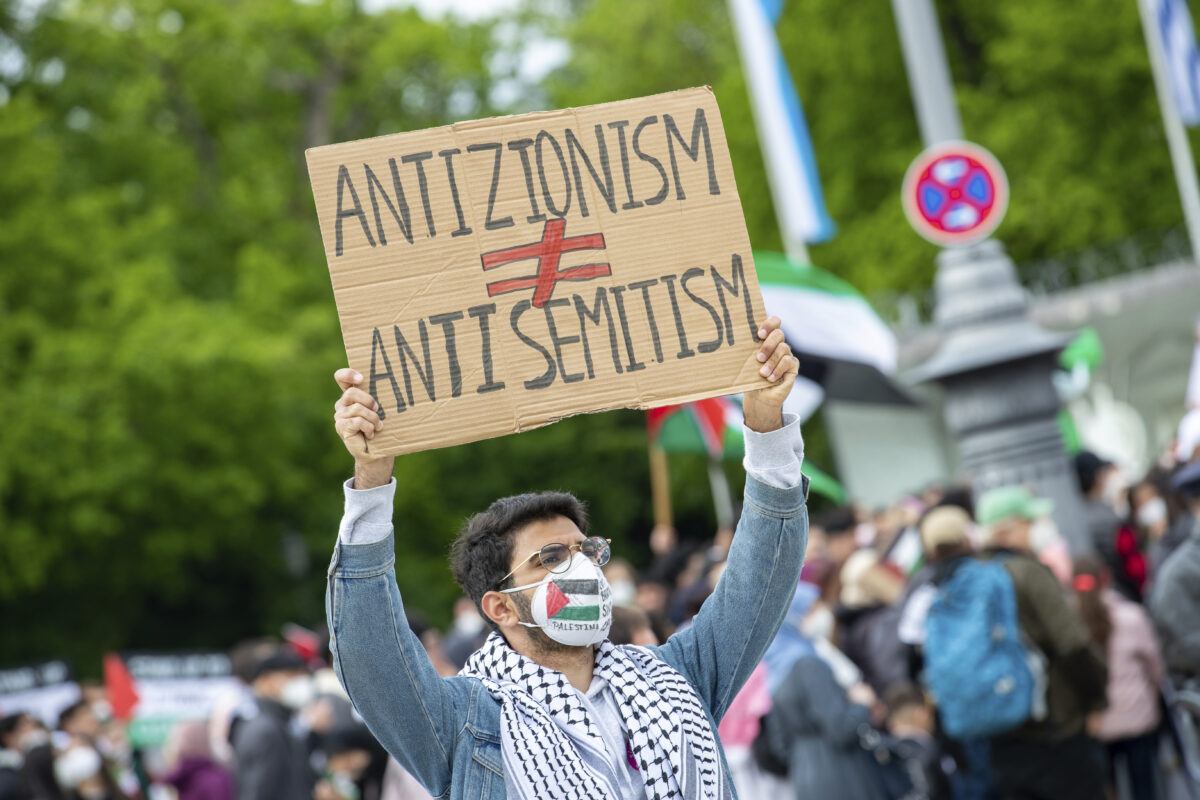
(Photo by Alexander Pohl/Sipa USA)(Sipa via AP Images)
Something is happening to Jewish Americans that the usual language cannot contain. Politicians call it “a rise in antisemitism.” Researchers count incidents. Advocates issue statements. And still, it grows.
Writer and long time researcher of extremism Yashar Ali has spent a decade tracking anti-Jewish movements, and he names it more honestly than most. What we are experiencing is not a rise — a word that suggests something temporary and containable. It is a pandemic: an ideological contagion that has crossed political movements, platforms, and demographics, reaching people with no prior history of anti-Jewish prejudice. The hatred itself is not new. What has changed is how widely and easily it travels.
He’s right. And we have made it easier. We allowed the language to collapse, and the collapse created cover.
Two interviews from recent weeks show exactly what that cover looks like, even among people operating in good faith — and at least one who may not have been.
Gavin Newsom sat down with journalist Jonathan Martin and described himself as a “proud” Zionist, in that he fully believes Israel has every right to exist. He said he reveres Israel. He then spent much of his answer explaining what he did not mean by that. He criticized Benjamin Netanyahu, opposed settlement expansion, and walked back his earlier use of the word “apartheid,” clarifying that he meant the direction of Netanyahu’s government rather than the nature of the Israeli state. The clarification was not a hedge. It was a requirement — because the moment Newsom claimed the label, he had to immediately dismantle what others would assume it meant.
Tucker Carlson, in a separate interview with The Economist’s editor-in-chief Zanny Minton Beddoes, turned what should have been a simple exchange into an extended confrontation. Asked whether Israel has a right to exist and whether he would consider himself a Zionist under a narrow definition, Carlson spent several minutes challenging the premise of the question, demanding definitions, rejecting the definitions he was given, and insisting he didn’t know what was being asked — even after he had already answered it. He said he didn’t want Israel destroyed. He said he opposed killing innocents. He said he believed in universally applicable standards, not ethnic rights. Those are coherent positions. But he delivered them only after exhausting every available avenue to avoid saying them directly, and he still refused the label even once it had been narrowed to the point where his own stated views satisfied it. Whatever his underlying philosophy, his performance in that interview was not principled resistance to imprecise language. It was combat.
One man accepted the label and worked to contain it. The other fought the question until the clock ran out. Both responses expose the same failure. The word has broken.
“Zionism” now carries two parallel meanings in public discourse. One is narrow and historical — the belief that Israel has a right to exist as a Jewish state. The other is expansive and punishing, used as shorthand for Netanyahu’s policies, settlement expansion, and a broader set of moral indictments that have nothing to do with Israel’s right to exist.
These meanings have long coexisted, but they are now deployed interchangeably at scale, in mainstream conversations, and almost never distinguished. Accept the label and your critics assign you the second definition. Reject it and your opponents hold you to the first. The word has become a trap — and it is a trap that serves the spread of exactly the hatred Ali is describing.
When language stops meaning one thing, it starts meaning anything. And when it means anything, it provides cover for the ugliest ideas to travel under the most defensible flags.
My two sons, 22 and 19, both politically engaged, have independently told me they are seeing more anti-Jewish rhetoric among their peers than at any point in their lives. It isn’t coming from one direction. On the right, conspiratorial hostility dressed in populist language. On the left, environments where criticism of Netanyahu moves, with little friction, into something broader — where “Zionist” stops being a political position and becomes a classification of people. A type. A them.
That is the mutation Ali is tracking. The language adapts, finds new carriers, and allows old hatreds to reappear in forms that feel fresh enough to defend and vague enough to deny.
The urgency is not abstract. The United States is now in active military coordination with Israel against Iran — a fact that has arrived with stunning speed and carries enormous consequence. Americans are being asked to form views about what that alliance means, what we owe, and what we stand for. Those conversations are happening right now, in newsrooms and on campuses and in the streets. They are happening in a vocabulary that has been deliberately loosened — one where meaning shifts depending on who is speaking and who needs to be accused.
That is not confusion. That is a weapon. And it is being used.
Ali is right that the scale of this has outgrown the language we are using to describe it. The broken language did not start the pandemic. But it is one of the primary reasons it cannot be stopped.
This is an opinion piece. The views expressed in this article are those of just the author.
New: The Mediaite One-Sheet "Newsletter of Newsletters"
Your daily summary and analysis of what the many, many media newsletters are saying and reporting. Subscribe now!







Comments
↓ Scroll down for comments ↓