
‘Don’t Have to Use That One’: Trump Acts Like He Runs CBS on 60 Minutes

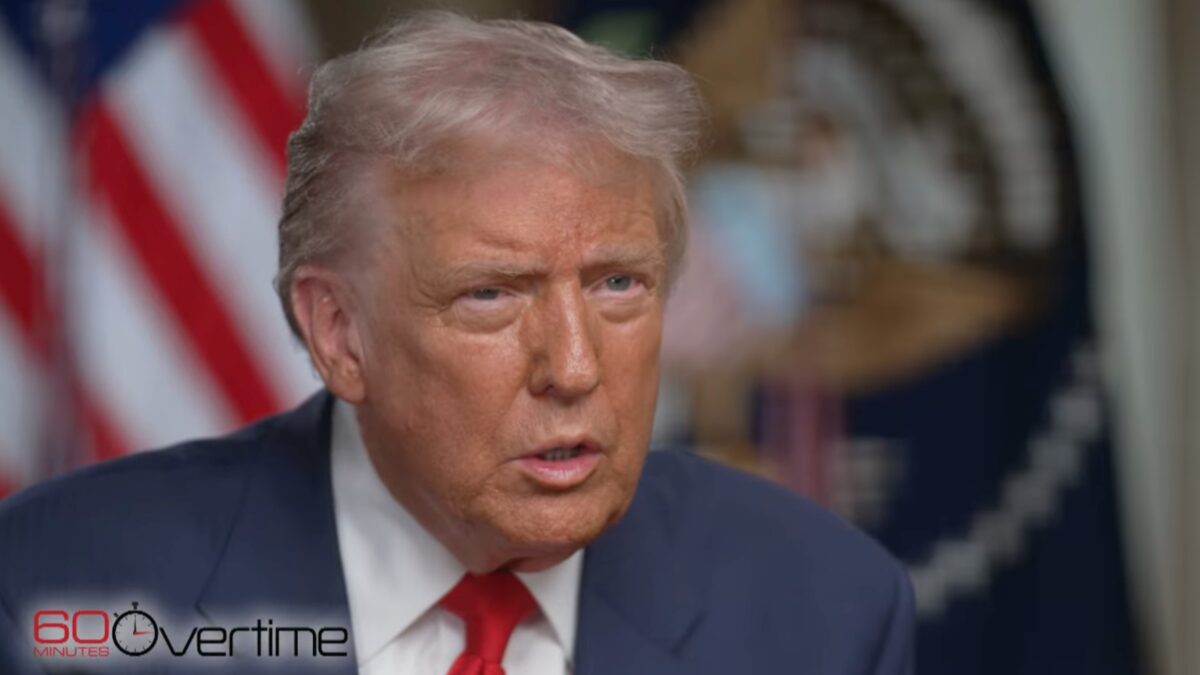
When President Donald Trump leaned back during his recent 60 Minutes interview and told Norah O’Donnell, “You don’t have to use that one,” it didn’t sound like a request. It sounded like a production note — the kind a network boss gives a junior editor. Trump spoke not as a subject being interviewed, but as someone directing the cut.
Then came the follow-up: “I don’t want to embarrass you.”
It was delivered like kindness, but it landed like a warning. The benevolent tone masked something unmistakably more assertive: an expectation that CBS would tailor the product to protect him — and to protect itself from him.
The stunning moment was not shown during the broadcast of the two-segment interview, but was revealed in the complete footage released by CBS News. It was a moment that clarified something: Trump’s performative outrage over how CBS allegedly edited Kamala Harris’s 60 Minutes interview from a year ago was never about journalistic principle, nor about factual accuracy. It was about control — a belief that legacy media should serve him, not scrutinize him.
And now, it appears CBS agrees.
In July CBS’s parent company Paramount quietly settled a lawsuit Trump brought over — reportedly paying $16 million, a tiny fraction of the absurd $20 BILLION he was chasing initially. That figure has been widely circulated as if it constituted some admission of wrongdoing.
But the truth is more banal: CBS admitted nothing. The deal was inked while the network was trying to complete a massive corporate merger, and the settlement functioned as a familiar corporate tool — a costly but convenient way to remove a legal landmine blocking the transaction.
This matters because Trump has held up the payout as vindication, proof that CBS “wronged” him. Yet the more revealing piece of evidence is not what CBS paid; it’s that CBS subsequently invited him back.
CBS’s posture has changed significantly in recent months. After the Ellison family’s acquisition closed in August, the network installed Bari Weiss—the former New York Times columnist and founder of The Free Press—as head of CBS News, signaling a strategic pivot toward confrontational interviews and cultural-war relevance. The appointment reflects a bet that provocation drives attention in a fragmented media landscape.
But the decision to invite Trump back reveals something beyond strategy: desperation. Legacy news organizations, facing declining trust and fragmenting audiences, have convinced themselves that access to Trump—on almost any terms—is essential to survival. They need the ratings, the cultural conversation, and the sense that they still matter to how politics unfolds. Trump delivers all three, and CBS calculated that a flawed interview beats no interview at all.
So of course they booked him. And this time, Trump acted like management.
A year ago Trump raged that CBS selectively edited his political rival’s answers to make her look better. Now, during the latest sit-down, he calmly instructed CBS which answers they may cut — and said so to their face. That sudden shift from aggrieved victim to casual overseer IS the entire story.
His “I don’t want to embarrass you” line is the purest expression of this dynamic. It is the language of the patron, the mob boss who dispenses courtesy even as he exerts dominance. The sentiment is conditional, flattering — and unmistakably coercive. Trump positions himself not as someone subject to editorial decisions but as someone entitled to influence them.
This isn’t standard hypocrisy. Hypocrisy implies there is a principle Trump is violating. Here, there is no principle, only power. The difference between outrage and indifference isn’t about the act of editing — it’s about who does the editing. When Trump believes CBS is on his side, editorial control becomes collaboration. When he thinks they are not, it becomes persecution.
This may sound extreme, but it mirrors a pattern visible in every strongman’s relationship with the media. Hungary’s Viktor Orbán didn’t abolish critical broadcasters; he domesticated them. Their editorial independence remains nominally intact, but power determines tone. Turkey’s Recep Tayyip Erdoğan used regulatory and financial pressure to force networks into alignment, often without needing explicit censorship.
The goal is never to eliminate journalism. The goal is to teach it who’s boss.
Trump can’t commandeer American newsrooms — yet. But he can shift the culture so that journalists internalize the imperative to accommodate him. CBS’s settlement and its renewed interview signal a willingness not just to platform Trump, but to accept his terms. Whether that stems from economic calculation, political anxiety, or institutional insecurity matters less than the public result: a former president who now treats America’s most iconic TV news magazine like his programming partner.
The stakes extend far beyond one network or one interview. If institutions learn that the easiest way to avoid conflict with Trump is to pre-emptively soften coverage, then a second Trump administration won’t need to prosecute reporters or seize media assets. Compliance will arrive voluntarily, one polite request at a time: You don’t have to use that one.
That’s the real threat: not that Trump demands obedience, but that respected institutions are already practicing it.
This is an opinion piece. The views expressed in this article are those of just the author.
New: The Mediaite One-Sheet "Newsletter of Newsletters"
Your daily summary and analysis of what the many, many media newsletters are saying and reporting. Subscribe now!







Comments
↓ Scroll down for comments ↓