Remember the Epstein Binder Photo Op? MAGA Influencers Hope You Don’t.

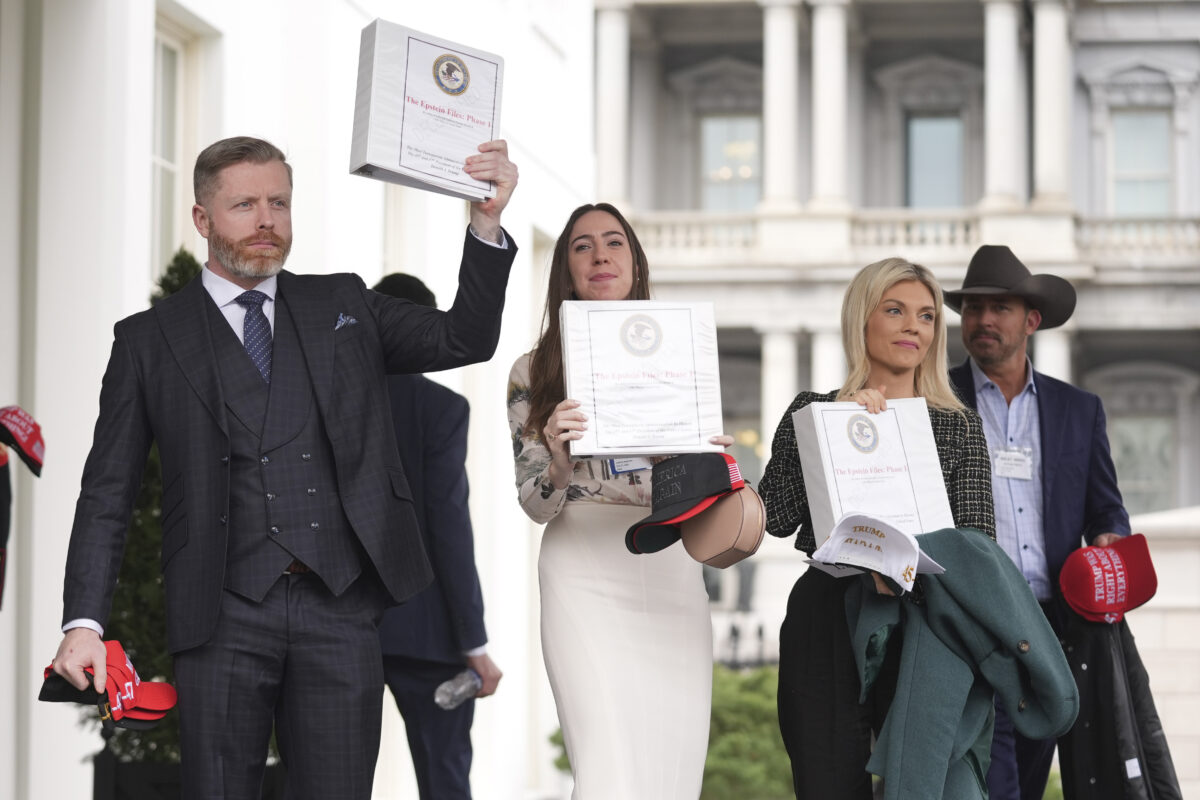
(AP Photo/Evan Vucci)
Last February, 15 right-wing influencers were invited to the White House and handed binders stamped “The Epstein Files: Phase 1.” They walked out of the West Wing smiling as they had just uncovered something seismic.
Rogan O’Handley (who goes by DC_Draino on X) held his binder high for the cameras. Jack Posobiec made sure his was visible in every frame. Liz Wheeler went live and flipped through the pages. Jessica Reed Kraus described the White House setting and the sense of insider access. The event was staged to signal that long-suspected corruption was finally about to be exposed.
After years of insinuation about elite depravity, here was the proof — and it was unlikely to damage the people handing out the binders. It was terrific political theater for the most ardent Trump supporters, but like so many partisan performative photo ops, it aged terribly.
The documents contained in the professionally produced notebooks were largely familiar to those fluent with the case: address books, flight logs, previously circulated material now packaged with official letterhead. Even some attendees conceded there was little new in the first tranche. “Phase 1” implied escalation, and the performance did the rest.
What followed over the next year did not resemble a clean partisan detonation. Additional disclosures under the bipartisan Epstein Transparency Act resurfaced President Donald Trump’s documented flights on Epstein’s plane and his 2002 remark calling Epstein a “terrific guy” who liked women “on the younger side.” Emails and witness statements reinforced that this was real proximity among powerful people, not a cable-news fever dream.
No criminal charges emerged against Trump, and that absence became the rhetorical escape hatch. In a binary media culture, the choice is framed as guilty or cleared. The messier middle ground — documented association, social overlap, uncomfortable context — is entirely narrative driven and, as such, much easier to wave away. That gray space is precisely where this story now lives.
The influencer class responded accordingly — those who stayed loud did not abandon Epstein. They narrowed him.
O’Handley continued to post about sulfuric acid deliveries and Clinton connections while demanding the names be unredacted. Wheeler declared that her “biggest takeaway” from the latest releases was that “President Trump is exonerated all over again,” citing Epstein’s claim that Trump “never got a massage.” Posobiec labeled scrutiny of Trump’s 2006 call to Palm Beach police the “Biggest L ever” for critics and amplified headlines emphasizing Trump’s cooperation. Mike Cernovich insisted the real story was still buried somewhere in the intelligence community.
Others kept the outrage broad but carefully directed. Mario Nawfal highlighted allegations against billionaires and foreign figures. Collin Rugg clipped heated exchanges over redacted names. Laura Loomer chased side narratives involving political enemies. The volume remained high, and the target rarely shifted inward.
A separate group allowed the issue to recede altogether. Libs of TikTok’s Chaya Raichik, Scott Presler, Isabel Brown, Savanah Hernandez, and Emily Austin were eager to amplify the binder rollout. As the disclosures widened and the narrative lost its partisan neatness, Epstein effectively slipped from prominence in their feeds completely.
Then the Justice Department entered the frame.
In July, the Trump DOJ declared the matter effectively closed, asserting there was no hidden bombshell and nothing left to prosecute. Subsequent releases were heavily redacted. Deadlines under the Transparency Act slipped. Lawmakers later indicated that not all digital files had been reviewed before the department signaled that it had completed its review.
If the White House event had been about transparency as a governing principle, that development demanded scrutiny.
Instead, Chad Prather praised Attorney General Pam Bondi and accused Democrats of opportunism. Wheeler questioned redactions in the abstract but did not mount sustained criticism of the administration’s handling. Cernovich suggested bureaucrats were concealing the real story. Most of the others treated the DOJ posture as peripheral.
The February 11 House Judiciary hearing brought the contrast into sharper focus. Bondi was pressed on redactions, delays, and compliance with the Transparency Act. Epstein survivors stood during questioning about DOJ accountability. Bondi refused to apologize and pivoted to partisan counterattacks, arguing that Democrats had never pressed Merrick Garland and deflecting to economic talking points about the Dow and 401(k)s.
Of the fifteen influencers who had posed with “Phase 1” binders, only a handful engaged publicly with the substance of that hearing. Wheeler focused on prison footage and questions about Epstein’s death. Cernovich framed the oversight as partisan harassment that would intensify if Democrats won the midterm elections. Rugg highlighted the drama of Bondi sparring with lawmakers. Nawfal amplified survivor frustration alongside clips of Bondi defending herself.
The majority did not weigh in.
No one involved was naive about political incentives. What the past year exposed is how quickly the interpretive standard adjusted once the story stopped being tidy. Demands for unredacted names traveled freely when aimed outward. When scrutiny approached Trump or his Justice Department, the volume softened, the framing shifted, or the subject drifted.
In theory, that pattern should carry consequences — loss of credibility, pushback from peers, erosion of audience trust. In the current environment, spectacle outperforms self-scrutiny. The binder moment generated engagement. The follow-through required discipline.
The reason is structural. These platforms do not reward consistency. They reward conflict. The algorithm that elevated the binder moment is indifferent to whether the outrage that followed was principled or performative — it measures engagement, not coherence. As long as the next post generates attention, the last one never needs to be answered for.
Fifteen influencers walked out of the West Wing presenting themselves as avatars of accountability. Eleven months later, the most lasting takeaway from that afternoon is not what was inside the binders. It is how elastic the standard became once the story grew inconvenient — and how little that elasticity appears to cost them.
This is an opinion piece. The views expressed in this article are those of just the author.
New: The Mediaite One-Sheet "Newsletter of Newsletters"
Your daily summary and analysis of what the many, many media newsletters are saying and reporting. Subscribe now!







Comments
↓ Scroll down for comments ↓