The Media Teams Up with Democrats to Cover for Joe Biden and Smear Robert Hur

AP Photo/Evan Vucci. AP Photo/Alex Brandon
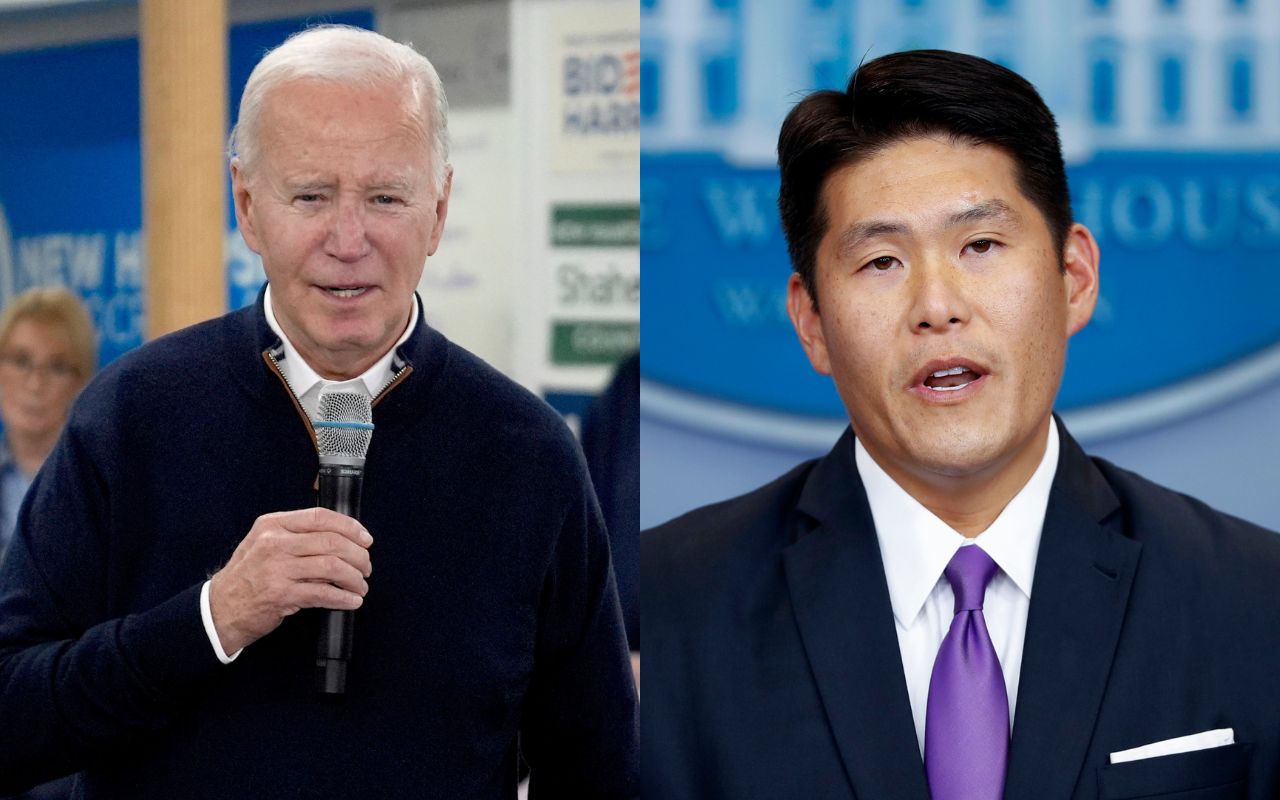
Former Special Counsel Robert Hur appeared before the House Judiciary Committee on Tuesday to discuss his explosive report on President Joe Biden’s improper retention of classified materials after the end of his tenure as vice president.
While Hur ultimately concluded that Biden’s actions did not warrant prosecution, one of his reasons for reaching that conclusion caught and has maintained the general public’s attention.
According to Hur, Biden would present to a jury as a “well-meaning, elderly man with a poor memory.” As evidence for this assertion, he relayed the fact that Biden could not recall when his son Beau Biden passed away or whether he was “still” vice president in 2009 (his first year on the job) or 2013 (the first year of his second term on the job).
Naturally, this inflamed already widespread concerns over the 81-year-old Biden’s mental acuity. And naturally, partisans on both sides of political aisle sought to use Hur’s testimony to their advantage.
For the Democrats and their allies in the media, this meant smearing Hur as a political operative and even outright lying about his work.
Rep. Adam Schiff (D-CA) upbraided Hur for using “pejorative” language to describe Biden.
“You could have written your report with his, with comments about his specific recollection as to documents or a set of documents. But you chose a general, pejorative reference to the president,” said Schiff, who insisted that it was a “political choice” meant to benefit Republicans.
As Hur went on to argue, embedded in Schiff’s charge is the assumption that it was incumbent upon the special counsel to “shape, sanitize, omit portions” of his “reasoning” for not charging Biden lest it have any political effect at all. This, submitted Hur, would have been the real political choice.
In another striking instance, Rep. Hank Johnson (D-GA) made a similar accusation of Hur, but took it one step further, stating that Hur was “doing everything you can do to get President Trump reelected so that you can get appointed as a federal judge or perhaps to another position in the Department of Justice.”
“Isn’t that correct?” he asked.
“Congressman, I have no such aspirations, I can assure you,” shot back Hur. “And I can tell you that partisan politics had no place whatsoever in my work. It had no place in the investigative steps that I took. It had no place in the decision that I made and it had no place in a single word of my report.”
Hur’s indignation was righteous. If he was “doing everything” he possibly could to secure an appointment in a future Trump administration, why would he have taken pains to compare Trump’s behavior unfavorably with Biden’s. Hur wrote in his report that Trump “not only refused to return the documents for many months” but “also obstructed justice by enlisting others to destroy evidence and then to lie about it.”
“In contrast,” he continued, “Mr. Biden turned in classified documents to the National Archives and the Department of Justice, consented to the search of multiple locations including his homes, sat for a voluntary interview. and in other ways cooperated with the investigation.”
There’s a reason some Republicans were also unfairly abrasive and even accusatory toward Hur during Tuesday’s forum.
Still, the most telling moment of the hearing came when Rep. Madeleine Dean (D-PA) gave Hur the “chance” to “correct the record.”
“Very sadly, your report on page 208 says that Mr. Biden couldn’t come up with the date, the year of his son Beau Biden’s death, when in fact, in the transcript, it shows that you asked him the month,” asserted Dean. “And do you know what he said, Mr. Hur? He said, ‘Oh, God. May 30th.’ Would you like to correct the record? His memory was pretty firm on the month and the day.”
When Hur pointed out that this description is not matched by the transcript — which unequivocally demonstrates that Biden asserted that his son was either “deployed” or “dying” in 2017 or 2018 despite the fact that he actually passed away in 2015 — and asked Dean to direct him to the page she was referring to, the congresswoman replied that she had “read about it in reporting.”
What a troubling, yet entirely unsurprising response.
Much of the media has played the part of accomplice in the effort to brush past concerns over Biden by smearing Hur.
Dean may have been referring to the “reporting” of CBS News’ senior White House correspondent Weijia Jiang, who spent the entirety of Tuesday falsely suggesting that Hur’s claim about Biden and Beau “was false.”
“The President was fired up about Hur’s claim that he couldn’t remember when his son Beau died… because it was false. He immediately said the date, according to the interview transcript,” insisted Jiang in direct contravention of the transcript.
Incredibly, CNN’s Anderson Cooper used his airtime later in the day to launder the falsehood being peddled by Dean and Jiang. “He remembered the day and the month, he was just sort of speaking out loud saying what year was that in a much more conversational way as opposed to sort of really stumbling over what year it was,” offered Cooper before actually touting Dean’s line of questioning.
“It’s a crucial distinction,” agreed The New Yorker‘s Evan Osnos, a Biden biographer and admirer who has been trotted out to lend the patina of “expertise” to Biden campaign talking points in recent days.
What he — like Jiang and Dean before him — didn’t do was actually refer to the relevant passage from the transcript, which reads:
BIDEN: Well, um … I, I, I, I, I don’t know. This is, what, 2017, 2018, that area?
HUR: Yes, sir.
BIDEN: Remember, in this time frame, my son is — either been deployed or is dying, and, and so it was — and by the way, there were still at lot of people at that time when I got out of the Senate that were encouraging me to run in this period, except the president. I’m not — and not a mean thing to say. He just thought that she had a better shot of winning the presidency than I did. And so I hadn’t, I hadn’t, at this point — even though I’m at Penn, I hadn’t walked away from the idea that I may run for office again. But if I ran again, I’de be running for president. And, and so what was happening, though — what month did Beau die? Oh, God, May 30-
WHITE HOUSE LAWYER RACHEL COTTON: 2015.
UNIDENTIFIED MALE SPEAKER: 2015.
BIDEN: Was it 2015 he had died?
UNIDENTIFIED MALE SPEAKER: It was May of 2015.
BIDEN: It was 2015.
MSNBC’s Katie Phang, meanwhile, narrated the hearing by observing that Hur was “conceding that on page 11 of his report, he set forth the difference between Biden and Trump.”
One must feel for Phang’s editors; that’s not what “conceding” means. It’s hardly a “concession” for Hur to acknowledge something that he not only chose to include in the report, but did so on page 11 of a 345-page report. Phang’s implicit and unproven assumption is that Hur is loath to credit Biden or take away from Trump. And the implicit argument that follows from that is that Hur is a partisan Republican actor. The irony of it all is that Hur’s actions as described by Phang actually refute her argument about his motivations
Other have pursued less sly strategies of character assassination. Phang’s colleague Joe Scarborough previewed the hearing by saying that Hur had “humiliated himself” and by coming up with the ill-founded conspiracy theory later echoed by Johnson.
All of this is part of a strategy to smear Hur in order to distract from the very serious concerns his report raises. If the president struggles to recall his tenure as vice president, it is indeed a wonder that he is asking the American people to extend his tenure as commander-in-chief.
Yet because addressing these concerns substantively is a heavier lift, Democrats have chosen to attempt to malign the messenger. To its shame, much of the Fourth Estate has been complicit in — rather than critical of — this dishonorable effort.
This is an opinion piece. The views expressed in this article are those of just the author.