
Trump’s Call to Hang Democrats Is Just Another Irresponsible Panic Move to Bury Bad News

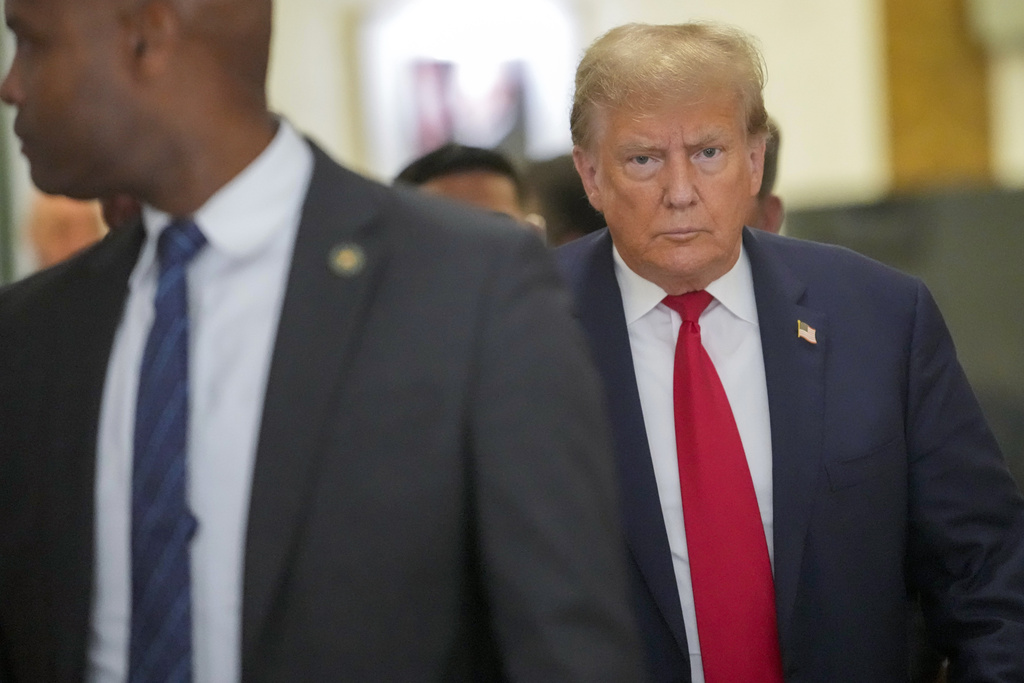
AP Photo/Mary Altaffer
On Thursday, President Donald Trump opened his Truth Social account and did what he almost always does when the narrative turns against him: he declared a group of Democratic members of Congress—combat veterans, no less—“seditious traitors.”
Trump wrote, “This is really bad, and Dangerous to our Country. Their words cannot be allowed to stand. SEDITIOUS BEHAVIOR FROM TRAITORS!!! LOCK THEM UP??? President DJT”
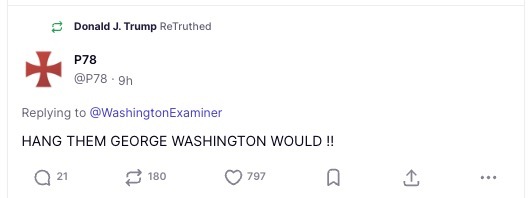
The apparent seditious offense? A short, civics-class video reminding U.S. military personnel of something they learn in basic training: troops must refuse unlawful orders. No insinuations, no subtext, no mention of him. The president also reposted a Truth Social user’s call to “HANG” these individuals, because, he said, it’s what George Washington would have done had he been faced with a digital video in the late 1700s.
But Trump treated it as an attempted coup because he needs something — anything — to drown out the storylines he could not control. And there are PLENTY to smother.
Inflation creeping upward. Markets stalling. A tranche of Epstein files—court documents he’d claimed were put to rest—bleeding into the news cycle again and reigniting suspicions he has long tried to scrub away. Polling that looks less like a glide path and more like a stall. A MAGA base showing cracks, with Marjorie Taylor Greene’s apostasy suggesting the possibility of more. The portrait is of a man hemmed in, hit from multiple angles, losing altitude and cohesion at the same time.
This is where the reflex kicks in. Within hours of the “seditious traitors” post, Trump unleashed the full battery: demands that Democrats be prosecuted, calls for a network to fire Jimmy Kimmel for mocking him, an AI video of himself having a kickabout with Cristiano Ronaldo in the Oval Office, and a random quote praising his own greatness. Jake Tapper captured it neatly in a tweet that read like a dispatch from inside the spinning machinery.
Each blast was its own small circus tent, pitched to redirect attention from the facts at hand. None of it had to be credible. It just had to be loud.
This isn’t extraordinary anymore, which is precisely the problem. What began as temperament has hardened into tactic. Trump’s eruptions are no longer expressions of rage; they are instruments he deploys with brutal consistency. He cannot fix the facts that imperil him, so he forces the press to rearrange the frame. And the press, conditioned by years of this choreography, still lunges toward the spectacle.
A Trump outburst carries the gravitational pull of a breaking story, complete with the panel debates and urgent chyrons that let newsrooms feel like they’re doing journalism rather than stenography. And lord knows I’m guilty of taking the very same bait myself.
Which is why this latest eruption shouldn’t be analyzed for its content so much as its timing. The insult is staging; the target is incidental. The real point is the pivot. Those lawmakers could have posted a video about how to check a parachute harness, and he would have transmuted it into treason if that’s what the narrative demanded. The key lies not in what he seized upon, but in what he needed to escape.
There is a moment when a pattern becomes too obvious to ignore, even if it’s been hiding in plain sight for years. Trump manufactures these emergencies because they work—not on the facts, but on the attention economy that now substitutes for civic memory. For as long as he has dominated American politics, he has relied on the same trick: turn every vulnerability into a brawl so noisy that the vulnerability dissolves. We treat each explosion as a fresh outrage when it is, in fact, just the latest iteration of a very old move.
The real work is not in ignoring him or policing his tone. It’s in watching the sequence instead of the spectacle. Because the next time Donald Trump fires off a blast like the one on November 20—and there will be a next time—the important question won’t be what he said or who he said it about. It will be what happened 24 to 48 hours earlier. That’s the real headline. And once you start looking there, the pattern becomes impossible to unsee—not because it stops working, but because you finally understand what it’s working on: you.
This is an opinion piece. The views expressed in this article are those of just the author.
New: The Mediaite One-Sheet "Newsletter of Newsletters"
Your daily summary and analysis of what the many, many media newsletters are saying and reporting. Subscribe now!








Comments
↓ Scroll down for comments ↓