Tucker Carlson’s 1999 Comments About Donald Trump Say A Lot About How We Got Here

Chip Somodevilla/Getty Images.
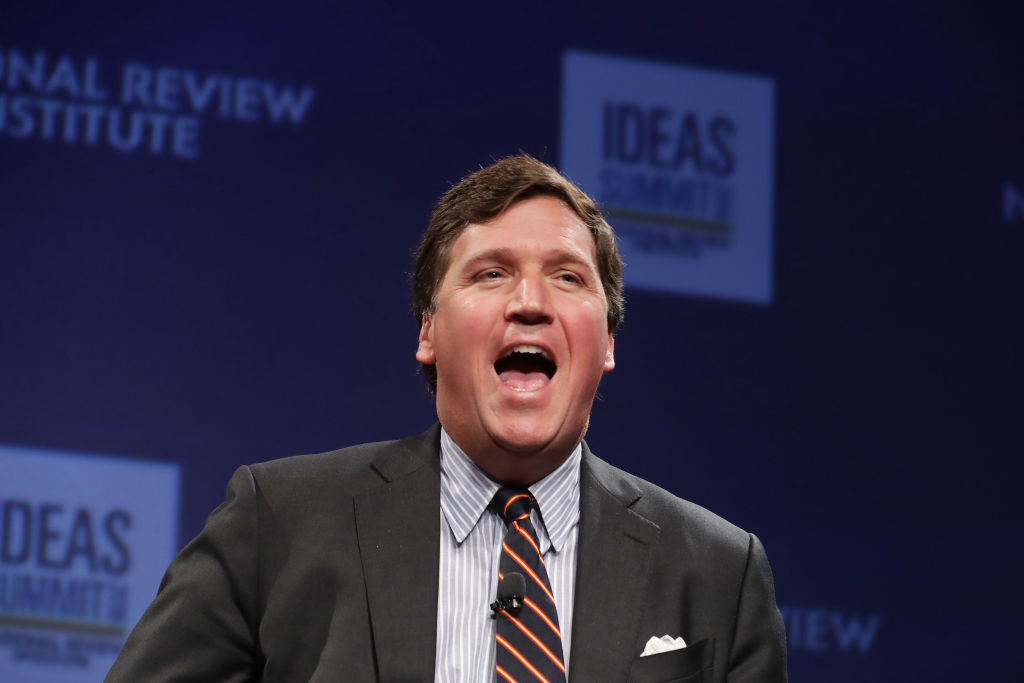
A Washington Post article calling Fox News host Tucker Carlson “the voice of White grievance” created a lot of buzz Wednesday, in no small part due to reporter Michael Kranish’s detailed research into Carlson’s past comments, including his harsh assessment of Donald Trump back in November 1999 as “the single most repulsive person on the planet.” But there is another sentence from that same Carlson quote that sheds light on how exactly we got to the point where a reality TV character with multiple bankruptcies could get elected president: Carlson acknowledging that while Trump was “horrible,” he was also “interesting.”
Carlson’s 1999 words, from an exchange with another writer at Slate published there as part of a running discussion, agreed with his fellow contributor that Trump was “the single most repulsive person on the planet,” and that quote made it into numerous headlines and tweets, chuckling over the oh-s0-obvious hypocrisy of Carlson being one of Trump’s most vocal cheerleaders on his popular Fox News program if he really thought so poorly of the real estate tycoon-turned-GOP figurehead.
Mediaite reached out to Fox News regarding the 1999 quote about Trump, and was pointed to a January 2016 article Carlson wrote for Politico, titled “Donald Trump is Shocking, Vulgar and Right.” Scolded the subhead: “And my dear fellow Republicans, he’s all your fault.”
Trump, wrote Carlson, was an “imperfect candidate,” but one whose candidacy could still be “instructive” for the GOP, as Republican voters rejected policies supported by conservative think tanks and evangelical Christians had “given up trying to elect one of their own” and simply wanted “a bodyguard, someone to shield them from mounting (and real) threats to their freedom of speech and worship.”
“In a country where almost everyone in public life lies reflexively,” Carlson opined, “it’s thrilling to hear someone say what he really thinks, even if you believe he’s wrong. It’s especially exciting when you suspect he’s right.”
Is Trump “thrilling”? The media certainly has treated him so. (I’ll acknowledge my own conflict on this, as I am spending time writing an article about what a cable news host said about Trump over two decades ago.)
Let’s look at the larger context of Carlson’s 1999 quote, as described by Kranish:
“You’ve said it all: He is the single most repulsive person on the planet. . . . That said, I still plan to write about him some time. I don’t think I’ll be able to help it. Horrible as he is (or perhaps because he is so horrible), Trump is interesting, or at least more so than most candidates.” Carlson wrote that Trump and the Reform Party reflected the fact “that ideology as a force in national elections is dead,” before correcting himself to say, “They’re just a bunch of wackos.”
Trump is indeed “repulsive” and “horrible,” but Carlson still planned to write about him because he was “interesting,” or at least more interesting than political candidates usually are. In fact, Carlson went so far as to frame it as possibly inevitable that he would write about Trump — and that was in 1999, when Trump was merely flirting with the idea of running as a third party candidate with the Reform Party, a group that Carlson dismissed as “a bunch of wackos” whose contribution to the national political discourse was to show that “ideology” was “dead.”
Trump as an official contender for the GOP presidential nomination certainly surpassed any level of “interesting” he may have achieved as a potential Reform Party candidate, and that argument became easier and easier to make as he steadily outlasted his Republican primary opponents.
But how much of that was a media creation, with Trump propped up by some of the very people who had met him personally and had direct knowledge and experiences to believe he would be a detriment to the country as president?
Jeff Zucker built the foundation of his media career with a lot of orange-tinted bricks, as countless profiles over the years have recounted. First, as the new head of NBC Entertainment, Zucker green-lit The Apprentice, the reality show that would convince millions of Americans that the guy who had turned a pile of inherited wealth into a series of bankruptcies, alleged fraud schemes, and failed products was actually a brilliant and savvy businessman.
The show was a stratospheric ratings boom for NBC, and paved the way for Zucker’s ascent to the head of NBC. When Trump rode down that Trump Tower escalator in June 2015 to launch his presidential campaign, Zucker had moved to the top spot at CNN, and he saw a guaranteed ratings bonanza in the new candidate.
“CNN seemed intent on giving Donald Trump as much help as possible for his presidential run,” wrote Washington Post media columnist Margaret Sullivan in February:
The network obsessively covered the candidate’s raucous speeches in the Republican presidential primary. It treated his campaign like entertainment, rather than a prelude to autocracy. It ran chyrons such as “Breaking News: Standing By for Trump to Speak” over footage of an empty stage and hired Trump loyalists such as Corey Lewandowski and Kayleigh McEnany as talking heads to boost his reputation.
Horrible… but interesting.
Zucker was far from alone in this treatment of Trump’s campaign.
“It may not be good for America, but it’s damn good for CBS,” said CBS chairman Leslie Moonves in February 2016, according to the Hollywood Reporter. “I’ve never seen anything like this, and this going to be a very good year for us. Sorry. It’s a terrible thing to say. But, bring it on, Donald. Keep going.”
“The money’s rolling in and this is fun,” said Moonves.
So, horrible… but interesting… and profitable?
Trump was already a celebrity when he tossed a red MAGA hat into the ring, with near universal name recognition. But celebrities have run for political office before without completely dominating the news cycle the way Trump did.
And dominate he did; multiple analyses of media coverage calculated that Trump didn’t just get more coverage than all of the other Republican candidates, he often got more than all of them combined. From the Washington Post in June 2016:
For example, Trump received 78 percent of all coverage on CNN between Aug. 24 and Sept. 4, 2015. He also dominated evening network news coverage in the first half of 2015, despite announcing his candidacy late in this period. By November 2015, Trump had received more evening network news coverage — 234 minutes — than the entire Democratic field. By contrast, Ted Cruz had received seven minutes.
The issue of Trump’s media supremacy is especially acute with regards to television airtime, which, unlike online coverage, is finite. There are only so many hours in a day, after all, and even 24-hour cable news could only devote a maximum of 1,440 daily minutes to Trump. None actually were that extreme in their coverage, even if it sometimes seemed like it, but with many Americans getting their news from evening television broadcast and cable news programs, the near-absence of the majority of the GOP primary field from those shows made the candidates all but invisible to the voters.
A July 2016 report from Harvard Kennedy School’s Shorenstein Center on Media, Politics and Public Policy observed that Trump didn’t just benefit from getting a larger share of the media coverage, but also from the focus on the “horse race” nature of the primary battle. “Overwhelmingly, election coverage was devoted to the question of winning and losing,” said the report, noting that such “competitive game” stories earned 56% of the total coverage of the GOP presidential primary. Stories about the “campaign process” (primary schedule, procedures and dates for debates, candidate appearances, etc.) got 33% of the coverage, and “substantive concerns” got only 11%.
It makes sense, especially with the benefit of 20/20 hindsight, to see how the focus on horse race topics over substantive issues would help Trump, whose bombastic speeches declared his opponents “losers” and proclaimed he would “Make America Great Again!” and “Build the Wall!” without the troublesome issue of explaining much about how.
“Ideology as a force in national elections is dead,” indeed. Former Gov. Jeb Bush (R-FL) and his policy papers never stood a chance.
Carlson’s critics often slam him as a hypocrite — the wealthy trust fund kid who rails against the “elites” and spreads anti-vaccine conspiracy theories when it’s highly likely he’s had a Covid-19 vaccine himself — but his 1999 quote about Trump wasn’t actually hypocritical. If anything, it was prophetic.
“The single most repulsive person on the planet,” Carlson wrote about Trump. He is “horrible.” One of a “bunch of wackos.” But he’s also “interesting” and proof that “ideology as a force in national elections is dead.”
Trump is “shocking, vulgar, and right,” claimed the headline of Carlson’s 2016 Politico article. Regarding the former president, the same could be said for Carlson himself.
This is an opinion piece. The views expressed in this article are those of just the author.
New: The Mediaite One-Sheet "Newsletter of Newsletters"
Your daily summary and analysis of what the many, many media newsletters are saying and reporting. Subscribe now!






Comments
↓ Scroll down for comments ↓