
Congress Sets Records in 2025 for Longest Shutdown, Fewest Bills, Retirements

Photo by Bryan Dozier/NurPhoto via AP
The 119th Congress made history in numerous ways, including the longest government shutdown in U.S. history, the fewest bills passed, and a growing number of retirements.
This year’s Republican-majority Congress set several records — “some more dubious than others,” wrote Washington Post senior congressional columnist Paul Kane.
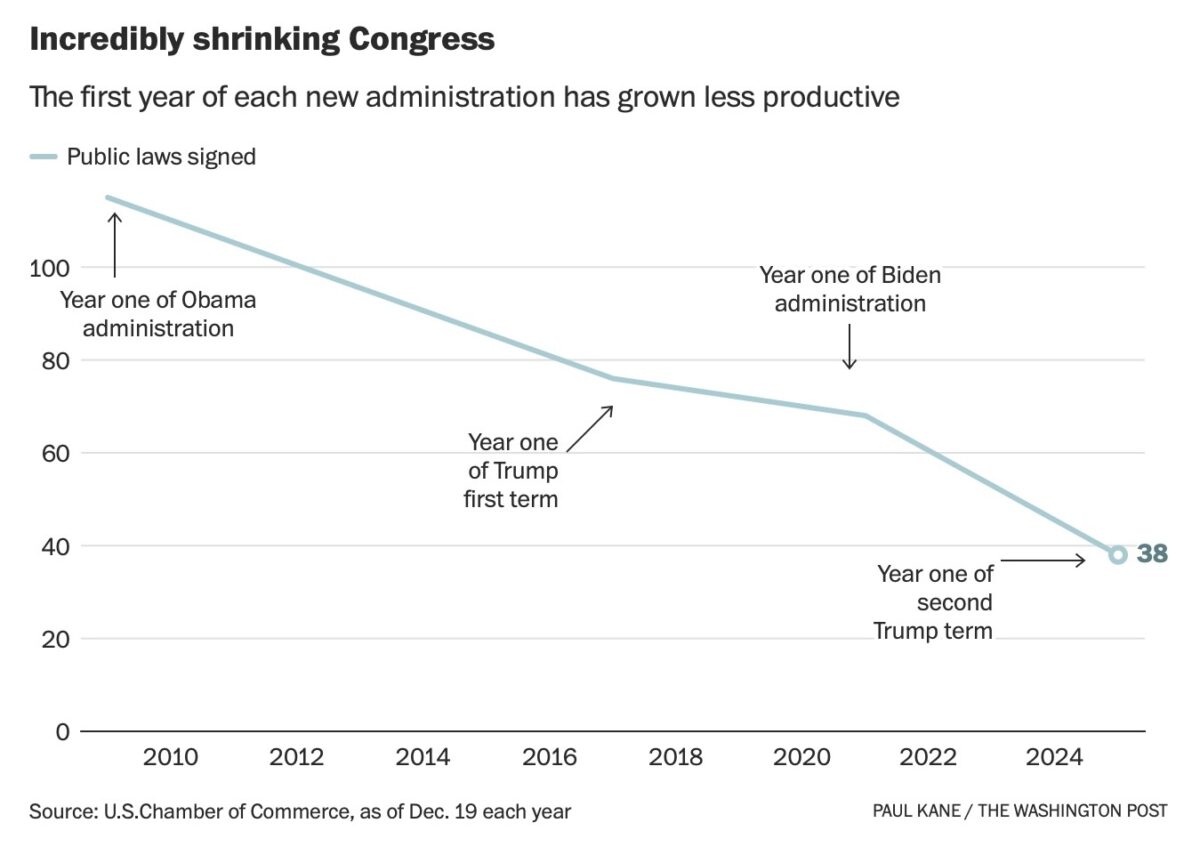
There were only 38 bills passed by this Congress (as of Monday, Dec. 22), Kane found from a review of C-SPAN archives and data compiled by Purdue University, which “set a modern record for lowest legislative output in the first year of a new presidency.”
Screenshot via The Washington Post.
A contributing factor to this “lack of productivity” was President Donald Trump’s increasing use of executive orders, often controversial and subject to multiple court challenges. So far in his second term, Trump has signed 224 executive orders, compared to the 52 he signed in 2017 and more than he did during his entire first term. President Joe Biden signed 76 in 2021, his first year in office. Trump has currently signed more than 70 percent of the all the executive orders that Biden and President Barack Obama signed during their cumulative 12 years in office.
The House set a record for fewest votes cast during a first year of a two-year congressional session for the entire 21 century thus far. The 362 votes they did cast were “barely half as many votes as in 2017, which was Trump’s first year in office” and another year when the GOP had majority control.
Kane noted that this was probably related to the “unusually large number of House members” who “have decided to leave the chamber either to retire or run for other office,” putting the House on pace to set a 21st-century record for retirements in one Congress.
So far, 24 Republicans and 19 Democrats are heading for the exit door, including Speaker Emerita Nancy Pelosi (D-CA) and and Rep. Marjorie Taylor Greene (R-GA) who are retiring, Reps. Harriet Hageman (R-WY) and Jasmine Crockett (D-TX) who are running for the U.S. Senate, and Reps. Eric Swalwell (D-CA) and Nancy Mace (R-SC) who are running for governor in their states. Rep. Elise Stefanik (R-NY) was running for New York governor but recently announced she was dropping out of the race and retiring from Congress as well, a remarkable fall after she gave up her leadership position when Trump nominated her as U.S. Ambassador to the United Nations but then her nomination was withdrawn amid concerns about defending the GOP’s razor-thin majority.
Kane interviewed several members of Congress and found that the Republicans gave a “mixed verdict” for their year in the majority, some calling it “a wasted year that didn’t meet the hype beyond that one piece of legislation [the “One Big Beautiful Bill” Act],” he wrote:
“I guess we got the big, beautiful bill done,” Ohio Rep. David Joyce said. The 13-year veteran from the party’s establishment wing paused for five seconds thinking about 2025.
“Other than that,” Joyce finally said, “I really can’t point to much that we got accomplished.”
The 43-day government shutdown was the longest in U.S. history, wrote Kane, and the issue of the expiring Obamacare tax credits is still unresolved and looming over Congress’ work next year — and dividing Republicans, with multiple moderate members allying with Democrats.
A lot of the data, wrote Kane, “paint a picture of a Congress that is steadily doing less legislative work and ceding greater powers to presidents.”
“All the numbers that should be going up, in a healthy and productive balance between Congress and the president, are instead going down,” he continued. “And the numbers that should be falling are instead on the rise.”
Meanwhile, the national debt is $38.5 trillion and counting.
New: The Mediaite One-Sheet "Newsletter of Newsletters"
Your daily summary and analysis of what the many, many media newsletters are saying and reporting. Subscribe now!









Comments
↓ Scroll down for comments ↓