Social Media & Religion: Even The Pope’s Online!

 Similarly Rev. Schenck believes that connectivity is at the core of his faith. He uses his blog, Clergy Family Confidential, his Twitter profile (@FatherTim) and other social media tools to “extend the pulpit, as it were, by reaching out to a much broader audience than I can reach on Sunday mornings.” Just like other smart thought leaders – whether religious, secular, political or business – Rev. Schenck can use these tools to connect with people all over the world.
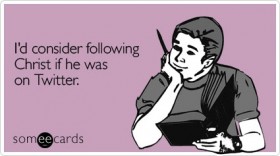
“As a Christian,” he says, “I believe that connectivity is at the core of my faith – Jesus called disciples into community after all. And there’s no reason to think He wouldn’t Facebook or Twitter if he came in to the world 2,000 years later. Imagine the killer status updates: “Jesus is changing water into wine – the good stuff” or “Jesus is cranking out more parables.”
Relationships are an underlying theme in religion, and religious leaders have picked up on that theme in relation to social media. Rev. Scott Stiegemeye, Director of Admission at Concordia Theological Seminary, told me, “Our aim is to connect people with their Creator and with one another. Today’s social media gives us amazing new ways to accomplish that goal.”
Rand Jenkins, Communications Director of the Baptist General Convention of Texas is using social media to not only connect with congregants, but to stay true to Christianity’s missionary doctrine.
“As an organization, we are in the midst of Texas Hope 2010, an initiative to share the Christian message with every Texan by Easter 2010,” Jenkins explains. “Part of that effort is to place Scripture in every Texas home. A monumental task such as this requires the involvement of thousands of people.”
Texas Hope 2010 has been using Facebook and Twitter to engage and encourage people in this monumental effort. By using these tools, Jenkins says, he has been able to cultivate new relationships with people, connect individuals with ministry opportunities and encourage those who already are plugged into Texas Hope 2010.
“There’s no reason to think [Jesus] wouldn’t Facebook or Twitter…Imagine the killer status updates: ‘Jesus is changing water into wine – the good stuff’ or ‘Jesus is cranking out more parables.’”
Social media has also been used on the business-side of religion. Carlos Hernandez, president of the San Francisco chapter of the Catholic Professional Business Club, enjoys using social media to connect with others in the community, whether through LinkedIn, Facebook or Twitter. He has also started using Eventbrite to coordinate church-related events. Hernandez says that Eventbrite “brings online organizing to a new level because it lets me post updates to LinkedIn, Facebook and Twitter automatically. I believe in the adage of meeting people where they are at, and many are gathering at these sites.”
While social media is on the rise in the religious world (there are churches that want you to Tweet during services!), there are still some areas where social media may not be useful to religion.
For example, take Alexandra Chauran, High Priestess of British Traditional Wicca, Kingstone path. She told me that, “… for an experiential religion like mine, it is a poor substitute!” Many clergy that I spoke with echoed this sentiment, but more along the lines that while social media is great for connecting and spreading the Gospel or Talmud, it still cannot supplant the human, face-to-face communication that is the clergy’s role. Social media cannot help a grieving husband who has lost a wife to cancer in the same way that a Rabbi can.
We have seen, however, how social media can help in a community crisis. Recently, at Ebenezer Church, a non-denominational church in Austin, Texas, a congregation was able to use social media – specifically Twitter – to communicate urgent needs in the wake of a fire that burned 58 homes. As photographer Steven Bush wrote on his blog:
A 4-alarm fire struck a complex in the low-income neighborhood of St. John. it took over 100 firefighters, 1/3 of Austin’s force, to fight the fire. many people, including a 8th month pregnant women & some kids, were forced to jump down two floors from their balconies to escape the flames. there are almost 100 (quite possibly more) people that have lost everything. 85 men, women, & children are staying in one shelter that I know of, and many others have gone to stay with other family.
it was a devastating fire that has caused some extreme needs. it has been AMAZING to see the response from people at The Austin Stone and surrounding churches to come and help these people who have experienced such great loss. So many people have brought so much stuff to help out! I was our volunteer point person tonight at Ebenezer Church, a local Hispanic church, in the neighborhood, and it was amazing to see how many people showed up to help. They came by the truckload with things like food, clothing, baby supplies, diapers. I asked them how they heard about the fire & the needs, and they said Twitter & Facebook. Every single one of them…said Twitter & Facebook. Unbelievable!
As more religious institutions start moving into the social sphere, the possibilities on how to reach an audience will be endless. And it’s already starting. On Good Friday 2009 from the hours of 12pm to 3pm, Jesus really did tweet. Or, more specifically, the Trinity Church on Wall Street in New York City tweeted the story of Christ’s final hours in what could be the first time liturgy was tweeted. (There’s an @Jesus_Christ on Twitter, but I’m guessing he’s no one’s Lord & Saviour).
There is evidence other religions outside the Judeo/Christian mold are incorporating social media into their own congregations, but unfortunately for this piece, requests to speak with Muslim and Buddhist clerics went unanswered.
However, it appears there is a growing discussion in the social sphere – particularly on Facebook – about how social media can dispel myths and characterizations of minority religions. For example, there is a Facebook group called I’ m a Muslim and I’m Proud with close to 700,000 members who discuss topics such as Muslim law and Muslim perception around the world
There are also countless blogs from Hindu and Buddhist members, which are broader in scope as opposed to a specific congregation.
As social media becomes its own Institution, we will see the Institution of religion embrace new conduits of perpetuating particular faiths; from rites and rituals to customs and culture, social media will play a large part in religion in the coming years.
Social media and religion, two seemingly polar opposites, are actually perfect for each other.
Josh Sternberg is the owner/founder of Sternberg Strategic Communications, a firm that merges traditional and digital approaches to help clients get their messages to the right audiences. He also sits on an advisory board for Break The Cycle, a non-profit helps youth communities free from domestic violence. Josh has honed his professional communications skills at a couple of NYC firms. Follow him on Twitter at @josh_sternberg.
Pages: 1 2
This is an opinion piece. The views expressed in this article are those of just the author.