
Washington Post‘s Dana Milbank: ‘If There Is A Republican Establishment, The Tea Party Is It’

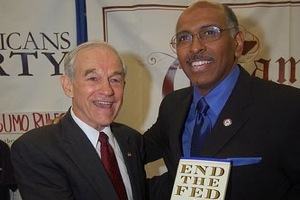 The accumulation of primary victories by Tea Party-backed candidates has frazzled many in the media– what will an anti-incumbency movement look like when its leaders are all incumbents?– but not all of them are taking the bait. In fact, Washington Post‘s Dana Milbank contends that the marriage between the GOP and the Tea Party is going swimmingly.
In his weekly column today, Milbank details a visit to RNC headquarters, where he ventured to find the state of the “Republican establishment” to be a slightly more comfortable affair that the shambles he expected to find after listening to the media. In fact, he found a promotion for the book Young Guns, on, among others, the party’s vigorous septuagenarians and their youthful ideas. He notes that one of the authors ecstatically told the press the book was “the No. 1 political book on Kindle! It’s 26th overall on Amazon!” At the very least, the RNC was not dying commercially, he argues.
But the crux of his piece has little to do with book sales and much to do with the harmony of ideals he finds between established Republican leaders and the Tea Party. Yes, Karl Rove and Sarah Palin have butted heads. Yes, the party appeared to collectively hold its breath for a few months in May when Rand Paul decided he would make the 1964 Civil Rights Act a major player in the news cycle. But, Milbank argues, no one with power in the GOP has broken ranks with the Tea Party movement as a whole. He notes that RNC Chairman Michael Steele and figures like House minority leader John Boehner have heaped praise upon the movement and asserted that, were they not in positions of authority already, they would be seeking further involvement with the Tea Party. And as for Rove, “after [Christine] O’Donnell‘s victory, George W. Bush‘s “brain” declared on Fox News that ‘this is not a race we’re going to be able to win,’ citing the ‘nutty things’ she has said. (The nominee has claimed, among other things, that there are mice with human brains.) But after hearing complaints from Tea Party types such as Sarah Palin, Rove returned to Fox News to say that O’Donnell is ‘not out of the game’ and that he was ‘one of the first’ to endorse her.”
The evidence, Milbank concludes, points to a union between the two where the Republicans both support and attempt to control the Tea Party, such that there is little ideological dispute. He does leave open-ended whether there is too little wiggle room out at the front of the movement and whether that may cause friction between the two. Instead, he offers: “The Republican establishment of popular imagination, like the Georgetown salon, no longer exists. If there is a Republican establishment, the Tea Party is it… [GOP Party leaders are] stepping out in front of the Tea Party parade and pretending to be drum majors.”
In the media disarray that emerged as a result of this year’s series of Tea Party victories, to think of the Tea Party and the GOP as essentially the same thing takes much of the excitement out of the game. On the other hand, that the Democrats will have to contend with unified ranks of conservatives and the small-government conservatives and/or libertarians that claim the Tea Party mantle (that’s enough of a power struggle in itself) may be something the left has to worry about significantly more than the right.
New: The Mediaite One-Sheet "Newsletter of Newsletters"
Your daily summary and analysis of what the many, many media newsletters are saying and reporting. Subscribe now!











Comments
↓ Scroll down for comments ↓