This Weekend’s Times Magazine Cover Story Cost $400,000 (They Didn’t Pay For It)

Investigative reporting is often trotted out in defense of newspapers — without their newsrooms, who will go about the expensive and important work of digging up stories that don’t fall into reporters’ laps?
But with plummeting ad sales and shrinking newsrooms (not to mention print space), newspapers are not the bastions of investigative reportage that they once were, except in the minds of nostalgic mainstream media diehards. The good news, however, is that old-school outlets like the Times are fostering mutually beneficial relationships with independent, non-profit investigative teams — like Pro Publica.
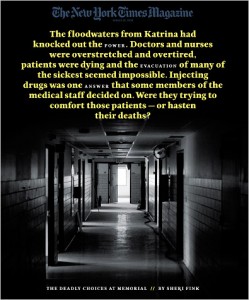
Exhibit A: This weekend’s New York Times Magazine cover story about the horror at Memorial Medical Center in Uptown New Orleans by Sheri Fink.
Gerald Marzorati, assistant managing editor and editor of the Times Magazine, estimated in a “Talk to the Times” feature that the story cost nearly $400,000 to produce — between years of reporting and lawyering and a year of editing. But the Times received it for free from Pro Publica, where Fink works now. Fink also worked on the story as a fellow for the Kaiser Family Foundation and as a freelancer.
Though the various foundations may have picked up the tab for the reporting, the story still cost the Times money to edit and print, of course. The Times has printed four Pro Publica stories before, but this is the first to appear in the magazine, according to Editor and Publisher. And why not? The Times exists to publish all the news that’s fit to print — we’re all in trouble if that only includes the cheap news. Investigative reporting is expensive work…and it’s not like the Times has extra cash to kick around these days. Seems like joining forces with upstart non-profits like Pro Publica is a perfect solution — and the product is magnificent.
Fink carefully unwraps the scene at Memorial Medical Center in Uptown New Orleans before, during and after Hurricane Katrina in 2005. The reporter, an M.D. herself, explores the desperation and exhaustion that led doctors at the hospital to inject some patients with drugs to hasten their death and turn away others who could have been helped.
The 13,000-word story oscillates between the gruesome and the terrifying. From the New York Times and Pro Publica:
By Wednesday afternoon, Dr. Ewing Cook was physically and mentally exhausted, filthy and forlorn. A 61-year-old pulmonary specialist, he’d had his semi-automatic Beretta strapped to him since he heard on Monday that a nurse was raped while walking her dog near the hospital (a hospital official denies that this happened). Cook had had two heart attacks and could not help transport patients in the heat.
That afternoon, Cook stood on the emergency-room ramp and caught sight of a mattress floating up Napoleon Avenue. On it lay an emaciated black woman, with several young men propelling her through the fetid water. “The hospital is closed,” someone shouted. “We’re not accepting anybody.”
…
Isbell searched for Robichaux, her boss. “What is going on?” she asked, frantic. “Are they going to do something to our patients?”
“Yes, they are,” Isbell remembers Robichaux, in tears, saying. “Our patients aren’t going to be evacuated. They aren’t going to leave.” As the LifeCare administrators cleared the floor of all but a few senior staff members, Robichaux sent Isbell to the back staircase to make sure nobody re-entered. It was quiet there, and Isbell sat alone, drained and upset. Isbell said she thought about her patients, remembering with guilt a promise she made to the daughter of one of her favorites, Alice Hutzler, a 90-year-old woman who came to LifeCare for treatment of bedsores and pneumonia. Isbell fondly called her Miss Alice and had told Hutzler’s daughter that she would take good care of her mother. Now Isbell prayed that help would come before Hutzler and her other patients died.
The Nieman Lab followed up with Marzorati, who clarified that $400,000 is the amount that it would have cost if the story were executed entirely by Times staffers. Man, those were the days.
Fink discusses her reportage with Bruce Shapiro, executive director of the Dart Center for Journalism and Trauma at the Columbia University Graduate School of Journalism:
New: The Mediaite One-Sheet "Newsletter of Newsletters"
Your daily summary and analysis of what the many, many media newsletters are saying and reporting. Subscribe now!







Comments
↓ Scroll down for comments ↓