
Judge Imposes New Restrictions on Stewart Rhodes, Oath Keepers With Commuted Sentences: Can’t Enter D.C. or Capitol


AP Photo/Susan Walsh, File
A federal judge imposed new release conditions on Oath Keepers founder Stewart Rhodes and other members of the far-right group whose seditious conspiracy sentences from the Jan. 6, 2021 Capitol riot were commuted by President Donald Trump, restricting them from visiting Washington, D.C. or the U.S. Capitol without permission from the court.
Within hours of his inauguration Monday, Trump signed off on orders to pardon approximately 1,500 people, commute the sentences of fourteen more, and direct the Department of Justice to dismiss with prejudice (meaning the cases cannot legally be re-filed) any remaining indictments. The 47th president’s broad grant of freedom applied to nearly all the Capitol rioters, even those charged with or convicted of violently assaulting police officers and the ringleaders of the attack like Proud Boys leader Enrique Tarrio and Rhodes, who walked free early from his 18-year sentence.
The sudden release of hundreds of rioters who had been charged or convicted of felonies for violently assaulting law enforcement officers has raised concerns about potential future acts of violence. At least one freed rioter has already been re-arrested, a Florida man indicted for assaulting police officers and setting off an explosive device during the riot, but that was for a previous federal gun crime. The rhetoric coming from Tarrio, Rhodes, and other newly-freed rioters expressing a lack of remorse and a desire for “retribution” has intensified worries about what they may do next.
On Wednesday, Rhodes was photographed in a food court area of the Longworth House Office Building. The Hill’s Emily Brooks reported that he was there to meet with Rep. Gus Bilrakis (R-FL) to advocate for the release of another Oath Keeper member, Jeremy Brown, who was not included in Trump’s pardons and commutations and remains in prison on federal weapons charges.
Rhodes also chatted with reporters during his Capitol visit. As Politico’s senior legal affairs reporter Kyle Cheney noted, Rhodes’ visit shocked Democratic lawmakers who watched as he “strode nonchalantly into the Capitol complex, took a seat in a Dunkin’ Donuts and held court with reporters in the same building he gleefully watched under attack.” A Jan. 10, 2021 comment by Rhodes that was recorded and played at his trial has been making the rounds this week as well, highlighted by critics of Trump’s release of the rioters:
“My only regret is they should have brought rifles,” said Rhodes. “We should have brought rifles. We could have fixed it right then and there. I’d hang fucking [then-Speaker Nancy] Pelosi from the lamppost.”
Since Rhodes’ release, he has been pushing for Trump to grant him a full pardon instead of just commuting his sentence; the commutation ended his prison sentence but he is still a convicted felon and under multiple legal restrictions.
Those legal restrictions on Rhodes may mean that Wednesday is his last congressional confab for a while.
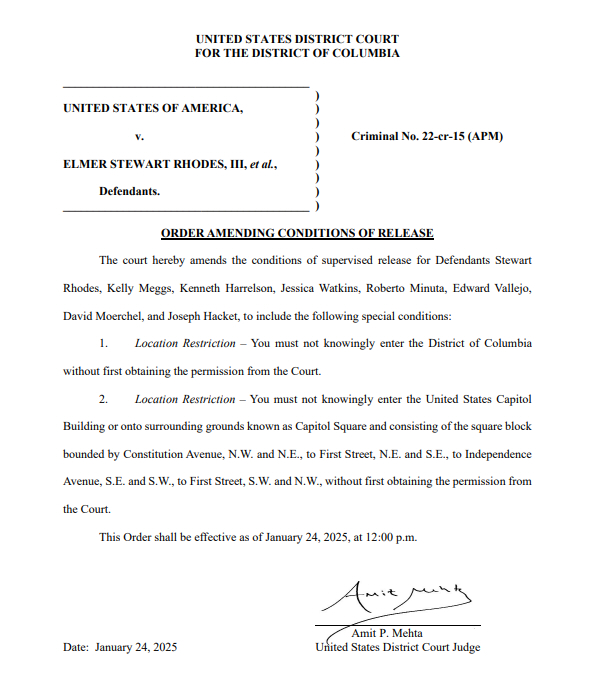
On Friday, U.S. District Court Judge for the District of Columbia Amit Mehta issued an Order Amending Conditions for Release that affected Rhodes and other Oath Keepers whose sentences were commuted, in what “appeared to be a response to Rhodes’ decision to hold court in the Capitol Wednesday,” Cheney reported.
The order amended the conditions of supervised release for Rhodes, Kelly Meggs, Kenneth Harrelson, Jessica Watkins, Roberto Minuta, Edward Vallejo, David Moerchel, and Joseph Hacket with two new “location restrictions.”
The first restriction mandated that these people “must not knowingly enter the District of Columbia without first obtaining the permission from the Court,” and the second covered the U.S. Capitol complex, including the Capitol building itself and the “surrounding grounds known as Capitol Square and consisting of the square block bounded by Constitution Avenue, N.W. and N.E., to First Street, N.E. and S.E., to Independence Avenue, S.E. and S.W., to First Street, S.W. and N.W.” –again “without first obtaining the permission from the Court.”
Read the order below:
—







Comments
↓ Scroll down for comments ↓