
‘A Conspiracy Theorist for a Decade’: Trump’s Chief of Staff Gets Stunningly Candid in Blockbuster Vanity Fair Exposé

(AP Photo/Evan Vucci)
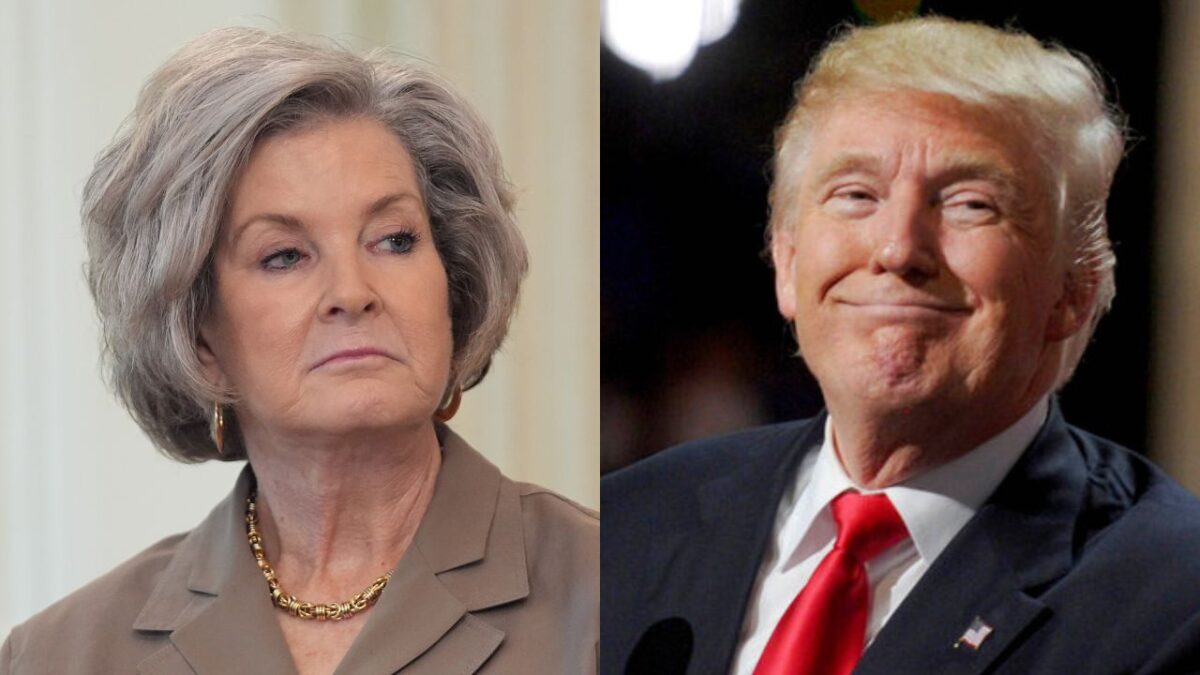
President Donald Trump’s chief of staff Susie Wiles offered a remarkably candid window into a presidency she described, repeatedly, as driven by impulse and a widening view of executive power, in a blockbuster Vanity Fair portrait built around months of exclusive on-the-record conversations.
Wiles may be the most powerful figure in Trump’s West Wing besides Trump himself, but her role is exercised less as a brake than as a gearbox, translating the president’s instinct into policy, and urging everyone else to fall into line.
“I’m not an enabler. I’m also not a bitch,” Wiles said. “I guess time will tell whether I’ve been effective.”
Throughout the two-part article, Wiles was unusually free with labels for the people closest to Trump. Vice President JD Vance’s political transformation from calling Trump “Hitler” to becoming his partner, she said, has been “sort of political,” as she jibed he’s been “a conspiracy theorist for a decade.”
Office of Management and Budget director Russell Vought, Project 2025 co-author and architect behind many civil service cuts, was branded “a right-wing absolute zealot.” Former First Buddy Elon Musk, she said, was “a complete solo actor” and an “avowed ketamine” user, an “odd duck” whose early scorched-earth DOGE cuts to USAID she admitted left her “aghast.” Meanwhile, Health Secretary Robert F. Kennedy Jr. was hit with “quirky Bobby,” although she defended his changes to Health and Human Services. Having been instrumental to their selection, however, she complimented the team as “a world-class Cabinet, better than anything I could have conceived of.”
The president himself was not spared the pointed analysis either.
Wiles told Vanity Fair she sees Trump through the lens of her father, the late Pat Summerall, whom she described as an absentee parent and an alcoholic. She said that experience left her “a little bit of an expert in big personalities.”
Her verdict was that Trump “has an alcoholic’s personality.” She explained that she does not mean substance abuse, but a temperament defined by exaggerated confidence and risk-taking. Trump, she said, “operates [with] a view that there’s nothing he can’t do. Nothing, zero, nothing.”
The article frames her comments against major policy efforts, which lays out a second-term sequence that often begins with brief internal dissent to Trump’s broad edicts, then total institutional alignment.
She admitted that DOGE’s wrecking ball approach to USAID, shutting the agency down first before dismantling programs, was her first crisis and that despite Trump’s order to spare some essential programs, Musk pushed forward. She clashed with Musk on the issue, she said, but admitted when it came to implementation, the president was unaware of the cleanup.
“The president doesn’t know and never will,” she said. “He doesn’t know the details of these smallish agencies.”
Perhaps the sharpest example of Wiles’s limits is a recounting of the administration’s approach to January 6. On day one, Trump issued pardons to almost everyone convicted over the Capitol attack, including violent offenders. Wiles told Vanity Fair that she raised objections at the time, asking whether Trump really wanted to pardon them all.
“I did exactly that,” Wiles replied. “I said, ‘I am on board with the people that were happenstancers or didn’t do anything violent. And we certainly know what everybody did because the FBI has done such an incredible job.’ ”
But Wiles told the outlet Trump insisted the offenders had been treated unfairly and she ultimately moved with him and “sort of got on board.”
“There have been a couple of times where I’ve been outvoted,” Wiles said, equal parts shrug and confession. “And if there’s a tie, he wins.”
Likewise, on tariffs, she described “huge disagreement” internally before insisting the team fall in line with Trump’s instincts.
Of the rollout, she mused it was all a form of “thinking out loud” before explaining how she told staff to get behind it.
“I said, ‘This is where we’re going to end up. So figure out how you can work into what he’s already thinking.’ Well, they couldn’t get there.”
“It’s been more painful than I expected,” Wiles relayed.
On immigration, Wiles admitted process failures – “I will concede that we’ve got to look harder at our process for deportation” – and urged caution: “But if there is a question, I think our process has to lean toward a double-check.”
Yet she was also unable to explain high-profile cases that Vanity Fair’s Chris Whipple confronted her on, including U.S. citizen children deported with their mothers, including one small child with cancer.
“It could be an overzealous Border Patrol agent, I don’t know,” she said. “I can’t understand how you make that mistake, but somebody did.”
Throughout the piece in conversation with Vanity Fair, Wiles lays out a second term governed by a president following instincts then enforced by loyalists where the consequences are absorbed by institutions and above all by her, the woman trying to “facilitate his vision” while insisting she’s not there to enable it.
Hours after publishing on Tuesday Wiles responded to Vanity Fair’s article. While she did not deny any of the quotes attributed to her, she lashed out via X, arguing the articles was “a disingenuously framed hit piece” designed to make the administration look bad in which “significant context was disregarded.”
White House Press Secretary Karoline Leavitt and members of the cabinet, including Vance and Vought, have also posted in her defense.
New: The Mediaite One-Sheet "Newsletter of Newsletters"
Your daily summary and analysis of what the many, many media newsletters are saying and reporting. Subscribe now!




Comments
↓ Scroll down for comments ↓