
Al Jazeera Staffers ‘Frustrated’ By Lack of Support From News Organizations After Israeli Strike on Gaza Tower

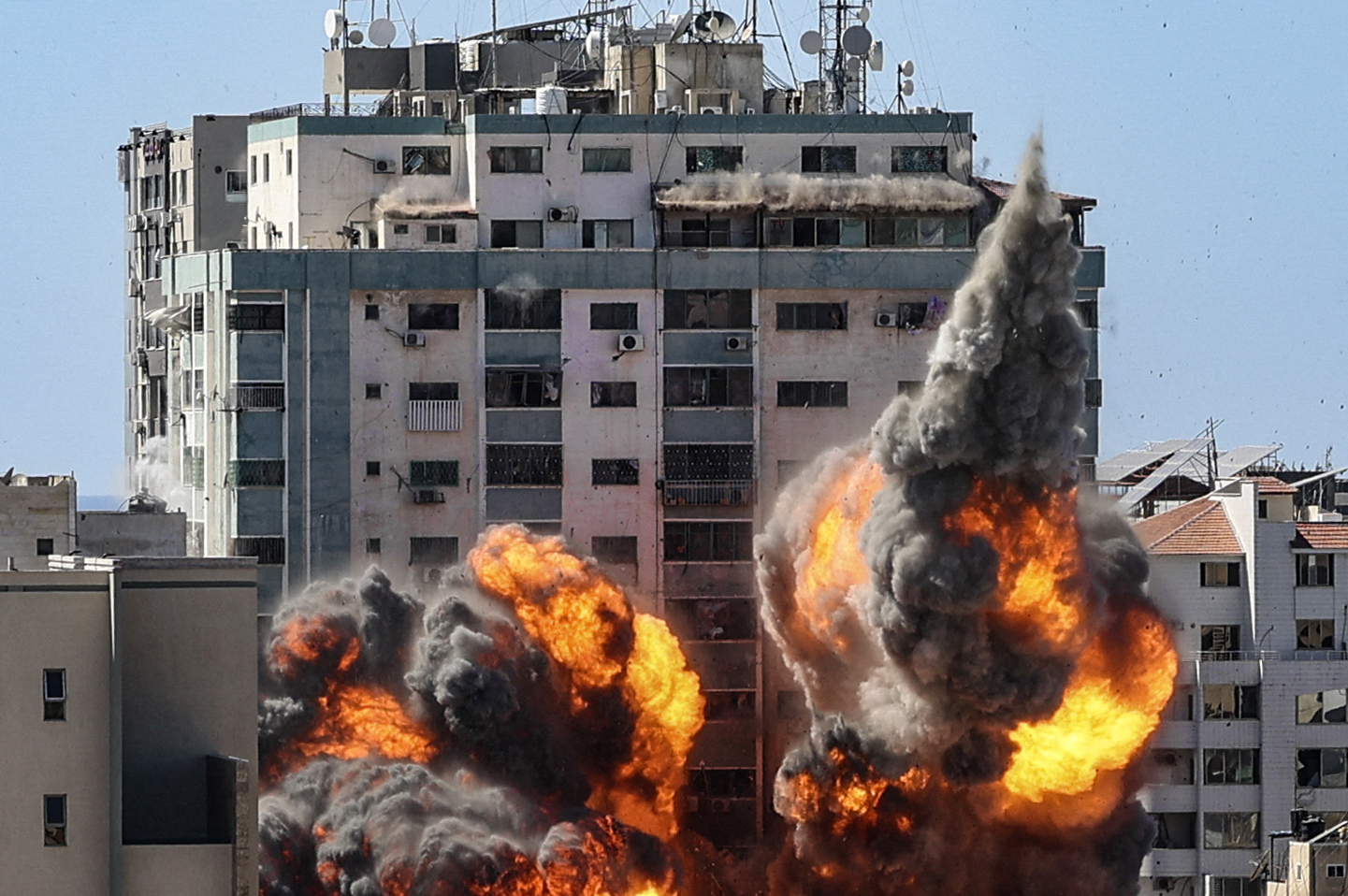
Mahmud Hams/Getty Images
Journalists at Al Jazeera and elsewhere are disappointed in a lack of solidarity from media organizations following Saturday’s targeted strike by Israel on a building in Gaza that housed multiple international media organizations, including Al Jazeera and the Associated Press.
While some news organizations and advocacy groups have issued statements questioning, or even criticizing, the strike, others with wide-ranging national and international audiences have not.
“Of course there should be more solidarity from other media organizations, and beyond solidarity, there should be outrage,” one American journalist with an international outlet told Mediaite. “This could have been the bureau of any of the news outlets that have since been silent.”
“Attacking journalists is a war crime,” the journalist added. “Israel claimed Hamas operated in that building without providing so much as a shred of evidence. They should also be condemning the fact that Israel is barring international media from entering Gaza.”
The Israeli military has said that the strike was justified because Hamas was operating in the building, and gave the news organizations about one hour to evacuate. No one was killed in the strike.
Israel has yet to release evidence publicly supporting the claim of a Hamas presence. Israeli Ambassador Gilad Erdan said media outlets likely did not know Hamas was operating in the building because it housed a “secret unit.”
The Associated Press and Al Jazeera were quick to issue statements about the destruction of their respective bureau offices in Gaza, but since Saturday, there have not been widespread expressions of solidarity with the media organizations with offices in the al-Jalaa tower. News organizations including MSNBC, Fox News, CNN, NBC News, ABC News, and CBS News either did not respond to Mediaite’s requests as to whether a statement was forthcoming, or did not have a statement to provide. A Washington Post spokesperson told Mediaite that the paper had “nothing to share at this time.”
To some journalists, the silence from other news organizations has been deafening.
“For me and many other journalists here, the lack of solidarity coming from journalists is frustrating,” said one Al Jazeera staffer. “I haven’t seen any news unions or high-profile journalists on Twitter making statements of solidarity. We saw weeks of outrage from journalists when Jamal Khashoggi was brutally murdered by the Saudi government, so I don’t understand what’s stopping journalists from being in solidarity with other journalists as well.”
Many media organizations and journalists condemned the murder of Saudi journalist and Washington Post contributing columnist Jamal Khashoggi, who was killed while inside the Saudi consulate in Istanbul in October 2018. Several media companies and journalists withdrew from a high-profile Saudi media and business conference, and many journalists decried Khashoggi’s disappearance and murder.
One Al Jazeera journalist said that the relative silence from major media organizations since the Gaza tower strike isn’t particularly surprising.
“I’ve become embarrassed by much of the Western coverage of the Israeli attacks,” the Al Jazeera staffer told Mediaite, arguing that news media fails to accurately describe the violence in the region, and underplays Israel’s culpability. “I’m not surprised that this problematic industry is silent when Israel targets and attacks our brave colleagues in Gaza.”
Some Al Jazeera insiders cited comments from CNN’s Brian Stelter, who asked “what were the Israelis supposed to do?” if Israel had good intelligence that Hamas was operating in the building, as one example of indifference toward media organizations reporting from inside Gaza, although it should be noted that Stelter also pressed the IDF to share its evidence of such intelligence. They also pointed to Newsweek’s Josh Hammer questioning why the AP was in Gaza at all, sentiments echoed by Sen. Tom Cotton (R-AR).
“Attacks on media organizations are war crimes, and ignorant comments like this put us all at risk,” an Al Jazeera staffer added. “Speak out, shut it down, or out-of-control armies will think it’s OK to silence us whenever things become uncomfortable.”
“I think there should be more solidarity, at least some sort of acknowledgment that the attack was unjustified,” said one journalist at a national news network, who asked that Mediaite not identify where they work. “And now there are people questioning why journalists were even in Gaza, implying that there’s some sort of sympathy or collusion, which is an absurd claim.”
Not all media organizations have been silent about the strike. On the day of the attack, the New York Times issued a statement saying that the Times is “troubled by the destruction of the building in Gaza that house multiple news organizations,” and emphasized the importance of a “free and independent press.” The National Press Club and Committee to Protect Journalists have also criticized the strike.
“Journalists play a crucial role covering conflicts around the globe and risk their lives to report the news,” Maribel Perez Wadsworth, president of USA Today Network and publisher of USA Today, told Mediaite in a statement. “Their protection is essential, and any acts of violence toward them must be condemned. Press freedom is paramount to securing all freedom.”
Saturday’s strike on the al-Jalaa tower wasn’t the first time Israel has targeted buildings that house media organizations. Just days earlier, the Committee to Protect Journalists reported, the IDF destroyed one building and damaged another in Gaza City that housed more than a dozen international and local media outlets.
“I’m not necessarily surprised [at the lack of widespread solidarity],” said one journalist, who also asked that Mediaite not reveal where they work. “I think the respectable thing to do is wait for answers. [Secretary of State Antony] Blinken says Israel gave justification. There’s a lot we don’t know, so I think it’s reasonable to see what emerges before offering blanket statements of solidarity.”
“Critiques of how the strike was carried out are reasonable,” this journalist also said. “It’s concerning they were bombed but even more concerning AP was supposedly unaware if the intel turns out to be true. I generally would say don’t bomb media organizations but that oversimplifies a very complex situation.”
The decision not to issue statements in support of the international media housed in the al-Jalaa building may ultimately come down to a business or political decision, as the journalist added: “I think most in the media don’t want to get dragged into a thorny Israeli/Palestinian debate.”
New: The Mediaite One-Sheet "Newsletter of Newsletters"
Your daily summary and analysis of what the many, many media newsletters are saying and reporting. Subscribe now!







Comments
↓ Scroll down for comments ↓