Ezra Klein Presses Mahmoud Khalil on Oct. 7: ‘What Do You Mean We Had to Reach This Moment?’

Ted Shaffrey/AP photo
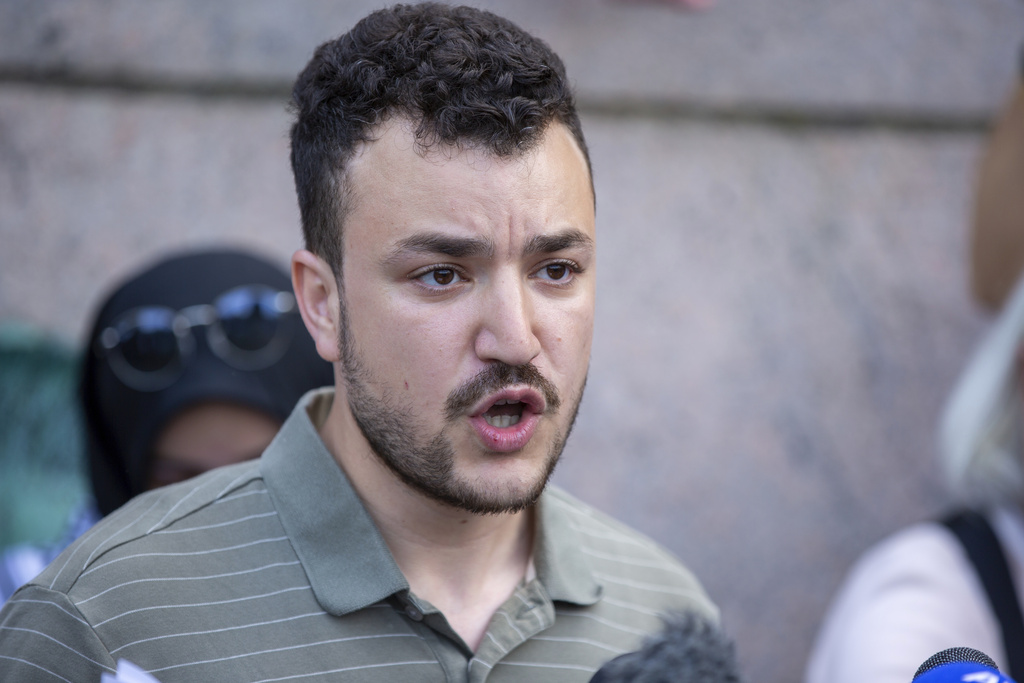
Mahmoud Khalil, the Columbia University graduate student controversially detained by ICE earlier this year before he was released on the order of a federal judge, suggested that Hamas’ attack in southern Israel on October 7, 2023 “had to” happen to “break the cycle” during a recent interview with The New York Times‘ Ezra Klein.
Asked by Klein for his thoughts about the day of the attack, Khalil responded:
At that day, I was at the cinema with my wife, Noor, at Lincoln Center. When I left the cinema around midnight, 12:30 a.m., I started to receive all these notifications.
To me, it felt frightening that we had to reach this moment in the Palestinian struggle. I remember I didn’t sleep for a number of days, and Noor was very worried about my health. It was heavy. I still remember. I was like: This couldn’t happen.
Klein then asked the obvious follow-up: “What do you mean we had to reach this moment? What moment is this?”
“I was interning at UNRWA at that point — the United Nations Relief and Works Agency — at the U.N.’s New York office. As part of my internship, my research and work were focused on Palestine, on the situation in the West Bank and Gaza. You can see that the situation is not sustainable. You have an Israeli government that’s absolutely ignoring Palestinians. They are trying to make that deal with Saudi and just happy about their Abraham Accord without looking at Palestinians — as if Palestinians are not part of the equation. They circumvented the Palestinian question,” replied Khalil. “It was clear that it was becoming more and more violent. By Oct. 6, over 200 Palestinians were killed by Israeli forces and settlers. Over 40 of them were children. So that’s what I mean by: Unfortunately, we couldn’t avoid such a moment. It was absolutely difficult to see not only the horrific images but also the response of Israel. Because I knew that’s what [Israeli Prime Minister Benjamin] Netanyahu wants because Netanyahu thrives on the killing of Palestinians. At that point, there were already big demonstrations in Israel regarding the judicial reforms. But I knew that was something that Netanyahu would use to ethnically cleanse Palestinians.”
Klein later posed the question to Khalil one more time:
KLEIN: I remember I did a piece right after Oct. 7, and one of the things that seemed clear to me very, very quickly on that day — as you’re watching the images, you’re hearing the screams, you’re seeing the videos of Jewish Israelis being paraded around, of corpses — is both that this attack is horrific and that the counterattack is going to be overwhelming.
On some level, I understood that as something Hamas must have wanted. Pull Israel into this attack, pull it into some kind of war. Maybe you involve other players in the Middle East. But a lot of lives are being used there as chips on the table. Was that your perception? Or did you see this as something that needed to happen to break the equilibrium?
KHALIL: It’s more the latter — just to break the cycle, to break that Palestinians are not being heard. And to me, it’s a desperate attempt to tell the world that Palestinians are here, that Palestinians are part of the equation. That was my interpretation of why Hamas did the Oct. 7 attacks on Israel.
Because at that point, there was no political process. It was clear that the Saudi-Israel deal is very imminent, and Palestinians wouldn’t have any path to statehood and self-determination. So they had to do that, according to their calculations — which, it’s obvious, were not right.
KLEIN: I’ve heard you in other news be very clear about condemning the killing of civilians. Oct. 7 was obviously an operation that did target and kill a lot of civilians. Do you see that as unavoidable, that Hamas had no other choice? Do you see it as a mistake?
KHALIL: What I know is that targeting civilians is wrong. That’s why we’ve been calling for an international independent investigation to hold perpetrators to accountability. It’s very important, for those of us who believe in international law, that this should happen.
And it’s very important to underscore, as well, that Palestinians have tried all forms of resistance — including nonviolent resistance. However, this was always targeted by Israel. Palestinians who participated in the Great March of Return were killed or maimed because of that.
There’s nothing that can justify the killing of civilians — and the international law is very clear about that. We cannot pick and choose when international law applies to us or to others.
But also, there’s another point to this, Ezra: Palestinians don’t have to be perfect victims. That’s what the world is asking of Palestinians amid the dispossession, the occupation, the killing, all of that. Horrible things happened. Nothing can justify that. I would do everything in my power to stop that from happening.
But we cannot ask Palestinians to be perfect victims after 75 years of dispossession, of killing people in Gaza, being under siege — at that point for over 17 years. Palestinians in the West Bank being stopped at checkpoints, settlers attacking them at every opportunity. The human dignity of Palestinians was absent — and still is, unfortunately.
So that’s why, when discussing this — unfortunately, these horrible things happened, but we cannot ask Palestinians to be perfect victims.
During a recent appearance on CNN, Khalil repeatedly refused to condemn Hamas, instead insisting that anchor Pamela Brown was being “disingenuous” by asking him to disavow the terrorist group; though he again stated his opposition to the targeting of civilians.
“Do you condemn Hamas, specifically?” asked Brown.
“No, I am very clear with condemning all civilians. I’m very straight in my position in that part. But it’s disingenuous to ask about condemning Hamas while Palestinians are the ones being starved now by Israel,” answered Khalil.
New: The Mediaite One-Sheet "Newsletter of Newsletters"
Your daily summary and analysis of what the many, many media newsletters are saying and reporting. Subscribe now!










Comments
↓ Scroll down for comments ↓