
Mediaite One Sheet: Epstein Media Chaos, Nancy Guthrie Media Circus, NewsNation’s Folly and More!

The Big Picture
Happy Presidents’ Day. The Epstein files saga entered a new and chaotic chapter this weekend as AG Pam Bondi declared “all” records released — and virtually nobody bought it. The Nancy Guthrie disappearance continued to blur the line between journalism and true-crime content creation. Status revealed that NewsNation has pivoted rightward to court Trump’s FCC ahead of a mega-merger — and the ratings show nobody’s buying that, either. And the chattering class spent the holiday weekend sorting through Trump’s “Phase 3” policy whiplash, the WBD bidding war’s newest suitors, and a Bad Bunny outrage cycle built on lyrics that were never sung.
Today’s sources: Politico Playbook | Status | Semafor Media | CNN Reliable Sources | CJR | The Bulwark | The Ankler | Page Six Hollywood | Barrett Media | Mediaite | Michael Tracey | Feed Me | Noahpinion
TOP STORY
THE EPSTEIN FILES COVER-UP IN PLAIN SIGHT — AND MEDIA THAT AREN’T SAYING IT
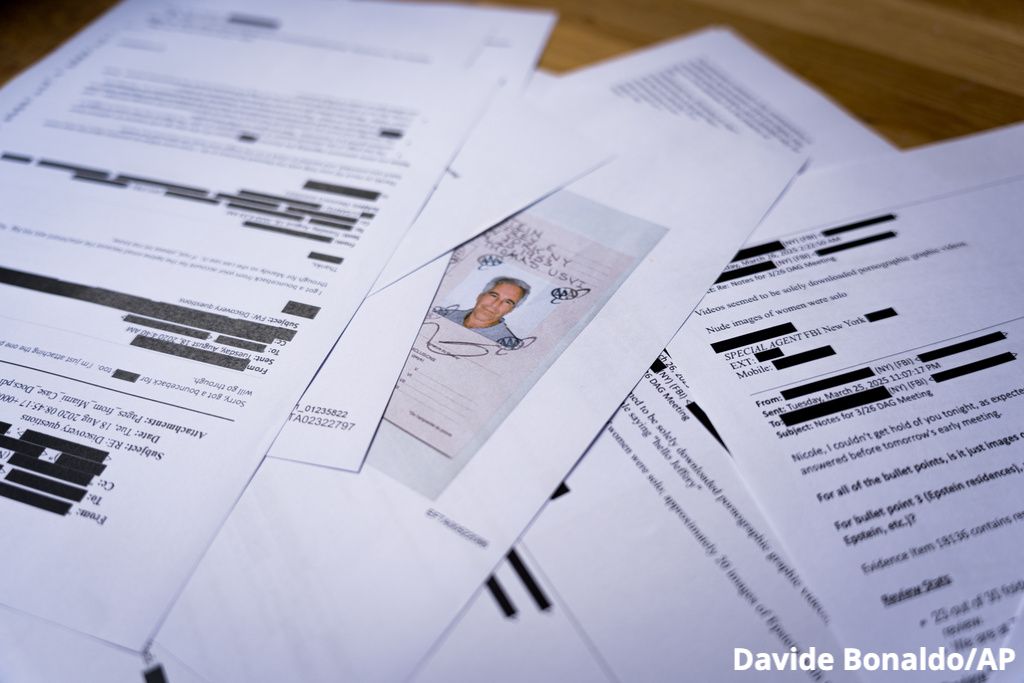
Attorney General Pam Bondi informed Congress on Saturday that the DOJ has released “all” Epstein-related records required by law. She listed over 300 names — including Trump, Biden, Zuckerberg, and Tucker Carlson — among “politically exposed persons.” Fox News carried the announcement prominently. And the administration’s message was clear: case closed, move along.
Almost nobody is moving along.
Rep. Thomas Massie (R-Ky.) went on ABC’s This Week and called the Trump White House “the Epstein administration,” saying he’s “up against” the “Epstein class” of billionaires. Rep. Nancy Mace rejected Bondi’s letter outright in a scathing social media thread, writing “This isn’t going away!” Even Marjorie Taylor Greene has said publicly that Trump “fought the hardest” to block the files.
The newsletter class has been processing the files from every conceivable angle. Status reported that key MAGA media figures are calling for Bondi’s ouster over her handling of the release — while Rupert Murdoch‘s Fox News runs cover for her. The New York Times‘ Tiffany Hsu and Steven Lee Myers reported that the document dump has been hijacked by conspiracy theorists, foreign influence operatives, and AI-armed trolls, making the information environment almost impossible to navigate. CJR’s Jem Bartholomew wrote that the sheer volume of material is “as indigestible as a spoonful of sawdust” and chronicled Jmail, an AI-powered tool replicating Epstein’s inbox that its creator calls “a newer form of journalism.”
Semafor’s Brendan Ruberry broke new ground with emails showing that Nautilus magazine founder John Steele courted Epstein for funding, once comparing his own labor dispute with freelancers to Epstein’s sex crime conviction. Breaker’s Lachlan Cartwright dredged through emails revealing PR fixer Matthew Hiltzik‘s long relationship with the financier. And Page Six Hollywood‘s Tatiana Siegel detailed how Casey Wasserman‘s flirtatious 2003 emails with Ghislaine Maxwell have triggered an exodus of music clients — Chappell Roan, John Summit, Orville Peck among them — even as Wasserman hosted 300 VIPs at his annual NBA All-Star party, with Adam Silver, Brian Roberts, and Netflix’s Bela Bajaria in attendance. The Ankler‘s Allen Salkin described “Ctrl+F dread” spreading across Hollywood as anyone who was anyone between 2008 and 2018 gets name-dropped in what he calls “a messy soup of the guilty, the adjacent, and the random.”
Meanwhile, contrarian voices pushed back on the panic. Michael Tracey, writing in Compact, mounted a defense of Noam Chomsky against what he called an “utterly repellent crusade” of disavowal, arguing the timeline doesn’t support the worst accusations against the 97-year-old stroke victim. He pointed to a UCLA professor whose innocuous neonatal research emails were misread as coded language by online conspiracy theorists — and who is now being protested at his office.
Mediaite’s Colby Hall cut through the competing framings with a blunt assessment: this is a cover-up. The piece argued that Bondi’s claim of full compliance cannot be independently verified by anyone outside the DOJ — there is no audit, no outside review, and no mechanism for confirmation. The only people who can prove there is no cover-up are the very people accused of running one. The column noted that the press has historically used the word “cover-up” before every tape was turned over or every memo surfaced — from Watergate to Iran-Contra to Abu Ghraib — and argued the evidentiary bar the press is setting for itself here is one only the government has the power to clear.
TAKEAWAY: The Epstein files have become less a transparency exercise and more a Rorschach test — conspiracy theorists see codes in baby research, MAGA media sees a weapon against Bondi, Hollywood sees an existential threat to its Rolodex, and the prestige press sees a story it still can’t quite bring itself to name. The only people who seem satisfied are the ones controlling what gets released.
Three Takes
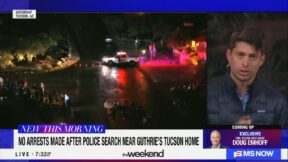
THE NANCY GUTHRIE MEDIA CIRCUS: WHEN ‘CITIZEN SLEUTHS’ DESCEND
CNN Reliable Sources, Brian Stelter: On Friday, Stelter devoted significant space to the “parallel universe” of true-crime influencers who have swarmed Tucson since Nancy Guthrie‘s disappearance, noting that podcasters, TikTokers, and YouTubers are churning out content that is “more raw and personal, and often much more speculative in nature, crossing lines that journalists are taught to avoid.” He cited a pizza delivery ordered to the crime scene for a controversial YouTuber, the Pima County sheriff asking people to stop spreading unsubstantiated rumors, and a 20-year local news veteran who said he’d “never seen anything like this.” Stelter acknowledged the tension honestly, writing that he’d been “hesitant” to cover the topic because he didn’t want to sound like “some old-fogey member of the legacy media” — but that the aggressive coverage has been “unhelpful” to the actual investigation.
Page Six Hollywood, Ian Mohr: Over the weekend, Mohr approached the story from the industry security angle, reporting that the disappearance has TV news networks beefing up security for on-air talent and their families. The kidnapping of a prominent anchor’s mother has forced executives to confront how much personal information talent routinely shares with audiences — and what kind of exposure that creates. The framing was less about the influencer circus and more about how the case has changed the risk calculus inside television newsrooms.
Status, Natalie Korach: Korach’s Sunday deep dive on NewsNation surfaced the network’s own Guthrie problem. Ashleigh Banfield — who transitioned to leading the network’s true crime vertical — drew some criticism for reporting that Guthrie’s son-in-law was a “prime suspect” in the disappearance. The Pima County sheriff called her reporting “reckless,” though to be fair, she could still be right. The episode illustrates what happens when a cable network pivots to true crime content at a moment when the line between news coverage and speculation is already collapsing in the name of chasing clicks — and when the competitive pressure to break something, anything, overrides discipline to wait.
TAKEAWAY: Three different framings, one uncomfortable truth. Stelter sees an influencer invasion threatening a real investigation. Page Six Hollywood sees a security crisis inside newsrooms. And Status reveals that even a cable network supposedly staffed with professionals produced reporting the sheriff called reckless. The Guthrie case isn’t just testing citizen sleuths — it’s testing the institutions that are supposed to know better.
📰 Top Reads 📰
Status, Natalie Korach
NEWSNATION’S AUDIENCE OF ONE — AND IT’S NOT THE VIEWER: Korach’s Sunday spotlight revealed that Nexstar’s cable news upstart has visibly pivoted right — hiring former Fox News contributor Katie Pavlich for primetime, stacking the roster with Fox alumni, and earning a public congratulations from FCC chair Brendan Carr — in what current and former employees believe is a transparent effort to curry favor with Trump’s FCC and smooth Nexstar’s $6.2 billion acquisition of Tegna. The strategy hasn’t worked with audiences: Pavlich’s Trump interview drew just 75,000 total viewers. Her show averages 24% below NewsNation’s already-weak primetime numbers. But as one former employee told Status, the ratings may not be the point … QUOTE (former NewsNation employee): “Trump obviously needs the media to express fealty and help him tell his narrative, or get behind it, and they seem willing to do that.” … QUICK TAKE: NewsNation was supposed to be the “unbiased” alternative. Now it’s a Fox News understudy performing for an audience of one — and even he probably isn’t watching.
Semafor Media, Max Tani
TRUMP’S MEDIA REGULATORS: SCARY OR JUST LOUD? Tani’s lead essay posed a question the newsletter class has been dancing around: Are Trump’s media regulators actually as powerful as they make themselves out to be? The FTC sent a warning to Apple over conservative content in Apple News. FCC chair Brendan Carr applauded it — then his team went hunting for ways to punish Bad Bunny’s halftime show. Both moves got attention, but neither seems likely to go anywhere. Apple is insulated from the FTC despite the “creative complaint,” and the New York Post‘s Charles Gasparino reported the FCC’s halftime probe was over before it began. Tani’s sharper point: with a less aggressive antitrust posture, stalled regulatory moves, and the potential for a Democratic Congress in 2027 ready to punish companies that bowed to the administration, media companies may start deciding that tangling with Trump’s regulators “isn’t as scary as it seemed a year ago” … QUOTE: Tani’s framed a regulatory posture that’s “cast a major shadow” but may be losing its power to compel … QUICK TAKE: The FTC threatened Apple. The FCC chased Bad Bunny. Neither went anywhere. At some point, the media industry is going to realize the scarecrow is stuffed with straw.
CJR, Betsy Morais
SOUNDING THE ALARM ON PRESS FREEDOM ‘DON’T THINK WE’VE SEEN ANYTHING QUITE LIKE THIS’: CJR’s live taping of The Kicker featured Knight First Amendment Institute director Jameel Jaffer and NYT editor David Enrich assessing the press freedom landscape. Jaffer said no modern president has been “so hostile to the freedoms of the press and speech.” Enrich said even after Trump leaves, the damage won’t revert. The New Yorker‘s general counsel Fabio Bertoni asked from the crowd, “If there is a post-Trump period, can we revert?” — a question Enrich answered flatly: “No” … QUOTE (Jameel Jaffer): “I don’t think we’ve, at least in modern American history, had a president who was so hostile to the freedoms of the press and speech.” … QUICK TAKE: When The New Yorker’s lawyer starts his question with “if” instead of “when,” the press freedom conversation has moved past alarm and into something closer to grief.
Barrett Media / Status / CJR
DON LEMON PLEADS NOT GUILTY — AND DHS HAS HIS PHONE: Don Lemon entered a not guilty plea on federal charges stemming from his coverage of an ICE protest at a Minnesota church. His attorney said Lemon’s phone was seized during the arrest and is currently being searched by DHS. The Washington Post‘s video review of Lemon’s actions contradicts claims in the government’s indictment. CBS News’ Sarah N. Lynch reported the charge is “so constitutionally flawed” that the DOJ’s own Civil Rights Division has never used it to prosecute interference in a house of worship. Meanwhile, Status reported that Lemon’s arrest has been a boon for his media business — Substack subscriptions jumped 73%, and he added roughly 300,000 Instagram followers and 140,000 YouTube subscribers … QUOTE (Lemon): “I will not be intimidated, I will not back down, and I will fight these baseless charges.” … QUICK TAKE: The government seized a journalist’s phone, charged him under a statute it’s never used, and the video evidence contradicts the indictment. The silver lining for Lemon: persecution is great for subscriptions.
Status, Oliver Darcy / CJR, Riddhi Setty
BEZOS KILLED THE FIRST LAYOFF PLAN — THEN LET THE SECOND ONE GUT DIVERSITY: Before The Washington Post slashed nearly half its newsroom, Jeff Bezos rejected then-CEO Will Lewis’s initial layoff proposal in a previously unreported meeting. A Bezos confidante has since re-emerged behind the scenes. But CJR’s Setty revealed Monday what the cuts actually looked like from inside: half of the Post’s Hispanic/Latino guild members were laid off, along with 45% of Black members and 43% of Asian members — compared to 37% of white members. An internal survey of Black journalists, reported for the first time by CJR, found staffers rated leadership’s commitment to diversity at 1.61 out of 5. Nobody scored higher than 3. Forty-five Black journalists signed a letter to leadership. When they met with Lewis in December, he asked, “How did it get this bad?” — then took no action. Outgoing race and ethnicity reporter Emmanuel Felton said he went from traveling the country constantly to taking two reporting trips all of last year … QUOTE (Felton): “We had gone from trying to do aggressive work about race and racism to sort of sliding into covering it as a cultural issue, which feels a little crazy.” … QUICK TAKE: The richest man in the world had two chances to save a newsroom. He used the first. The second time, the cuts hit hardest at the journalists who looked least like him.
Status, Brian Lowry
NY DAILY NEWS CUTS 28% OF STAFF; RICHMOND FREE PRESS DIES AT 34: Alden Global Capital is gutting the New York Daily News again, eliminating 16 of 58 unionized positions. The guild accused Alden of living up to its reputation as a “destroyer of newspapers.” Separately, the Richmond Free Press is ceasing publication after 34 years … QUICK TAKE: Two more data points in the ongoing argument that local news isn’t dying of natural causes — it’s being killed.
Noahpinion, Noah Smith
VIBE-CODING THE APOCALYPSE: Smith’s updated AI risk assessment argued that the advent of vibe-coding has “significantly increased” his fears about catastrophic AI risk — specifically AI-enabled bioterrorism. He cited an Anthropic study showing AI-assisted coders scored 17% lower on mastery tests, a Time report that AI models now outperform PhD virologists in wet lab problem-solving, and warned about “vibe-coded superviruses.” Smith’s top doomsday worry: a jailbroken AI designing engineered pathogens and hacking automated labs to produce them … QUICK TAKE: The man who wrote “LLMs are not going to destroy the human race” in 2023 is now losing sleep over vibe-coded superviruses. That’s not a flip-flop — it’s a weather report.
Status, Jon Passantino
THE BAD BUNNY MISINFORMATION LOOP, START TO FINISH: Passantino documented the full lifecycle of the Bad Bunny halftime outrage — from Rep. Randy Fine’s viral post accusing the artist of broadcasting “illegal” obscenities (based on lyrics never performed), to Glenn Beck reading verses from a different rapper on air, to the FCC quietly determining there was nothing actionable, to Fine never issuing a correction. The post remains live with 1.3 million views. Semafor separately reported the FCC probe was “shelved” almost before it began … QUOTE: “Lock them up,” Fine demanded, in a post that remains live with over 12,000 shares … QUICK TAKE: A congressman demanded arrest over lyrics that weren’t sung, read by pundits who don’t speak Spanish, investigated by regulators who found nothing, and corrected by nobody. The system is working exactly as designed.
🎬 SHOWBIZ 🎬
Semafor Media, Rohan Goswami
THE WBD BIDDING WAR GETS A NEW PLOT TWIST — AND LOSES ITS REFEREE: Warner Bros. Discovery’s board is leaning toward opening negotiations with David Ellison’s Paramount, even as Netflix has threatened to walk if denied exclusivity. Meanwhile, DOJ antitrust chief Gail Slater was ousted Friday — the same official overseeing the Netflix-WBD review. Sen. Elizabeth Warren warned of “corruption,” saying MAGA-aligned lawyers are “trying to sell off merger approvals to the highest bidder.” And Status’s Brian Lowry reported that Comcast’s Brian Roberts could make a run for Paramount if the Ellison bid fails — or that Netflix could pivot to Comcast entirely … QUOTE (former Comcast executive to Status): “They know they have to buy or sell, and Brian has never been a seller.” … QUICK TAKE: The biggest media merger in a generation just lost its antitrust cop, gained a potential third bidder, and has a senator screaming corruption. Just another Monday.
Page Six Hollywood, Tatiana Siegel / Ian Mohr
EPSTEIN AFTERSHOCKS RATTLE HOLLYWOOD — FROM WASSERMAN TO MOTTOLA TO DILLER: The Epstein files continue to send tremors through the entertainment industry. Casey Wasserman’s Maxwell emails triggered client departures. Jimmy Fallon scrapped a pasta sauce venture with former Sony Music boss Tommy Mottola after Mottola’s Epstein ties surfaced. Barry Diller is dealing with his own fallout. And through it all, Page Six Hollywood’s Katcy Stephan interviewed AI “actress” creator Eline Van Der Velden, who says Hollywood figures publicly bash her creation while privately asking to collaborate …QUICK TAKE: Hollywood’s two biggest anxieties — Epstein exposure and AI replacement — are running on parallel tracks this week. The difference is that only one of them can be solved by hiring a crisis PR firm.
The Ankler / Status
THE SEEDANCE SHOWDOWN: Disney and Paramount both sent cease-and-desist letters to ByteDance over its new Seedance AI video model, with the MPA and Human Artistry Campaign calling the tool’s output “massive” copyright infringement. Reuters, meanwhile, reported that Seedance 2.0 has “impressed the likes of Elon Musk” and gone viral in China. Reliable Sources framed the split perfectly: same technology, two completely different headlines depending on whether you’re covering Silicon Valley or Hollywood … QUICK TAKE: ByteDance built a tool that can generate cinematic video from a text prompt. Hollywood responded with lawyers. This is the AI copyright war’s opening salvo, and neither side is bluffing.
👀 What Got Missed? 👀
The newsletter class spent the weekend deep in Epstein files, Munich dispatches, and WBD merger math — but almost nobody stopped to note that Gail Slater‘s ouster as DOJ antitrust chief didn’t just affect the Netflix-WBD deal. She was also overseeing the Live Nation/Ticketmaster monopoly case — and with MAGA stalwarts Kellyanne Conway and Mike Davis advising the company, her removal could pave the way for a quiet settlement that lets the concert monopoly off the hook. The newsletters that covered WBD’s antitrust implications largely ignored Ticketmaster’s, even though the consumer impact is arguably larger. When the DOJ’s top merger cop gets fired and the chattering class only notices the Hollywood angle, that tells you something about whose interests are being tracked.
🏆 Newsletter of the Day 🏆
Status, Natalie Korach — Korach’s Sunday edition was the weekend’s most valuable single dispatch. The NewsNation investigation — documenting how a network marketed as “unbiased” has pivoted rightward to court Trump’s FCC ahead of a $6.2 billion merger — was the kind of original, source-driven reporting that makes the meta-media beat matter. She got current and former employees on the record (anonymously), pulled Nielsen data showing the strategy is failing with audiences, and connected the editorial decisions to the regulatory stakes. On top of that, the edition surfaced the Banfield/Guthrie “reckless” reporting, the Don Lemon subscriber surge, Wasserman putting his music agency up for sale, and noted Ars Technica retracting an article over AI-hallucinated quotes. That’s a full newsletter doing the work.
🎯 The Bottom Line 🎯
Here’s what the newsletters revealed this weekend without quite saying it: the Epstein files have exposed a fundamental asymmetry in American transparency. Congress can pass a law demanding disclosure. The press can demand compliance. The public can demand answers. But the executive branch still decides what gets released, when, and with how many redactions — and the only way to prove the process is honest is to trust the people running it. The same asymmetry is playing out in every major story right now: the DOJ controls the Epstein files and the antitrust review of the biggest media merger in a generation. The FCC investigates a halftime show based on lyrics no one bothered to verify. DHS seizes a journalist’s phone under a statute it’s never used. In each case, the government acts first and explains later — if it explains at all — and the press is left to describe the pattern without quite naming it. The newsletters are getting closer. But “cover-up” still feels like a word most of them are circling rather than landing on.
Get full access to premium content with a Mediaite+ subscription.



Comments
↓ Scroll down for comments ↓