ONE SHEET: White House Photo Police, MAGA Cracking Over Iran, and Zucker’s Return?

The Big Picture
The Trump administration’s war on press access has a new front: the photo wire. Status broke the story of the White House leaning on AFP to pull an unflattering image of press secretary Karoline Leavitt — and today, government lawyers are back in court defending Pete Hegseth’s sweeping Pentagon press restrictions. Meanwhile, MAGA media’s Iran war fracture is widening, with Fox personalities, podcasters, and influencers openly questioning the mission. On the business side, a federal judge’s temporary block of the Nexstar-TEGNA merger wiped nearly $850 million in market value in a single day. And Politico has a new editor in chief.
Today’s sources: Status | CNN Reliable Sources | The Bulwark | To the Contrary | Page Six Hollywood | Tubefilter | Simon Owens | CJR | Poynter | Newsbusters
Top Story
The Trump White House Photo Police
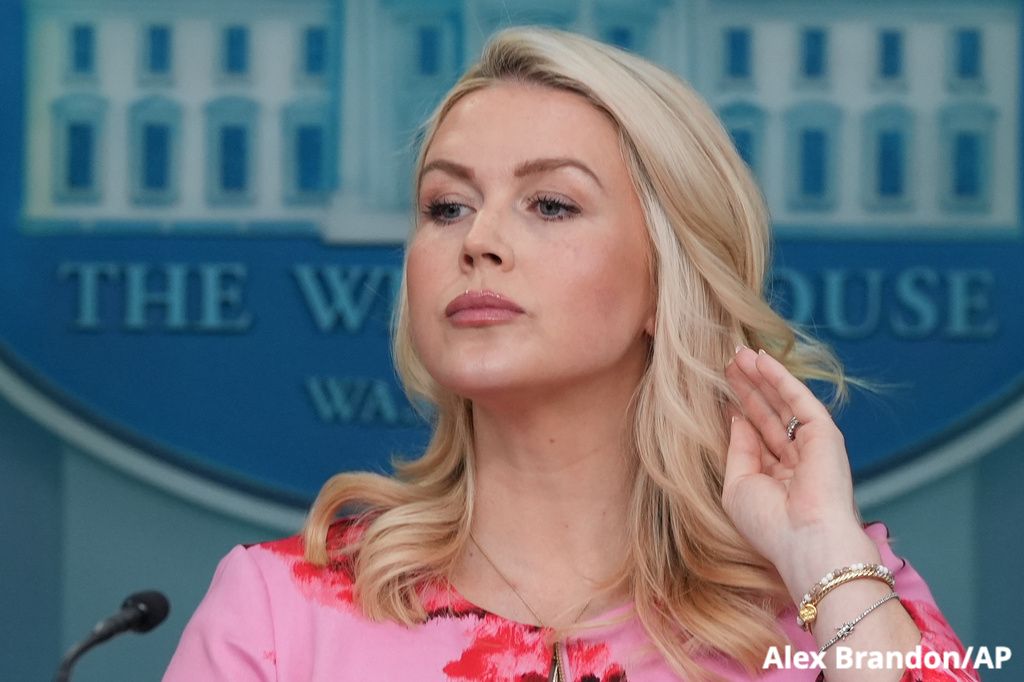
It started with a turkey and ended with a wire photo quietly vanishing from the internet.
In late November, AFP photographer Andrew Caballero-Reynolds snapped a photo of White House press secretary Karoline Leavitt holding her young son at a Thanksgiving turkey-pardoning event in the briefing room. The image was innocuous. It was also unflattering. And according to Status, the White House made sure AFP knew it.
The result: the photo was pulled from AFP’s wire and automatically scrubbed from the Getty Images library. AFP’s director of brand and communications Grégoire Lemarchand confirmed to Status that the agency was “made aware” the White House didn’t approve of the photo — while insisting the decision to unpublish was “an internal editorial one” based on quality and selection criteria. Status notes the careful phrasing: the White House doesn’t need to issue a formal demand. Making its displeasure known is enough.
Status found only one outlet that published the photo before it disappeared: a Swiss newspaper, Tages-Anzeiger.
Oliver Darcy connects the episode to a pattern. The Washington Post reported earlier this month that Hegseth exiled photographers from Pentagon Iran war briefings after they published photos of him he didn’t like. Trump, Darcy notes, is known to scrutinize appearances and select staff based on how they look on camera. “The image of Leavitt was innocuous,” Darcy writes, “but what it suggests about the way the White House operates is not.”
The photo pressure story lands alongside a live court fight. This morning, government lawyers appeared before U.S. District Judge Paul Friedman defending the Pentagon’s latest press restrictions — which include eliminating the longtime reporter workspace inside the building and moving journalists to an outside annex. First Amendment attorney Ted Boutrous, representing the New York Times, called the new restrictions “radical” and “gaslighting by the government.” Friedman questioned the moves but did not rule from the bench.
CNN Reliable Sources‘ Brian Stelter notes the scale of the Pentagon’s communications blackout: Hegseth hadn’t held a press briefing in over 10 days (though he held one Wednesday a.m.). His spokesman’s response to a Washington Post story about the U.S. supply of Tomahawk missiles was to accuse the media of being “obsessed with portraying the world’s strongest military as weak.” Obama administration spokesman Matthew Miller wrote on X: “We learn more of what the U.S. military has been doing from bystander videos than DoD.”
TAKEAWAY: AFP’s carefully worded statement — no “formal request,” no “external pressure,” and yet the photo vanished — is a case study in how media organizations absorb government pressure without admitting they’ve done so. The photo is gone. The question is whether the precedent stays.
Three Takes
MAGA Media’s Iran War Fracture
One month into the U.S.-Israel war on Iran, the right-wing media coalition that propelled Trump back to the White House is showing visible cracks — and the newsletters are covering it from very different angles.
CNN Reliable Sources | Brian Stelter: Stelter catalogs the split methodically, treating it as a structural phenomenon. Marjorie Taylor Greene accused Fox of “brainwashing boomers.” Tucker Carlson called his former network “the world headquarters for ‘boots on the ground.'” Ann Coulter drew a direct parallel to Fox’s 2020 election coverage. Podcaster Matt Walsh said he hasn’t met a single ordinary conservative “actually enthusiastically in favor” of the war. Stelter also highlights SE Cupp‘s observation that some GOP lawmakers are using TV appearances as a backchannel to Trump because “he’s not listening to them” through any other means.
To the Contrary | Charlie Sykes: Sykes frames the fracture not as a media story but as a chronicle of political self-destruction. Trump, he argues, had every advantage coming into his second term — a healthy economy, a demoralized opposition, a dominant electoral coalition — and squandered it through failures of character. The MAGA media split, for Sykes, is downstream of that: “Everything that is tanking his numbers flows directly from the character and judgment of Donald Trump.”
The Bulwark | Will Sommer: Sommer goes granular, profiling MAGA influencer Mike Cernovich — one of Trump’s earliest and most ardent online boosters — as a bellwether. Cernovich’s growing disillusionment, Sommer argues, reflects a mix of policy disappointment and corruption concerns that is spreading through the influencer ecosystem. If the Pizzagate king is souring on Trump, it’s a warning sign.
TAKEAWAY: Three newsletters, three frames — Stelter maps the terrain, Sykes indicts the president, Sommer finds the human face of the defection. Notably, none of them reckon seriously with what comes next if the MAGA media infrastructure actually fractures. They’re all better at describing the crack than predicting the collapse.
📰 Top Reads 📰
Page Six Hollywood | Tatiana Siegel
🚨 SCOOP — ZUCKER ADVISING WEISS AT CBS NEWS: As Bari Weiss faced turbulent early months running CBS News, she quietly sought advice from former CNN and NBCUniversal chief Jeff Zucker, Page Six Hollywood reports. The two are longtime friends — Zucker was among the first to congratulate Weiss when she sold The Free Press to Paramount Skydance and took over the network’s news division. A formal Zucker role was considered but shelved: sources say Paramount Skydance CEO David Ellison doesn’t want “big personalities that are ego driven.” The Zucker connection also carries a political third rail — his name would complicate Ellison’s pursuit of government approval for the Warner Bros. Discovery acquisition … QUOTE (source with knowledge): “He wanted to find a way to get in, and she definitely had conversations with him, asking advice.” … QUICK TAKE: The reporters most aggressively covering Weiss’s stumbles have historically been among Zucker’s loudest defenders — which means a formal Zucker role would have put them in the awkward position of either backing off Weiss or turning on their guy. The White House of media gossip dodged that particular logic puzzle.
Status | Oliver Darcy
NEXSTAR-TEGNA MERGER BLOCKED, STOCK CRATERS: A federal judge’s temporary restraining order halted the $6.2 billion Nexstar-TEGNA merger — already cleared by both the FCC and DOJ — after DirecTV argued the deal would create a local TV juggernaut reaching 80% of American households and spike retransmission fees. Nexstar’s stock dropped 13% Monday, erasing nearly $850 million in market value. Eight state attorneys general, led by California’s Rob Bonta, filed a separate antitrust suit on similar grounds … QUOTE (U.S. District Judge Troy Nunley): “The Supreme Court has found that a merger that creates a firm with a combined market share of 30 percent or more is presumed likely to violate the antitrust laws.” … QUICK TAKE: The deal cleared a Trump-friendly FCC and a compliant DOJ, then got stopped anyway by a California federal judge responding to a DirecTV lawsuit and a coalition of Democratic AGs. Federal deregulation doesn’t neutralize state-level antitrust enforcement — and the broadcast industry apparently forgot that.
Tubefilter | Emily Burton et al.
NETFLIX’S MLB OPENING NIGHT WAS A SWING AND A MISS: Netflix’s exclusive broadcast of MLB’s season-opening Giants-Yankees matchup was widely panned by fans and casual viewers alike. The production featured Bert Kreischer, Jameis Winston, and WWE’s Jey Uso before a pitch was thrown, missed the first-ever ABS challenge in MLB history while conducting a softball interview, and delivered hazy picture quality and a scorebug that was difficult to read — despite making room for the Netflix logo … QUOTE (Burton): “The end result was a distraction-filled broadcast that treated MLB like a second-class product while encouraging viewers to divide their attention.” … QUICK TAKE: Netflix eventizes everything. The problem is not every sport wants to be an event. Baseball, in particular, is a sport that rewards attention — and Netflix spent three hours testing how little it could demand.
Media Newsletter | Simon Owens
JOANNA STERN’S HYBRID DEAL POINTS TO A NEW MEDIA MODEL: Tech journalist Joanna Stern launched her own independent venture, New Things, last month — then almost immediately struck a partnership with NBC News making her the network’s chief tech analyst while she builds her own company. Owens argues the arrangement previews a structural shift: legacy outlets increasingly need to offer hybrid arrangements to retain star talent, and creators will always value the reach and imprimatur a major platform provides… QUOTE (Owens): “We’re going to see more and more interesting partnerships like this between independent creators and traditional media companies.” … QUICK TAKE: The Stern deal reveals the real negotiating dynamic: legacy outlets need star names more than star names need legacy outlets — but only once you’ve already built the audience that makes you worth calling. The model doesn’t democratize journalism. It rewards journalists who already escaped it.
To the Contrary | Charlie Sykes
DEMOCRATS HAVE A HASAN PIKER PROBLEM: Michigan Senate candidate Abdul El-Sayed announced that Twitch streamer Hasan Piker would join him at campaign rallies — prompting sharp pushback from fellow Democratic candidates and members of Congress. Rep. Brad Schneider called Piker “an unapologetic antisemite” and warned Democrats against embracing figures who “traffic in hate.” Sykes draws the comparison to the GOP’s Nick Fuentes debate: healthy political parties, he argues, police their borders … QUOTE (Schneider): “Democrats risk losing our credibility to condemn those on the right who traffic in bigotry, antisemitism, & hate when our own Members of Congress & candidates are celebrating or, worse yet, platforming those who espouse hate of any kind.” … QUICK TAKE: The Nick Fuentes parallel Sykes draws is precise — and the GOP’s experience is instructive. Republicans spent years telling themselves the fringe was useful until it wasn’t, by which point it had eaten the party. Democrats are now having the same argument about whether online reach justifies the associations it requires. The GOP already ran that experiment.
Newsbusters | Jorge Bonilla
CNN GIVES FIDEL CASTRO’S GRANDSON A SOFTBALL PLATFORM: CNN correspondent Patrick Oppmann sat down in Havana with Sandro Castro — Fidel’s grandson, influencer, and nightclub impresario — in a segment that Newsbusters argues amounted to reputational rehabilitation for the Castro family ahead of a potential U.S.-Cuba deal. The segment’s central exchange: Oppmann asks Castro why so many people hate his family, and Castro answers that Cubans simply wanted capitalism. Oppmann offers no follow-up referencing the imprisonments, executions, expropriations, and decades of political repression that are the more specific answer to that question … QUOTE (Oppmann): “Why do you think there are people, though, that hate the Castro family so much?” … QUICK TAKE: Newsbusters has an ideological axe to grind, but the editorial criticism here is fair on its own terms. Oppmann had the transcript of history sitting right in front of him and chose not to use it. Whatever CNN’s intentions, the segment reads like access journalism — the kind that prioritizes the interview over the accountability.
Poynter | Tom Jones
CNN CREW DETAINED AND ASSAULTED BY ISRAELI MILITARY IN WEST BANK: CNN correspondent Jeremy Diamond and his crew were detained for two hours by Israeli reserve soldiers while covering settler violence in the West Bank, with photojournalist Cyril Theophilos put in a chokehold and his camera damaged. Within 48 hours, Israeli military chief of staff Eyal Zamir suspended the entire reserve battalion and dismissed one soldier — what Poynter’s Tom Jones called unprecedented in speed and scope. The IDF called the incident a “serious ethical and professional failure”… QUOTE (Diamond): “The two hours we spent detained by them laid bare the settler ideology motivating many of the soldiers who operate in the occupied West Bank.” … QUICK TAKE: The Israeli military’s swift disciplinary response is notable — but the speed also reflects how much the video evidence left no room for denial. What’s harder to measure is how many similar incidents don’t happen to CNN crews with cameras rolling.
Media Newsletter | Simon Owens
STOP WRITING “CEO SAID A THING” JOURNALISM: Owens endorses a piece arguing that the entire cottage industry of business coverage built around uncritically amplifying tech CEO claims has directly incentivized executives to make absurdly ambitious predictions — and that much of Elon Musk’s wealth is derived from the resulting hype cycle… QUOTE (Owens): “It annoys the hell out of me that there’s an entire cottage industry of business ‘journalism'” built around amplifying tech CEO claims without skepticism. … QUICK TAKE: The incentive structure is simple: CEO says wild thing, outlet publishes it, CEO stock moves. The reporter gets the traffic and the CEO gets the pump. Nobody writes the accountability piece when the prediction doesn’t pan out.
CJR | Jem Bartholomew
THE FBI RAID ON A WAPO REPORTER’S HOME: CJR offers the most comprehensive account yet of the January FBI raid on Washington Post reporter Hannah Natanson‘s home — in which agents seized her phone, laptop, work computer, and smartwatch, and reportedly guided her finger onto a Post-owned MacBook to unlock it. The Justice Department, which framed the search as a leak investigation, made no mention of the 1980 Privacy Protection Act, a federal law that shields journalists from exactly this kind of seizure. Judge William B. Porter rebuked DOJ in a February hearing — “How could you miss it? How could you think it doesn’t apply?” — but stopped short of returning the devices. The administration has since appealed, arguing journalists aren’t protected when the government believes they possess sensitive national security materials. Natanson’s Signal tipline, CJR notes, has gone dark … QUOTE (Seth Stern, Freedom of the Press Foundation): “Although it hasn’t charged Natanson with a crime, the Department of Justice contends that she, along with her source, violated the Espionage Act by possessing classified documents.” … QUICK TAKE: The most alarming detail isn’t the raid itself — it’s the DOJ’s argument that a reporter can violate the Espionage Act simply by receiving classified information. If that theory holds, the legal distinction between a journalist and a leaker effectively disappears. Every national security reporter in Washington should be paying attention.
Poynter | Tom Jones
NYT CUTS FREELANCER AFTER AI PLAGIARISM DISCOVERY: The New York Times severed ties with freelance book reviewer Alex Preston after discovering his January review of a French novel contained language lifted — via an AI tool — from an August 2025 Guardian review of the same book. Preston told the Times he had used an AI tool “improperly” and failed to catch the overlapping language. The Times added an editor’s note to the piece and linked to the Guardian review. Crucially, the problem was flagged by a reader, not by anyone at the Times… QUOTE (NYT editor’s note): “His reliance on A.I. and his use of unattributed work by another writer are a clear violation of The Times’s standards.” … QUICK TAKE: The Times caught this one because a reader happened to notice. The more uncomfortable question is how many AI-assisted reviews — at the Times and everywhere else — have already run without anyone flagging them. The guardrails, if they exist at all, clearly aren’t in the editing process.
🎬 SHOWBIZ 🎬
The Ankler | Sean McNulty and Christopher Rosen
WARNER BROS.’ HOT STREAK IS OFFICIALLY OVER: After nine consecutive No. 1 openings — from A Minecraft Movie last year through Wuthering Heights last month — Warner Bros. has now gone 0-for-2 in March. The Bride! flopped earlier this month, and this weekend’s horror-thriller They Will Kill You earned just $5 million, the worst wide-release opening for a Warners title since The Alto Knights last year. The Ankler’s Rosen suggests a marketing misstep may have contributed: a key plot twist in the first 15 minutes wasn’t surfaced in trailers, possibly leaving audiences cold … QUOTE (McNulty): “The heater’s officially over. March has instilled the chill.” … QUICK TAKE: The Ankler’s Rosen puts his finger on something specific: the film had a twist worth marketing, and Warners didn’t use it. After nine straight wins, there’s a real risk that a studio starts believing its own momentum rather than doing the work. That’s what losing streaks are made of.
The Ankler | Sean McNulty and Christopher Rosen
PROJECT HAIL MARY IS AMAZON MGM’S BIGGEST FILM EVER: The Ryan Gosling-led sci-fi film dropped just 32% in its second weekend and crossed $300 million globally — making it the highest-grossing film in Amazon MGM Studios history and the year’s first bona fide blockbuster … QUOTE (McNulty): “This movie could have gone really easily wrong. So to see the audience respond like this is great.” … QUICK TAKE: Amazon MGM has spent years as the studio that buys franchises without quite knowing what to do with them. A film that holds 68% of its opening weekend audience — for a mid-budget original sci-fi adaptation — is proof that the formula works when the material is right. The harder question is whether Amazon builds on this or treats it as a one-off.
Page Six Hollywood | Peter Kiefer
🚨 SCOOP — ROLE MODEL SIGNS WITH CAA FOR FILM AND TV: Singer-songwriter Tucker Pillsbury — known professionally as Role Model — has signed with CAA for film and TV representation, Page Six Hollywood has learned. The 28-year-old indie artist will make his acting debut in Netflix’s rom-com Good Sex, directed by Lena Dunham and also starring Natalie Portman and Mark Ruffalo … QUICK TAKE: The real story here isn’t CAA signing another musician — it’s that Dunham cast him opposite Portman and Ruffalo in a Netflix film before he’d acted a single day professionally. That’s a bet on cultural cachet over craft, and it tells you something about how streaming platforms are now building casts: audience first, resume second.
👀 What Got Missed? 👀
The newsletter class treated the AFP photo story as a press freedom scandal today — and covered it well. But almost no mainstream news outlet picked it up as a news story in its own right. That’s worth sitting with. The same access dynamic that got the photo pulled in the first place also discourages outlets from amplifying the story: cover it aggressively and risk your briefing room standing, your interview requests, your placement. So Status breaks it, the newsletters discuss it, and the mainstream press largely looks away — not because they don’t know, but because the incentive to stay quiet is structural. Previous administrations played the access game too. What’s different about the Trump White House is that it has weaponized access openly, as policy — making the suppression self-enforcing without ever having to issue a formal order. The most effective censorship is the kind nobody has to mandate.
🏆 Newsletter of the Day 🏆
Media Newsletter | Simon Owens In a news cycle dominated by Iran war coverage and Washington drama, Simon Owens did what he does best: identified a structural shift in the media industry that everyone else was too distracted to name. His piece on the Joanna Stern/NBC News hybrid deal isn’t just a profile of one journalist’s career move — it’s a framework for understanding how the talent economy in media is being fundamentally renegotiated, with independent operators gaining leverage that simply didn’t exist five years ago. That’s original analytical work, not aggregation.
The Bottom Line
The through-line in today’s newsletter stack, if you squint at it, is institutions discovering that the cost of resistance is higher than they budgeted for. AFP pulled a photo and called it an editorial decision. The Pentagon eliminated the press workspace and called it a security measure. The mainstream press largely ignored the photo story and called it not news. MAGA media personalities are souring on the Iran war but doing it carefully, incrementally, with plenty of hedging. None of these are acts of courage, and none of them are accidents. They are rational responses to a White House that has made the price of pushback explicit and the reward for compliance reliable. The Trump administration didn’t create institutional cowardice. It just got very good at pricing it.
Get full access to premium content with a Mediaite+ subscription.




Comments
↓ Scroll down for comments ↓