Small Florida Town Finds Itself in Middle of George Floyd Story After Cop Revealed to Have Second Home Nearby

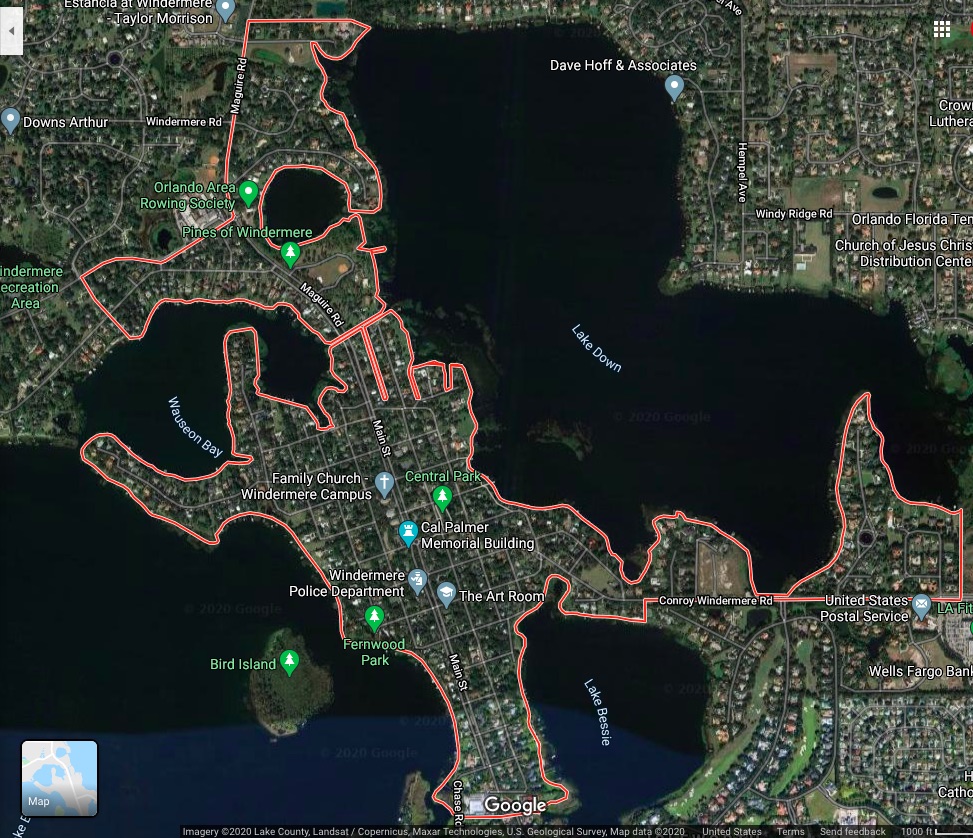
Image via Google Maps, accessed May 29, 2020.
The small Central Florida town of Windermere found itself thrown into national headlines this week when it was reported that Derek Chauvin, the Minneapolis police officer who was seen on video with his knee on the neck of George Floyd before he died, has a second home with a Windermere address. But Chauvin doesn’t actually live in the town.
Windermere is a very small town in western Orange County, nestled on an isthmus spanning the Butler Chain of Lakes, comprised of 3,800 people living within 2.2 square miles. It’s so small you might blink and miss it as you drove through, if not for the infamously restrictive speed limits (Windermere Police are well-known by locals for issuing tickets for driving even one or two miles over the posted limits) that slow you down enough to appreciate the quaint shops and Spanish moss-draped oak trees along Main Street. The main residential areas still feature dirt roads and short wooden posts for street signs.
My grandparents lived for years in this old part of Windermere, within walking distance of the Town Hall and library. I have many childhood memories of car rides from our home in Orlando to visit them, past acres and acres of sweet-smelling citrus groves, over those bumpy dirt roads, and down their driveway lined by navel orange, grapefruit, and tangelo trees to their split-level home with the wooden dock that was rough under my bare feet in summer.
Like many areas in Florida, Windermere couldn’t help but be affected by the major growth the state has experienced over the past century — most notably when a Californian named Walt Disney decided to build a theme park about 10 miles to the southwest. Property values soared, and new developments sprouted around the little town, attracted by the convenient location near downtown Orlando and attractions like the theme parks.
The citrus groves, battered over the years by occasionally harsh winters and citrus canker outbreaks, gradually gave way to new single-family homes, townhouses, and apartments — as well as upscale lakefront developments like Isleworth, which has been home to professional athletes and celebrities like Tiger Woods, Wesley Snipes, and Shaquille O’Neal.
Many of these new neighborhoods did everything they could to claim a “Windermere” address, even though they were not part of the town proper, but rather in unincorporated Orange County. Both the new apartment complexes and multimillion dollar mansions seemed worlds apart from the modest “Florida cracker” style homes on those dirt roads, but they still all listed Windermere as their mailing address. There’s a running joke among locals calling these neighborhoods “Windernear.”
The Windermere address connected to Chauvin (which Mediaite is not publishing here) is in this category: not actually in Windermere. Many of the social media posts since Chauvin’s address was discovered yesterday are nonetheless encouraging action in Windermere, with several even posting the address of the Windermere Police Department.
I reached out to Gary Bruhn, who was mayor of Windermere from 2004 until the most recent term when he retired from public office by moving four doors outside Windermere’s city limits. A new mayor, Jim O’Brien, was elected with Bruhn’s support.
Over 30,000 people have a Windermere address, Bruhn pointed out. “Although this individual [Chauvin] has a Windermere address, he does not live in Windermere, and the city has no jurisdiction over where he lives.”
I also called Robert Smith, the Windermere town manager. Smith confirmed that Chauvin’s residence was in unincorporated Orange County.
“We’re getting all the calls and emails about the situation and it’s a county issue,” said Smith, likening it to Tiger Woods’ 2009 car crash outside his Isleworth home — another incident that put Windermere in national headlines but also occurred outside the city limits.
“We’re really small and it’s outside of our city limits and jurisdiction,” added Smith. He referred me to a Facebook post written by Windermere Chief of Police David Ogden as representing the official position of the city.
Beginning by quoting Lou Holtz about the importance of doing the right thing, Ogden extended his department’s “deepest condolences to the Floyd family,” and then addressed the issue of use of force against Floyd, even though he has avoided commenting on such cases in the past.
“It’s okay to support law enforcement and also condemn officers that are wrong at the same time,” wrote Ogden. “In fact, that is one simple way we can earn trust. For me this isn’t a debate or a political statement…Treating everyone with dignity and respect is right, it’s honorable and it’s just. It is simply what is right and my direction to our officers is clear on this issue.”
Ogden discussed at length his experience and the training he makes available to his officers. He stated explicitly that what happened to Floyd was “wrong” and a “senseless loss,” vowing that “this will not happen on our watch in the Town of Windermere”:
We are all angry, upset, outraged and disgusted with what we saw being done to George Floyd. It is wrong! It hurts all good law officers willing to risk their lives for strangers and the profession we work hard to make right. It places further fear and tension between everyone. It also puts citizens, officers and their families in danger from those who choose revenge as their own form of justice.
But words do little unless we all are willing to take some positive action. Our residents should know that this will not happen on our watch in the Town of Windermere. We have trained and continue to train to treat people with dignity and respect even when force options are necessary. We mourn the senseless loss of George Floyd and pledge to never participate in or standby and watch this happen in our Town.
There are valid debates occurring in many cities about issues that may arise when law enforcement officers are not a part of the communities they are policing. In Chauvin’s case, he may not live within the town of Windermere, but he has viewed himself as enough of a Florida resident to vote in recent elections.
I confirmed Friday with Nicholas Shannin, the attorney for the Orange County Supervisor of Elections office, that a Derek Michael Chauvin with the Windermere address posted online voted in the 2016 and 2018 general elections in Florida. Voting records provided by Shannin indicate that Chauvin voted early in both elections, meaning that he was physically present in Orange County to cast his vote at an early voting location (usually at centrally located public facilities like libraries).
The Orange County Sheriff’s Office — an agency which does actually have jurisdiction over Chauvin’s Florida address — posted an update on Twitter Friday stating that Chauvin was not at that address and “has no plans to be in the area,” undoubtedly hoping to avoid the unrest seen in Minneapolis.
New: The Mediaite One-Sheet "Newsletter of Newsletters"
Your daily summary and analysis of what the many, many media newsletters are saying and reporting. Subscribe now!










Comments
↓ Scroll down for comments ↓