
Trump’s Epstein Problem Is a Monster of His Own Making — And It’s Turning on Him

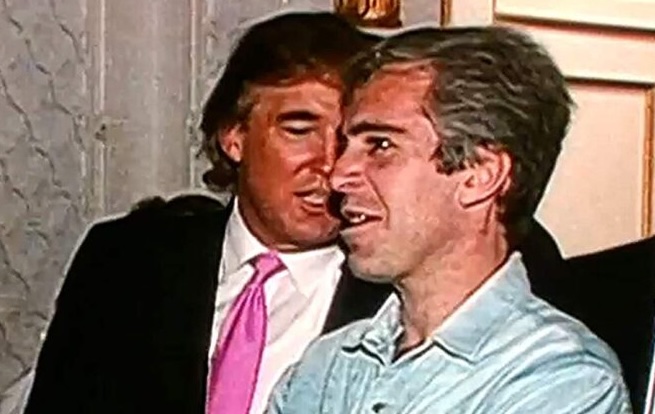
President Donald Trump spent a decade building a coalition that treats suppression as proof and denial as confession. The recent Epstein files just activated that machinery—against him.
That problem is not just about media mechanics. It is about audience conditioning. Trump is confronting a story tailor-made to trigger the reflexes he spent years sharpening.
That dynamic was on full display this weekend. The Trump Justice Department treated the release of Epstein-related documents as a procedural cleanup and moved quickly to declare the matter closed. Trump reacted to a joke about Epstein with a lawsuit threat. Government links appeared and disappeared. Each move reinforced the same underlying reality. Containment requires disengagement, and disengagement is not compatible with Trump’s political identity or his base’s worldview.
Epstein endures as a political liability because it resists narrative resolution. The documents are sprawling, uneven, and filled with allegation-level material that will never be cleanly adjudicated in public. In that environment, stories do not advance through proof. They advance through repetition, proximity, and reaction. This is the epistemological environment Trump helped build. For years, he trained his coalition to treat volume as evidence, repetition as confirmation, and official denials as proof of cover-up. That framework now applies to him.
The New York Times finding that Trump’s name appears more than 5,000 times across the Epstein files matters for precisely that reason. It does not function as a legal claim. It functions as a narrative accelerant. That number will circulate in the same spaces that once treated every Hillary Clinton email as dispositive. The benefit of the doubt Trump routinely denied others is not available to him now.
The administration’s handling sharpened the effect. Declaring the story finished while managing access to the files in real time turned process into performance. Trump’s threat to sue Trevor Noah completed the loop. Lawsuit threats do not drain stories of energy. They signal sensitivity. They tell supporters and critics alike that the issue remains live.
Here is the trap Trump cannot escape. The MAGA movement was built on the premise that elites protect each other and that document releases reveal hidden truths. Trump cannot suddenly ask that coalition to accept “nothing to see here.” He cannot deploy the establishment playbook against an audience he taught to distrust establishment assurances. The move that might work for another president is structurally unavailable to him.
This is the Frankenstein problem I’ve written about before and is at the heart of Trump’s predicament. He built the thing. He trained it to sniff out secrecy and recoil from denial. Now it does not distinguish between enemies and creator.
You can see the strain in the media strategy designed to contain it. As of 9:30 Monday morning, Epstein had not been mentioned once on Fox News since a 5 a.m. rerun of Big Saturday Night with Jimmy Failla. That silence is not accidental. It is an effort to starve the story of oxygen among the very viewers most conditioned to suspect a cover-up. Asking that audience not to notice what is missing is a high-risk maneuver.
The press responds to the same signals his base does. Visibility, reaction, perceived suppression. When Trump reacts, the story rises. When access tightens, motive becomes the headline. Both ecosystems feed on the same cues, and Trump keeps supplying them.
This story no longer needs new documents. It moves on reflex. Every attempt at closure confirms its relevance. Every effort to slow it resets the cycle.
That is why Epstein has not yet fully attached to Trump and why it still damages him. Conservative media, led by Fox News, continues to provide insulation, limiting exposure and dampening immediate political fallout. But insulation is not erasure.
Trump’s base was built on conspiratorial energy, on the belief that hidden files always contain damning truth and that exposure is the point of politics. That audience cannot simply be told the Epstein story is over, especially when Trump’s name saturates the record. The scandal lingers because it feeds a need Trump himself created. His supporters want pelts. They want revelation. They want confirmation that the system is corrupt. Epstein satisfies that appetite even when the trail leads back to Trump.
The monster has not turned on him completely, but it is no longer under control. And monsters that cannot be recalled do not quietly disappear.
This is an opinion piece. The views expressed in this article are those of just the author.
New: The Mediaite One-Sheet "Newsletter of Newsletters"
Your daily summary and analysis of what the many, many media newsletters are saying and reporting. Subscribe now!








Comments
↓ Scroll down for comments ↓