
5 Most Disturbing Details From The New York Times’ Stunning Trump-Epstein Investigation

The New York Times published its most comprehensive investigation yet into President Donald Trump’s relationship with Jeffrey Epstein on Thursday morning, and the portrait that emerges fundamentally contradicts years of Trump’s public denials about the depth of their friendship.
While the Times found no evidence implicating Trump in Epstein’s sex trafficking crimes, the investigation — based on interviews with more than 30 former Epstein employees, victims, and associates — reveals a social and personal relationship far more extensive than Trump has ever acknowledged. The piece includes what I believe to be a previously unpublished photo of the book, Art of the Comeback, with an inscription from October 1997 in which Trump wrote to Epstein: “To Jeff — you are the greatest! Donald.”
The piece cites multiple women describing a dynamic where the two men appeared to be competing for female attention. “I just think it was trophy hunting,” Stacey Williams, a Sports Illustrated swimsuit model from the 1990s, told the Times, describing how Trump groped her at Trump Tower in 1993 while Epstein — whom she was dating — watched. Trump has denied her account.
The stunning deep dive investigation, co-bylined by Nicholas Confessore and Julia Tate, which was published one day before a congressional deadline requiring the release of additional Epstein files, includes previously unreported details about the frequency of their contact, Trump’s presence at parties where trafficking occurred, and what Trump may have known about Epstein’s crimes. Here are the most notable revelations:
“I Was Donald’s Closest Friend for 10 Years”
That’s what Epstein told author Michael Wolff in a 2017 interview. The Times investigation suggests he wasn’t exaggerating.
Beginning in the late 1980s and extending into the early 2000s, Trump and Epstein maintained what multiple sources describe as an unusually close friendship. Former Epstein employees told the Times the two men spoke by phone “at least three times a week” during the mid-to-late 1990s. Trump was a “regular presence” in Epstein’s life, according to handwritten notes kept by one assistant.
Mark Epstein, Jeffrey’s brother, told the Times that his brother said Trump “was in the office all the time back then,” referring to Epstein’s Manhattan office in the Villard Houses. This directly contradicts a White House statement from this summer claiming Trump had never set foot there.
The relationship wasn’t just social proximity — it was intimacy of a particular kind. Multiple former Epstein employees recalled him putting Trump on speakerphone during office hours, sometimes when staff were present. Trump would discuss his sexual exploits in graphic detail. In one mid-1990s call, the two men discussed “how much pubic hair a particular woman had, and whether there was enough for Mr. Epstein to floss his teeth with.” In another, Trump described having sex with a woman on a pool table.
One assistant said Epstein seemed to enjoy making her uncomfortable by broadcasting these conversations.
The Party Circuit: Mar-a-Lago, Trump Tower, and Epstein’s Mansion
The Times documents nearly two decades of overlapping social worlds. The two men “prowled” Epstein’s Manhattan mansion, Trump’s Plaza Hotel, at least one Atlantic City casino, and both their Palm Beach homes, according to former employees and women who spent time in those spaces.
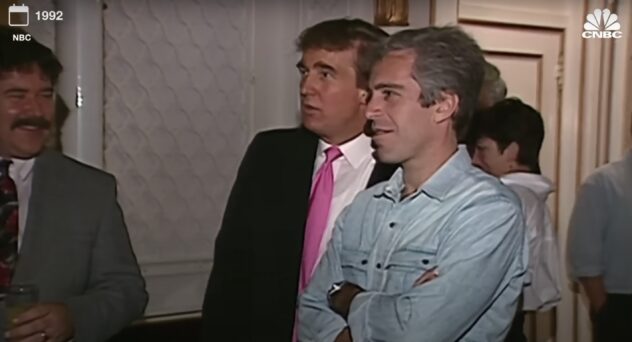
In 1992, NBC captured Trump and Epstein together at Mar-a-Lago for a party with Miami Dolphins and Buffalo Bills cheerleaders. In January 1993, Trump held another Mar-a-Lago party for potential beauty pageant contestants. The only other guest, according to organizer George Houraney, was Epstein.
The modeling and pageant world served as the connective tissue. Trump befriended Elite Model Management founder John Casablancas and Hawaiian Tropic founder Ron Rice, who told The Boston Globe he would send models to Mar-a-Lago at Trump’s request. Epstein cultivated a relationship with Victoria’s Secret owner Les Wexner, telling women he could arrange bookings.
Multiple models described being bused to Mar-a-Lago parties in the mid-to-late 1990s, often facilitated by Jason Binn, co-founder of Ocean Drive magazine. The events were open-bar, no one checked IDs, and young women — some as young as 14 — were given champagne. Tina Davis, who modeled for Ford, said she was told to “dress sexy” for a 1994 Mar-a-Lago party when she was 14.
Her mother recalled that waiters kept offering her daughter champagne, and that Marla Maples pulled her aside with a warning: “Whatever you do, do not let her around any of these men, and especially my husband.”
Maples denied making the comment but said, “I would always protect young women in any way I could.”
What Trump Knew
The Times reports that Epstein or Ghislaine Maxwell introduced at least six women who later accused them of grooming or abuse to Trump. One was a minor at the time. None have accused Trump of inappropriate behavior toward them.
But one woman told the Times that Trump attended all four parties at Epstein’s Manhattan mansion that she was coerced into attending in the early 2000s. At two of those parties, she said Epstein directed her to have sex with other male guests. She showed the Times a handwritten address book from that period containing Trump’s name and two phone numbers. She said Trump did not act inappropriately with her.
In emails released by Congress last month, Epstein claimed he “gave” Trump a 20-year-old woman whom Epstein dated in the 1990s. During a flight in the early 1990s, Trump came on to another Epstein employee, telling her “he could have anyone he wanted,” according to a different Epstein worker who learned of the incident.
Perhaps most significantly: In a 2019 email to Wolff, Epstein wrote of Trump, “of course he knew about the girls as he asked ghislaine to stop.” The Times notes the full context is unclear, but the implication is obvious — and damning.
In a 2010 deposition, Epstein was asked if he had ever socialized with Trump with girls under 18. He invoked the Fifth Amendment. He did so more than three dozen times during that deposition.
The Falling Out: Multiple Stories, No Clear Answer
Trump and his representatives have offered varying accounts of when and why the friendship ended. It was 2004 over a real estate dispute. Or 2007. Or whenever Epstein was banned from Mar-a-Lago for being inappropriate with a masseuse — or with the teenage daughter of a member. Or for poaching employees, including Virginia Giuffre, who said Maxwell recruited her from Mar-a-Lago’s spa in 2000 when she was 16.
The Times notes that Trump praised Epstein to New York magazine in 2002, calling him “a lot of fun to be with” and noting that he liked beautiful women, “and many of them are on the younger side.” Yet by 2015, as Trump prepared his presidential run, his lawyer Alan Garten told BuzzFeed that Epstein was merely “one of thousands of people who has visited Mar-a-Lago.” By 2016, Garten went further: “There was no relationship between Jeffrey Epstein and Donald Trump.”
That statement is now demonstrably false.
The Political Fallout
The Times investigation emphasizes something remarkable: The Epstein controversy has “shaken Mr. Trump’s iron hold on his base like no other.” In November, facing “an almost unheard-of revolt among Republican lawmakers,” Trump reversed course and signed legislation requiring the release of Epstein-related documents.
Those documents are due to begin emerging this week, though the statute allows Trump’s administration to withhold records identifying victims, classified information, or material that could jeopardize “an active federal investigation” — such as Trump’s newly ordered inquiry into Democrats associated with Epstein.
The Times concludes that while Trump is not accused of Epstein’s crimes, “the two men’s relationship was both far closer and far more complex than the president now admits.”
That’s putting it mildly. What the investigation reveals is nearly two decades of constant contact, shared social circles built around access to young women, mutual awareness of each other’s sexual behavior, and a friendship intimate enough that Epstein, years after their falling out, still considered Trump his closest friend for a decade.
Whether any of that constitutes criminal knowledge or complicity remains unclear. What’s no longer deniable is that Trump’s repeated claims of barely knowing Epstein — of having “no relationship” at all — are lies.
New: The Mediaite One-Sheet "Newsletter of Newsletters"
Your daily summary and analysis of what the many, many media newsletters are saying and reporting. Subscribe now!







Comments
↓ Scroll down for comments ↓