MSNBC’s Velshi Suggests Nations Are Welcoming Ukrainian Refugees ‘Because They’re White and Christians’

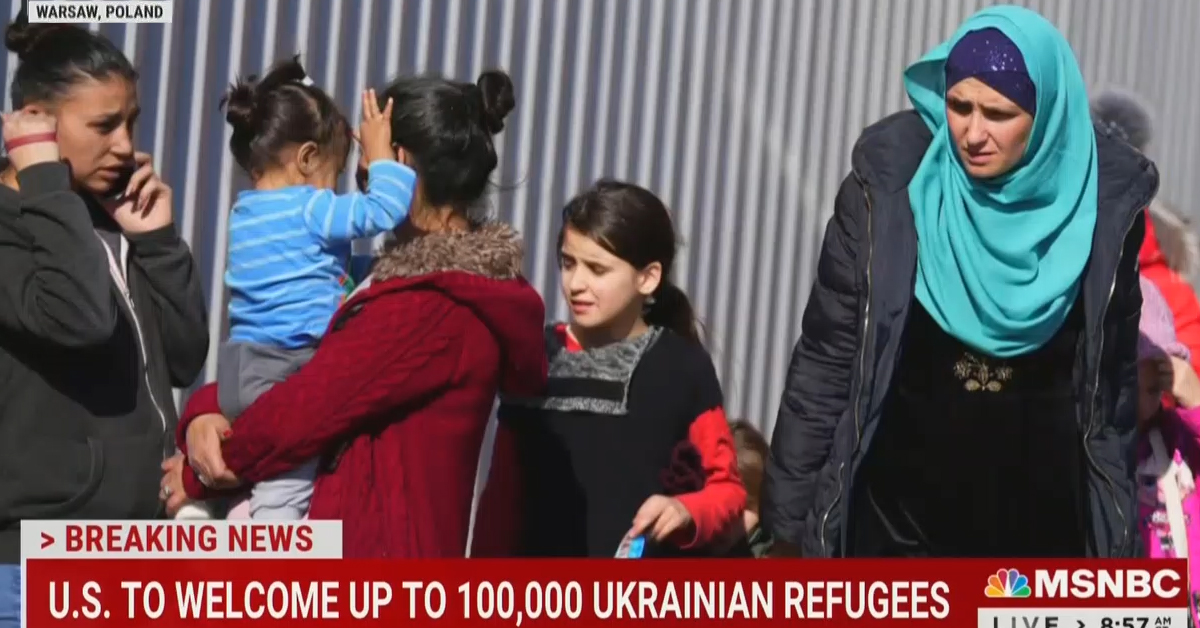
MSNBC’s Ali Velshi suggested twice that the willingness of the Biden administration, NATO nations, and the EU to take in Ukrainian refugees is motivated by prejudices, in a conversation with Atlantic writer Caitlin Dickerson.
Velshi has been reporting and anchoring from Poland throughout President Joe Biden‘s visit, and his coverage extended through when The Cross Connection with Tiffany Cross would normally air on Saturday morning, and he has covered the massive influx and diverse crowds of refugees fleeing the war zone.
Citing “a lot of people,” Velshi floated the idea that the United States and allies are doing a better job with refugees from Ukraine than with refugees of other conflicts in the past due to racial and religious preferences.
When he first brought up the notion, Dickerson pointed out that President Joe Biden initially tried “to reinstate” ex-president Donald Trump‘s historically low limits on refugee resettlement, but that “blowback” from Democrats convinced him to “eke” the numbers higher. That was before the Ukraine crisis. She also cited the logistics of having many millions right at the borders of these countries “all at once.”
Nevertheless, Velshi again floated that racism could be the reason Biden and other leaders are taking in so many refugees.
“I think I know the answer to this, but why have we not been good at this?” he said, implying the answer in the question. “We were not good with the Afghans. We were not good with the Syrians. We’re doing better with the Ukrainians, and a lot of people do sort of seem to think — and they deserve all the help we can give them — but a lot of people do seem to think it’s because they’re white and Christians and the other ones aren’t.”
Again, Dickerson noted the many complexities and the uniqueness of the situation.
“There are so many factors at play here, and I’ve spoken to a lot of experts this week who say it would be reductive to chalk up this distinction solely up to race,” she said.
Dickerson pointed out to Velshi that refugee resettlement isn’t merely a matter of charitable or “altruistic” motivations, but a tool used in international relations and in matters of dispute with non-allied nations.
“They’re also geopolitical tools that we’ve used historically to show our superiority, in a way, as a nation,” she said. “So when we accepted large numbers of people from Vietnam or from Cuba seeking communism, it was the same thing. It’s sort of the ultimate dig on the international arena to say to your enemy, you know, your people are fleeing – or people in this case, in the territory that you’re trying to take over – are fleeing and they’re coming to us for protection, that’s just how much superior we are as a country.”
“So it’s a way of helping people, but also showing our strength,” she said. “And also in this case, we have President Biden trying to show a sense of solidarity with the EU.”
A few weeks ago on CNN, Fareed Zakaria similarly explained to Don Lemon that attributing media attention or refugee policy to expressed racism is erroneous and ignores the particular realities of the situation in Ukraine in favor of a pat answer or particularly American grievances.
Velshi did not have time to reply again to Dickerson before the segment ended.
ALI VELSHI: I want to continue the conversation about refugees, I’m joined by Caitlin Dickerson, staff writer for The Atlantic, who covers the immigration beat. Caitlin, you heard this morning in the president’s conversation with the president of Poland. He recognized the fact that Poland is taking the vast majority of these refugees over two million. This city that I am in alone, Warsaw has taken more than 300,000 refugees. The United States has said that it will take 100,000. And a lot of people are saying, All right, that’s, you know, maybe we can do better than that in the United States. And yet it’s still better than we’ve done in other circumstances, including the Afghans.
CAITLIN DICKERSON: You’ll recall, Ali, that, you know, just a year ago, the president actually moved to reinstate President Trump’s historic low number of historic refugee resettlement, keeping it at 15,000 per year. And he faced so much blowback from Democrats in Congress that, you know, they ekes the number up slightly from there. But but 100,000, it’s a drop in the bucket. When you look at the overall number of Ukrainian refugees.
As you said, there are millions who are seeking shelter in Europe, but compared to recent American history, it’s a huge number and it has a lot of people calling into question. You know, why is that? Why couldn’t we raise the number of refugees for Syrians? Why couldn’t we raise the number of refugees for people from Afghanistan?
I actually spoke to the Secretary of Homeland Security about this, and he said that, you know, when you’re in the middle of an active conflict, it’s a lot easier in a way to go through this bureaucratic process of being presented with evidence and make a decision when you’ve got this overwhelming number of photos and accounts that are all coming in at once. It makes it easier to make this decision more quickly. But that’s of course not, you know, a bomb. It doesn’t make someone feel better whose family member may have died waiting to get into the US.
VELSHI: Why do you think? I mean, why have we? I think I know the answer to this, but why have we not been good at this? We were not good with the Afghans. We were not good with the Syrians. We’re doing better with the Ukrainians, and a lot of people do sort of seem to think and they deserve all the help we can give them. But a lot of people do seem to think it’s because they’re white and Christians and the other ones aren’t.
DICKERSON: There are so many factors at play here, and I’ve spoken to a lot of experts this week who say it would be reductive to chalk up this distinction solely up to race.
But as you point out, there’s this undeniable difference that has a lot of people frustrated. I mean, I can talk about what’s specific in this conflict and also just historically how the U.S. has used these policies, you know, as you and I have discussed, policies like asylum policies, like refugee resettlement and Temporary Protected Status, which we recently opened up to Ukrainians as well. That gives people who are already in the US undocumented or waiting for a resolution on their asylum case a year of protection.
These aren’t just altruistic policies, they never have been. They’re also geopolitical tools that we’ve used historically to show our superiority in a way as a nation. So when we accepted large numbers of people from Vietnam or from Cuba seeking communism, it was the same thing. It’s it’s sort of the ultimate dig on the international arena to say to your enemy, you know, your people are fleeing or people in this case, in the territory that you’re trying to take over are fleeing and they’re coming to us for protection. That’s just how much superior we are as a country.
And so it’s a way of helping people, but also showing our strength. And also in this case, we have President Biden trying to show a sense of solidarity with the EU. As you know, the entirety of the West is strategizing right now to prevent this conflict from growing into something larger. And so this is a way of saying to Europe, We’ve got your back. There’s a clearer sort of dog in the fight that the United States has, at least in the eyes of people who are making these decisions in Washington. But again, you know, we were talking about Syrians earlier Syrians who are facing a ground war just two years ago, as well as chemical weapons with help from Putin and couldn’t get that same support from the United States.
VELSHI: Caitlin, thank you. As always, we appreciate it.
Watch the clip above, via MSNBC.
New: The Mediaite One-Sheet "Newsletter of Newsletters"
Your daily summary and analysis of what the many, many media newsletters are saying and reporting. Subscribe now!









Comments
↓ Scroll down for comments ↓