1. Mediaite
  2. Gossip Cop
  3. Geekosystem
  4. Styleite
  5. SportsGrid
  6. The Mary Sue
  7. The Jane Dough
  8. The Braiser
Advertisement

Magazine Publishers Sneer At The Internet In Their Latest Print Ad

» 4 comments

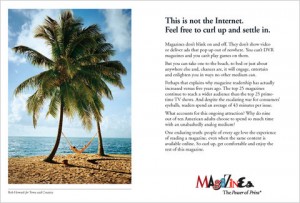
The Power of PrintIf you still read actual, physical magazines, chances are you’ve seen an ad touting “The Power of Print.” These collage-like notices, paid for by five major magazine companies (Condé Nast, Hearst, Meredith, Time Inc., and Wenner Media), glorify publications printed on dead trees. They’ve never launched a direct assault on the internet, though—until now.

The latest “Power of Print” ad features, on one page, a picture of a woman reclining in a hammock on the beach. Curiously enough, it doesn’t look like she’s reading a magazine. Regardless, though, she’s supposed to represent a type of enjoyment that these publishers don’t believe a person can get from reading the digital versions of magazines: “This is not the Internet. Feel free to curl up and settle in,” the opposite page begins. The ad continues:

Magazines don’t blink on and off. They don’t show video or deliver ads that pop up out of nowhere. You can’t DVR magazines and you can’t play games on them.

But you can take one to the beach, to bed or just about anywhere else and, chances are, it will engage, entertain and enlighten you in ways no other medium can.

Perhaps that explains why magazine readership has actually increased versus five years ago. The top 25 magazines continue to reach a wider audience than the top 25 prime-time TV shows. And despite the escalating war for consumers’ eyeballs, readers spend an average of 43 minutes per issue.

What accounts for this ongoing attraction? Why do nine out of ten American adults choose to spend so much time with an unabashedly analog medium?

One enduring truth: people of every age love the experience of reading a magazine, even when the same content is available online. So curl up, get comfortable, and enjoy the rest of this magazine.

Now take a minute to let the irony of reading this manifesto on your computer sink in.

[h/t Media Decoder]

Follow us on Twitter.

Sign up for Mediaite's daily newsletter.

Email Twitter Facebook Digg Reddit Stumble Upon Yahoo Buzz LinkedIn Tumblr Delicious
  • http://twitter.com/SailRabbits Magister

    I’m sure that I’ve revealed in response to one of Glynnis’ old anti-print posts that I subscribe to at least a half dozen magazines and I know that if not here, I’ve said on Twitter that there’s nothing like the feeling you get, when you go out to mailbox and find a new “Rolling Stone”.

    IOW: I’ve seen the ads in the physical magazines and if you’re only learning of them via the web, then you’re missing out. Which is kind of the point because I remember the ads, they’re generally toward the front and pretty much every magazine to which I subscribe is read cover-to-cover, not only during the time between issues, but for weeks, months and years afterward as they move from the coffee table to the bath, into the magazine rack and then to the basement, where they’re added to collection that in the case of “Rolling Stone” spans more than 25 years.

  • redwriteblue

    Magister said:
    I’m sure that I’ve revealed in response to one of Glynnis’ old anti-print posts that I subscribe to at least a half dozen magazines and I know that if not here, I’ve said on Twitter that there’s nothing like the feeling you get, when you go out to mailbox and find a new “Rolling Stone”. IOW: I’ve seen the ads in the physical magazines and if you’re only learning of them via the web, then you’re missing out. Which is kind of the point because I remember the ads, they’re generally toward the front and pretty much every magazine to which I subscribe is read cover-to-cover, not only during the time between issues, but for weeks, months and years afterward as they move from the coffee table to the bath, into the magazine rack and then to the basement, where they’re added to collection that in the case of “Rolling Stone” spans more than 25 years.

    You’re right, one of the great things is to flip-through a new issue of Rolling Stone or Wired and look at the ads and the article illustrations before starting to read one.

    The Evil Genius has plans for the Internet:

    http://www.flixya.com/post/brightlights/1989192/Apples_Plan_To_End_The_Free_Internet

  • ivanrich

    printed on dead tress? A little editorial comment there?
    You might want to check into the ecological impact the internet has and will have on the natural resources of this planet. The energy production involved, the e-waste, etc. etc. It is not without its impact.
    Cheap – and rather ill-informed – shot.

  • William Kelleher

    Critical
    Literacies Assignment 3

    Critical Text
    Analysis of an Advertisement


    William Kelleher Student Number 566746

    A South African view … (William Kelleher: willkelleheremails@yahoo.co.uk)

    If “all texts are positioned and positioning”
    (Janks, 2010 : 98) then none more so than advertisements.  At the very least these texts work to promote
    consumerism.  At most they present
    features of disrespect for the environment, machismo, paternalism, sexism and
    othering that border on the unethical.  In
    addition, since advertising is purposeful and market-driven the effects that it
    produces are not anodyne or theoretic but observable – changing people’s
    behaviour and position in the world.  If
    that were not enough advertising is massive and pervasive; accompanying us
    throughout the day and in a wide range of media.


    The advert with which we are concerned promotes
    a particular type of media: magazines. 
    It does so in a very interesting way. 
    Firstly it relies on its position as mouthpiece to include within its
    range the common attributes of many different magazine publications.  This advert for instance relies on the
    sporting coverage that magazines provide. 
    However, in a different advert for the same campaign the theme was
    travel and documentary photography as done by Bruce Dale for National
    Geographic.  Secondly, two media types
    are opposed.  If the internet is ‘surfed’
    then magazines are read, or by opposition with surfing, ‘swum’.  This allows a third step in which opposing
    lexical fields are constructed.  Internet
    is ‘exhilarating’ but ‘fleeting’ whilst magazines are ‘enveloping’ and ‘immersive’.  Fourthly, a reduction takes place.  Even as people who use Internet are qualified
    as being addicted or ‘hooked’, Internet itself is reduced to information
    searching as in the Google engine. 
    Finally a simple argument is proposed: new media do not replace old
    media.  In a reminiscence of Hegelian
    dialectics movies clash with radio, TV clashes with movies but in each case the
    movement of history allows both to find their place in a new synthesis.  This new synthesis is presented in terms of
    the extended metaphor that has been running throughout the text since the two
    opening claims.  From “We surf the
    Internet.  We swim in magazines.” the
    argument as recapitulated reads, “Which is why people aren’t giving up
    swimming, just because they also enjoy surfing.”


    What an extended metaphor such as surfing and
    swimming allows in addition to a fairly lame joke about internet use is to
    complete the advert with a close up picture of Michael Phelps emerging from a swimming pool and taking off his
    goggles.  The visual metaphor completes
    and extends the text since Michael Phelps echoes the lexical fields surrounding
    Internet and magazines (‘immersive’ and ‘exhilarating’) whilst adding a
    reference to the visual interaction with on-line content and magazine
    illustrations.  The enigmatic nature of
    the photograph and the clouded goggles seem to add a question … Are we blinded by Internet?


    Such as it is, the above description offers a
    first approach to the ‘Magazines’ advert. 
    Its basic mechanisms are exposed. 
    What is not dealt with however is the background motivations of such a textual artefact.  It has been investigated but not interpreted,
    interpreted but not explained.  It needs
    to be situated and contextualised.  Janks
    (2010) proposes several ways of doing this. 
    Three will be adopted in this essay whilst an argument will be made for
    involving a fourth approach.


    Firstly, the composition of a text which
    positions its reader involves choices of inclusion and exclusion.  A choice to include a particular realisation
    of mood, subject and theme involves a corresponding choice to exclude other
    wordings.  In reference to Halliday’s
    functional analysis of text this can be called realisation of meaning
    potential.  A first method of situating a
    text is then to analyse it in greater detail to see how meaning is realised.  Secondly, image and text are both sign
    systems.  Colour, disposition of
    elements, depiction in an image are used in the same way that words, clauses
    and cohesion create textual meaning. 
    Kress and Van Leeuwen (2001) call this multimodality since ‘mode’ means
    for them any understood and conscious manipulation of sign systems.  Following Janks a way of accessing the
    meanings in an image is the use of call outs to explain features of an image in
    a non-linear way.  This technique is
    drawn from the work of D. Alder and has been used here in annexe 1.  Finally a multimodal text, once understood, can
    be successively situated in terms of production and the conditions for such
    production.  Fairclough’s (1989: 142)
    work in this regard derives from cognitive sociology and Cicourel’s research
    into interpretative procedures.  When
    inserted into a critique of power and ideology these successive ‘frames’ or
    ‘schemata’ move from the semantics of utterance to cohesion and pragmatics, to
    local intertextual and interactional context to situational context and social
    order.


    In this text only one person gets the floor –
    the copy writer for ‘Magazines’.  The
    predominant mood is that of statement with the overwhelming majority of such declarative
    clauses being positive.  There are two
    negative statements concerning movies and TV but these are associated with a
    verb having negative connotations (KILL) and thus the negation of this
    connotation has a positive effect. 
    Similarly when Internet is placed in a negative clause the predicator
    for the ‘new medium’ is ‘DISPLACE’ (a verb containing a negative prefix) and
    the overall meaning is positive.  Finally
    ‘people’ (the third person referent for the ‘we’ of the first line) is combined
    through finite operator with ‘GIVE UP’ and the effect of juxtaposition of a
    negative phrase with negative verbal periphrasis is also positive.


    The result of this positive polarity is to
    create a sense of the categorical and the definite.  In the table (Annexe 2) are listed the
    predicators used and the processes with which they are associated.  Internet is associated with verbs such as
    ‘GRAB’ and ‘DISPLACE’ which are fairly direct in terms of connotation (but
    modified in the sense outlined above). 
    As for the reading of magazines however, the verbs such as ‘EMBRACE’,
    ‘RISE’, ‘GROW’ and ‘INCREASE’ or again ‘CONTINUE’, ‘FLOURISH’ and ‘OFFER’ have
    obviously positive connotations.  There
    is also the fact that the copulative ‘BE’ by establishing a thematic equative
    works repeatedly to directly associate ideas and moves in the argument.  The above points are given force in the third
    paragraph which (symmetrically situated between the opening and closing two
    paragraphs) uses the vocative ‘THINK’ to interpel the reader.


    In terms of process, ‘THINK’ is mental,
    referring to the internal processes of the reader.  This vocative interpellation literally forms
    the link with the other material and relational processes that give substance
    to the text (cf annexe 2).  This is not
    surprising since references are in the most part exophoric, referring to what
    media do and effect.  The thematic progression
    reflects this.  Whereas thematically the
    first third, approximately, of occurrences are experiential, from the
    interpersonal ‘THINK’ onwards the themes become textual, serving to cohere and advance
    the argument.  There is only one instance
    of modalisation in the passage (which refers to the ‘established medium’ which
    is the magazine format).  Here, towards
    the end of the text, ‘CAN’ is used rather surprisingly and in contrast to the
    categorical, definite tone of the rest. 
    Presumably the objective is to include a sense of possibility, of
    freedom.


    This latter point is better captured by
    considerations of texture.  Internet is
    subject for only five clauses and theme for only four whilst magazine reading
    carries the rest of the text.  Of the
    occurrences of ‘Internet’ however the word is replaced twice: once by a
    hyperonym – ‘new media’ – and once by a hyponym ‘Google’.  This cohesive technique in the text has
    specific effects.  It defines Internet as
    new and limits its action to search engine functions.  Similarly magazines are replaced by the
    corresponding (collocational) activity of reading and the role of ‘reader’
    whilst the hyperonym of ‘media’ which initially referred to the Internet is
    later captured through adjectives such as ‘established’ to refer twice,
    exclusively, to magazines.  In all,
    ‘magazine’ is repeated seven times, Internet five times and media four times
    (cf annexe 2 for a fuller analysis of subject and theme).


    Texture is achieved at the level of structure
    through theme and information whilst at the level of cohesion it is a function
    of reference, ellipsis and substitution, conjunction and lexis.  In terms of lexis: collocation, repetition
    and synonymy are important devices in this text.  Magazine becomes associated with the
    personal, the material and in turn is attached to nouns and adjectives such as
    ‘unique’, ‘loyalty’ and ‘growth’.  This
    latter epithet is in addition a nominalisation of a verb which appears in the
    first paragraph and thus repetition creates an effect of closure.


    Reference here involves specific effects of determination.  It is interesting to note that whereas ‘Internet’
    is systematically associated with ‘the’, ‘magazines’ and ‘readers’ are
    associated with the zero article.  The effect is one of changing distance.  Throughout the article the Internet is
    distanced whereas magazines are closer, more immediate, more generalisable
    since closer to the notion or referent. 
    It is a similar preoccupation with distance from the reader that prompts
    the use of the inclusive we at the start of the advert.  By including the reader in the term of reference
    a sense of impact and immediacy is again achieved.  Why then should the text end with ‘people’
    and ‘they’?  The answer is to be found in
    thematic analysis.  Because the last
    clause starts with ‘just because’ which is a textual theme if ‘we’ were used it
    would have an exclusive, anaphoric connotation. 
    It is necessary to revert to ‘they’ to give the last clause an axiomatic
    interpretation more in line with the categorical tone of the whole.


    As to the image that accompanies this text, it
    is taken from the front cover of a sports magazine – ESPN.  In its original context it showed Michael
    Phelps (the Olympic swimmer) seemingly emerging from the pool with his goggles
    clouded up and in the act of taking them off. 
    The photograph was accompanied by titles which referred to Phelphs’
    sexual attraction and sporting prowess. 
    The photograph in its original form was taken by Jim Fiscus who was
    elected photographer of the year in the 2005 Lucies and is known for his
    post-produced work in high-profile advertising campaigns for Levi’s and Nike.


    The image that accompanies the advertisement
    has been altered to become both a symbolic image and a narrative image.  It is narrative because there is a clear
    vector or direction to the gaze of the man in the photo which stares directly
    out of the frame and thus participates with the reader.  It is symbolic because of its suggestive
    power.  The focus, the action, the
    framing of the hands and the face (in close up) symbolise many of the
    dichotomies that are referred to in the accompanying text.


    This has been achieved primarily through
    cropping.  Firstly the frame of the photo
    has been tightened to emphasise the eyes, the face and the hands and remove
    both banner and magazine title.  Michael
    Phelps loses his name and becomes, literally, a symbol: of sport, power and determination.

    In cropping, the frame has also been elongated
    to emphasise the physiognomy of Michael Phelps. 
    His mouth has thus become smaller, less generous and his eyes have been
    displaced from centre to top of frame giving the photo a lower angle and
    introducing notions such as domination of frame, superiority etc.


    Focus has been changed through cropping.  The goggles are salient and their being
    clouded up now takes on a new significance through the accompanying text.  In their new setting (both in-frame and
    out-of-frame) there is ambivalence between the internet and magazine reading
    with vision being obstructed to become the object of the reader’s gaze.  The similarity between the words google /
    goggle is exploited and the focus of the photograph serves as a visual metaphor
    for the verbs used in the text: ‘surfing’, ‘reading’, ‘noticing’, ‘demonstration’
    and ‘display’.


    In a photo dominated by regularity and
    symmetry there is only one stray end so to speak – the elastic which breaks – and
    therefore emphasises – the gesture of hands and composition of frame.  As said above, the proportions of the
    original photograph have been changed to situate the eyes of the man towards
    the top of the frame instead of slightly off-centre as in the original.  This has a further consequence.  Following the table in Janks (2010) there is
    a correspondence in images with what Halliday notices in phrase onset.  The right therefore corresponds to the new
    and the bottom to the given, whilst the top corresponds to the ideal and the
    bottom to the real.


    The top (the ideal) is now dominated by the
    gaze, by the corresponding actions of seeing and touching with the hand.  The parallel with the text is now even more
    evident.  Whereas the text juxtaposes
    internet and magazine, the photo now juxtaposes the virtual and the
    tangible.  In addition, the left hand
    (the given), with the fingers curled away from the thumb and index seems to
    recall a pincer movement, framing in turn the lens of the goggles and providing
    horizontality.  The photo is literally
    cut at the level of the eyes.  On the
    right (the new) the hand is flatter and evokes more an action of shielding the
    eyes to look into the distance, the future.


    Salience has been achieved with respect to the
    gaze and gesture but cropping has also given salience to the picture as a
    whole.  The photo has become a close-up
    as opposed to a medium shot.  The effect
    of a close up is to enhance invasiveness, the reader is closer to the image
    than he or she would be in real life. 
    The details of the face portrayed impose a feigned intimacy that gives
    little away and forces a movement of the reader’s eye across the face whereas
    in a medium shot the face as a whole can be captured.  One is literally reading the face in this
    kind of close up and what is read (flattened by absence of perspective and the
    featureless blue background) achieves meaning.


    We have seen how, textually, the reader is
    interpelled once, in a vocative, mental process and how the text as a whole
    constructs its meaning using reference, connotation, synonymy and control of
    theme and process.  In a similar way the
    image has been cropped and modified to better reinforce the meaning that
    emerges from the text.


    It is now time to turn to the questions that Janks
    poses of a text: Who is speaking to whom? 
    What is going on? Who is involved? 
    What relations exist between them? 
    What is the discourse type? What is the socio-historical context?  What power relations: social, institutional,
    situational shape this discourse?


    A first approach to these questions could look
    at the signs of agency in this advert. 
    These are effaced and minimalised, but they achieve more impact from
    being underemphasised.  The logo
    ‘Magazines’ is in fact a word composed with the letters from a collection of
    famous magazines: the ‘T’ is from Time, the ‘Es’ from Esquire, the ‘G’ from GQ,
    the ‘A’ from Marie-Claire, the ‘N’ from National Geographic etc.[1]  Agency is therefore shared, collective and
    the slogan: “The Power of Print” with the italics (not hypertext)
    and alliterative appeal reinforces this. 
    It is not one specific agent that is being represented but a concept:
    print, font, the printed word, a typeface printed on paper as opposed to being
    projected on a screen.


    This can be offset (literally and
    figuratively) against the identification of the photograph itself.  Whereas one could expect to see Michael
    Phelps’ name under the image we read that of the photographer and of the
    magazine from which it is taken.  This is
    copyright information and at the same time a means of reinforcing magazines as
    actors, sponsors and promoters of events and of other media.


    But the transition to magazines as actors in
    the full sense of the word leads to a further consideration of discourse and of
    discursive frames.  In this new situation
    magazine texts become a part of the intertextual context of magazine discourse
    and in turn magazines themselves become a frame of reference.  What is then projected out from this one
    advert with its categorical phrasing and its photograph of a man with virile,
    dominant undertones is the whole institution of magazine publishing.


    Press kiosks and shelves strike us with their objectified,
    glossy rendering of both men and women.  How
    many times is the word ‘sex’ used to sell a magazine issue?  How many photos of semi-naked women in
    bikinis boost headlines from sliming to holidays?  How many fat or middle-aged men adorn covers
    … unless of course they have the advantage of being in key financial and
    institutional positions such as CEO or finance minister?


    The point of Fairclough’s successive contextualisation
    is to allow us to make these links between text, discourse and ideology and to
    see behind seemingly anodyne texts the deeper questions of power and subjection
    to the gaze of naturalised positions on age, sex, media and reading habits.


    As I noted in a previous assignment however,
    this is to use language to access understandings
    of power and to use power to
    understand the choices in meaning potential of language.  Language itself is however, in essence,
    expressive and communicative.  To return
    to the link between photograph and text, the photographer himself, Jim Fiscus, puts
    it nicely, “The photo has to illustrate the concept, obviously, but the look of
    that photo is what determines the emotional response.” (Stocklandmartel
    accessed September 2011).


    It would be advantageous to take language in
    its own terms and to seek a model that allows expressive features to be tackled
    in their own right.  One theory that does
    this is interactionism (Goffman, 1959). 
    The idea of performance, of a projection
    and an impression of reality serves
    to investigate human beings’ expressive behaviour.  In many ways this theory parallels and
    extends the contextualising movement of an analysis such as Fairclough’s based
    on orders of discourse and ideology.


    Reality, when projected, must involve belief -
    or cynicism – in what is being projected but the operation of such an
    impression of reality on a societal scale leads to use of front and idealisation.  Idealisation
    recalls the manner in which ideology supposes the naturalisation of discourse
    and is the adaptation (or failure to do so in the case of negative
    idealisation) of a performance to the common, official values of society.  Fronts are those generalised,
    institutionalised and abstract standardisations of appearance (status) and
    manner (behaviour) into which given situations which are infinite and varied
    can fit more or less tightly. 
    Conceptually and in terms of behaviour this concept is not dissimilar to
    that of frames or schemata of reference but with a double operation since they
    are used both naively and cynically.


    The motivation of performance is thus different
    to the enervation of power.  The performer seeks coherence in his/her
    act.  The impression of reality projected
    must not be found to be cynical.  Maintenance of expressive control,
    mystification and contrivance are called upon to ensure communicative and
    performative success.


    This will shed a new light on the ‘Magazines’
    text because in fact the advert as a whole is just a standardised front. 
    There is no company called ‘Magazines’, this is not an advert.  It is a contrived performance which attempts
    to convince would-be advertisers to
    invest their communications budgets in printed media.  For, behind what is not a logo (‘Magazines’ as such is an unregistered and inutilisable
    trademark) lies MPA (presumably the Magazine Publishing Association although no
    information on the acronym was available) the ‘Association of Magazine Media’
    which was founded in 1919.  As a
    commercial association of magazines its role is to be seen to promote magazine publishing as such and this is why it
    must adopt a categorical, positive outlook on the growth and health of the
    sector.  The slogan which can be registered under the association
    reflects this nicely, ‘The power of print’.


    What an interactionist analysis accesses that
    a critique based on power cannot is the fact that this ‘advert’ is intended as
    much for the members of MPA themselves as it is for future magazine readers and
    advertisers.


    Times have obviously changed since 1919 and
    html isn’t what it used to be.  The claim
    made within the ‘Magazines’ advert (that in the last twelve years magazine
    readership has increased 11%) rings hollow when compared to internet access
    statistics from 1998 to 2008.  In America
    Internet grew from just over 84 million to more than 230 million (almost 300%
    growth) whilst in South
    Africa comparable figures give a rise in use
    from 1,266, 000 to 4,187, 000 (more than 300% growth)[2].


    It is this fragility of the medium that this
    text is designed to opacify.  The
    categorical tone, the carefully cropped and edited photograph, the argument of
    the text and the control over reference, theme and process used in the wording
    are there to hide a discrepant reality.  An
    idealised front is here projected through language but the actor who projects
    this reality is aware of the misrepresentation
    and connivance; purposely using a naturalised discourse as a tool in a projection of reality.

    References:


    Statistics on internet use available from BBC
    website: http://news.bbc.co.uk/2/hi/8552410.stm
    (consulted September 2011).


    Bruce Dale photograph used in National
    Geographic available at http://powerofmagazines.com/latest-ad.html
    (consulted September 2011).


    Biography of Jim Fiscus captured on
    Stocklandmartel (accessed September 2011). 
    http://www.stocklandmartel.com/talent/jim-fiscus/bio


    Fairclough, N.
    (1989). Language and power. New
    York: Longman.


    Goffman, E. (1959). The
    Presentation of Self in Everyday Life (original re-edition ed.). New York: Anchor Books,
    Random House.


    Halliday, M. A. K.
    (1994). An Introduction to Functional Grammar: Second Edition. London, Melbourne, Auckland: Edward Arnold.


    Janks, H. (1998).
    Reading womanpower. Pretexts: studies in writing and culture, 7(2),
    195-211.


    Janks, H. (2010).
    “Language as a system of meaning potential”: the reading and design
    of verbal texts. In T. Locke (Ed.), Beyond the grammar wars (pp.
    151-169). New York:
    Routledge.


    Janks, H. (2010). Literacy
    and power. London and New York: Routledge.


    Kress, G., & van
    Leeuwen, T. (2001). Multimodal
    Discourse: The Modes and Media of Contemporary Communication. London: Arnold.

    [1] I would have identified more, but to be honest, I don’t often read
    magazines, and, in addition, most of the information for this analysis I got –
    ironically – from an internet search!

    [2] Statistics available on the BBC website: http://news.bbc.co.uk/2/hi/8552410.stm

© 2012 Mediaite, LLC | About Us | Advertise | Newsletter | Jobs | Privacy | User Agreement | Disclaimer | Power Grid FAQ | Contact | Archives | RSS RSS
Dan Abrams, Founder | Power Grid by Sound Strategies | Hosting by Datagram