What’s Ted Cruz Really Up To? 5 Must-Read Articles

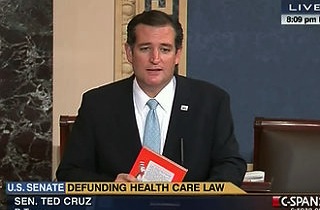 Senator Ted Cruz (R-TX) is filibustering a bill he wants passed, except it’s not really a filibuster, and Republicans are more pissed off at him than Democrats, and there’s no chance of him stopping ObamaCare even if he reads all the Dr. Seuss in the world. So what’s Cruz’s play here?
Below are five articles spanning the ideological spectrum and attempting to discern what Cruz is up to, whether he’s showboating or strategizing, and what he might actually win by losing.
1. It’s Not a Filibuster (Tara Culp-Ressler, ThinkProgress)
Even C-SPAN put up an explainer on all the ways Cruz’s marathon monologue is not, technically or spiritually, a filibuster. He’s not stopping a bill from gaining cloture (the Senate will vote on that later, anyway), he’s doing it with Senate Majority Leader Harry Reid’s permission and with a specified cut-off point, and it’s a bill he wants passed. In other words, Cruz is only fulfilling one of the requirements of the “talking filibuster.”
ThinkProgress’ Tara Culp-Ressler explains why his efforts won’t yield any results, either in stopping the vote or in stopping ObamaCare.
“A government shutdown could actually ironically help the law’s popularity,” Culp-Ressler said, citing E.J. Dionne’s op-ed. “That’s because, if the health law’s enrollment period experiences a few hiccups along the way (as any new government program undoubtedly will), this political battle may convince Americans that Republicans are actually to blame for that.”
2. But That Doesn’t Matter to Cruz (Ben Domenech, The Federalist)
So Cruz’s faux-filibuster, and the effort to defund ObamaCare that it highlights, are largely symbolic actions—and that’s the point, argues Ben Domenech.
“Taking this harsh step—attaching things to funding, the debt ceiling, and the like—happens because the president is so unwilling to come to the table,” Domenech wrote in the Federalist. “It is designed to highlight extreme differences in policy, not actually change that policy…Just as Rand Paul had no illusions about altering U.S. drone policy when he went to the floor, the aim is changing the conversation and focus, not the policy.”
3. But It Should Matter to the GOP Base That Believes in Him (David Freddoso, Conservative Intel)
Cruz may be taking a stand, and he may be inspiring a conservative base by doing so, but what’s the point of igniting passions, David Freddoso wondered, if they are immediately doused by defeat?
“When the strategy fails, as it must, do the grassroots just shrug off their enthusiasm and say, “’Aw shucks, we’ll get ‘em next time?'” Freddoso wrote in Conservative Intel. “Conservative voters and small-dollar donors aren’t fools. You can’t whip them up into a frenzy, fail them, and then just pat them on the head like it never happened. The illusory promise of an easy shortcut to beating Obamacare will leave a bitter aftertaste, resulting in anger, a loss of trust, and even withdrawal from the political process.”
Freddoso’s piece isolates the real problem perplexing the right over Cruz’s mission: the confusion of ideological desires and strategic wisdom. Cruz’s supporters see those who don’t join him as lacking ideological purity—but most of Cruz’s critics on the right agree with his aims, while finding his scorched-earth strategy recklessly counterproductive. Defeating ObamaCare is more likely if conservatives win elections, goes the argument—which they might not if they burn their base with Pyrrhic victories.
“I don’t know who will bear the blame,” Freddoso wrote. “But it’s not hard to see why bona fide conservative lawmakers, including people who have previously jeopardized their careers by sticking it in the eye of the leadership and the GOP establishment, are unhappy about this situation right now.”
4. Or is Cruz Playing the Long Game…? (Nick Gillespie, Daily Beast)
Nick Gillespie sees Cruz as part of an emerging cadre of conservative legislators who are scrambling traditional partisan divides in ways that could reshape voting patterns.
“There’s every reason to believe that the future belongs to the wacko birds and their general, transpartisan message that government is too big and too powerful,” Gillespie wrote in the Daily Beast. “Commentators who think these guys are in politics only for themselves are missing the energy that’s driving the wacko birds. Maybe, just maybe, they really do believe in shrinking the size, scope, and spending of the federal government. And maybe they realize that their vehicle of choice, the Republican Party, really does need to reach out to new swaths of the electorate while holding on to conservatives.”
Even if Cruz loses this battle, according to Gillespie, he and Paul and laying the groundwork for a more agile and inclusive conservative movement—one that may look back at Paul and Cruz’s twin filibusters as foundational stands.
5. If He Is Playing the Long Game, It’s An Expensive One (McKay Coppins et al, BuzzFeed)
Not impressed by Cruz’s tactics: some major GOP donors.
“According to several Republican sources, most of whom declined to disparage a rising star on the record, the party’s donor class is rolling its eyes at Cruz’s last-minute, long-shot attempt to keep the controversial health care law from fully going into effect—dismissing it as unintelligible parliamentary trickery at best, and counterproductive self-promotion at worst,” wrote a BuzzFeed tag-team. “While activists may take visceral satisfaction in Cruz’s campaign, many donors are more results-oriented—and they’re savvy enough to know that none of his maneuvering will actually stop the law from being implemented.”
While BF noted that grassroots can vaunt a candidate if they coalesce around one—see 2010, primaries of—it’s just as likely to generate feckless celebrity-disractions like Herman Cain or Michelle Bachmann, better at getting press than either funds or results.
“When the Wall Street Journal starts to belittle you…” one GOP aide said.
[Image via the Plazz]
——
>> Follow Evan McMurry (@evanmcmurry) on Twitter
New: The Mediaite One-Sheet "Newsletter of Newsletters"
Your daily summary and analysis of what the many, many media newsletters are saying and reporting. Subscribe now!





Comments
↓ Scroll down for comments ↓