1. Mediaite
  2. Gossip Cop
  3. Geekosystem
  4. Styleite
  5. SportsGrid
  6. The Mary Sue
  7. The Jane Dough
  8. The Braiser
Advertisement

Democratic Senators Push For Filibuster Reform– While They Only Need Simple Majority

video
» 20 comments

After a tumultuous lame duck session, Congress is getting ready to get back in gear, and the Senate in particular appears ready to tackle some practical business: the use of the filibuster, which Democrats appear poised to reform. Given that, for one day, a simple majority at the beginning of a session may change floor rules, the death of the filibuster appears, if not imminent, at least possible.

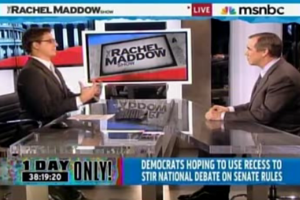
Chris Hayes, filling in for Rachel Maddow, took on the subject on The Rachel Maddow Show with one of the senators leading the charge: Jeff Merkley of Oregon. Hayes did little to hide his excitement at the death of the filibuster, though feared his “hopes dashed” by the limited time frame. Sen. Merkley assured him that, while it is customary (and logical) to change rules on the first day, it was “precedent,” but the Constitution did not limit reforms to that day.

Hayes was also concerned about the momentum for change in the Senate, another issue on which Sen. Merkley reassured him. While Republicans appeared to resist the change, and it’s “very hard to get people to pay attention to something as important as this,” the pressure has been mounting on the Senate to reform the filibuster as its use becomes more frequent, causing, he concluded, “hundreds of House bills never taken up because there will never be time.”

While the media will have to wait a few days to see whether congressional inertia will be overcome on this issue, at least, it appears, the senator left Hayes’ optimism intact.

The discussion via MSNBC below:

Follow us on Twitter.

Sign up for Mediaite's daily newsletter.

Email Twitter Facebook Digg Reddit Stumble Upon Yahoo Buzz LinkedIn Tumblr Delicious
  • BarneyFranken

    This will set a bad precedent. What is to stop Republicans from changing it back or other Senate rules when they have the majority in 2012?

    And yes, I said when, not if.

  • tigerprez

    The fix has been in on getting rid of the filibuster since the day Obama was elected. They knew his agenda would be so unpopular that they would lose the 60 votes in the Senate, and they know there’s no way that they can enact the remainder of Obama’s agenda without subverting the rules of the Senate. If only they could figure out a way to get rid of the filibuster and then bring it back when the Republicans take back the Senate in 2012, they’d be set. Instead, they’ll regret nuking the filibuster when they watch all their work rolled back as soon as the Republicans have a simple majority.

    Welcome to the new Congress, where no one’s work lasts a day after they’ve left office.

  • Grammie

    I’ll let the incomparable Charles Krauthammer speak for me on this.

    “In the latter days of the Carter presidency, it became fashionable to say that the office had become unmanageable and was simply too big for one man. Some suggested a single, six-year presidential term. The president’s own White House counsel suggested abolishing the separation of powers and going to a more parliamentary system of unitary executive control. America had become ungovernable.

    Then came Ronald Reagan, and all that chatter disappeared.”

    “It’s 2010 and the first-year agenda of a popular young president has gone down in flames. Barack Obama’s two signature initiatives – cap-and-trade and health care reform – lie in ruins.

    Desperate to explain away this scandalous state of affairs, liberal apologists haul out the old reliable from the Carter years: “America the Ungovernable.” So declared Newsweek. “Is America Ungovernable?” coyly asked The New Republic. Guess the answer.

    The rage at the machine has produced the usual litany of systemic explanations. Special interests are too powerful. The Senate filibuster stymies social progress. A burdensome constitutional order prevents innovation. If only we could be more like China, pines Tom Friedman, waxing poetic about the efficiency of the Chinese authoritarian model, while America flails about under its “two parties … with their duel-to-the-death paralysis.” The better thinkers, bewildered and furious that their president has not gotten his way, have developed a sudden disdain for our inherently incremental constitutional system.”

    “And then, of course, there’s the filibuster, the newest liberal bete noire. “Don’t blame Mr. Obama,” writes Paul Krugman of the president’s failures. “Blame our political culture instead. … And blame the filibuster, under which 41 senators can make the country ungovernable.”

    Ungovernable, once again. Of course, just yesterday the same Paul Krugman was warning about “extremists” trying “to eliminate the filibuster” when Democrats used it systematically to block one Bush (43) judicial nomination after another. Back then, Democrats touted it as an indispensable check on overweening majority power. Well, it still is. Indeed, the Senate with its ponderous procedures and decentralized structure is serving precisely the function the Founders intended: as a brake on the passions of the House and a caution about precipitous transformative change.”

    http://www.redding.com/news/2010/feb/19/charles-krauthammer-when-left-fails-it-blames/

  • gedgeler

    BarneyFranken said:
    This will set a bad precedent. What is to stop Republicans from changing it back or other Senate rules when they have the majority in 2012?

    Why would they want to change it back? When Republicans get a Senate Majority, I imagine they’d quite like to use it without needing Democrats onside!

    tigerprez said:
    The fix has been in on getting rid of the filibuster since the day Obama was elected. They knew his agenda would be so unpopular that they would lose the 60 votes in the Senate, and they know there’s no way that they can enact the remainder of Obama’s agenda without subverting the rules of the Senate.

    There’s also no way they get the rest of his agenda enacted without at least some Republican votes in the House.

  • Gasket

    BarneyFranken said:
    This will set a bad precedent. What is to stop Republicans from changing it back or other Senate rules when they have the majority in 2012?

    And yes, I said when, not if.

    No kidding! That is DEAD ON!

    DEMS are really dumb for pursuing this. This would be a good endeavor if the GOP was to be trusted. They are dealing with a nefarious opponent who has never shied away from getting dirty. They (GOP) also have the best spinmeisters (FNC) and messaging system (Talk Radio) than they do to orchestrate this sophistry. If I am the GOP, I would agree to this Dem request, kill the filibuster then overturn all of Obama’s legislation. They can do it with 51 votes in the Senate by flipping the weak kneed 2012 vulnerable Dems (Tester, Manchin, Both Nelsons et al). Of course they have more than enough in the house to do it. Granted Obama would veto that stuff, but, what better way to hype and amp their base for 2012 where they can promise to “finish the job” after they kick Obama out? I can see it now. After they kick Obama out and pass ultra conservative legislation, they would then reinstate the filibuster and all that stuff would be practically impossible for a future DEM congress to reverse. Do the Dems have strategists to know that this is a really BAAAAAAAAAAD idea? The myopia here is stunning!

  • Just4thefax

    Fact: I like the filibuster because the less they do the less it effects me!

  • Probably NOT wrong

    I watched for 10 minutes before I realized Rachel
    had taken the night off.

  • hanniballa

    Just4thefax said:
    Fact: I like the filibuster because the less they do the less it effects me!

    You made a good point. Im not sure if you knew this but the founders intended for the senate to be slow and deliberate. They didn’t intend for the legislature to work smoothly, it was supposed to be a deliberate grind to legislative success.

  • http://www.libertarianism.com/ Jack Burns

    Anything that slows down Government enacting new laws is good. Lord knows we have enough of them….

  • Nikki @ Common Cause

    The Senate is meant to be deliberate, yes, but not completely ineffectual. And the filibuster isn’t even in the Constitution–it’s a rule created by the Senate that can (and should) be altered by the Senate. Filibuster reform proposals aren’t intended to get all legislation crammed through by the majority. Rather, the goal is to make sure that legislation can at least come to the floor of the Senate for debate and discussion.

    The 111th Congress had double the filibusters of the 110th (http://bit.ly/e8Y0qF). That’s not deliberation, that’s obstruction. Common Cause is part of a coalition pushing for filibuster reform, because we think it’s unconscionable that our elected representatives can decide to ignore the will of the people.

  • ImNotBlue
  • butchbarb

    Strange they didn’t want to do away with it before now isn’t it? They cannot stand to not be able to push whatever they want down the American peoples throats without any debate or having the bills read.. They cannot or will not admit that Obama was a mistake, he won’t uphold laws unless he has enacted them.

  • Tony the Fist

    If their ideas are so good, Dems should own it. Then you can say the Repubs were against this wonderful thing. When you do it this way, it seems like you want someone else to share the blame. “But the Republicans did it tooooo…” Of course the argument could be made that it’s to bolster bipartisanship, but forgive me if I doubt that.

  • jrcmi

    The filibuster was enacted by the Senate decades ago, for the purpose of allowing the minority – of any party – an opportunity to have their say. It was NOT intended to be used as the political weapon/legislative roadblock that the Republicans turned it into by initiating a record number of them – 136 in the last session, some of which were filibusters of their OWN bills.

    The best proposals I’ve heard include ending the “secret filibuster” that allowed Saxby Chambliss (if memory serves) to anonymously hold up a bunch of judicial nominations without explanation – or consequence – and the “talking filibuster” advocated by outgoing Sen. Arlen Specter. If a “Sen. Windbag” wants to filibuster proposed legislation, he or she would have to take the floor and tell us WHY. Both ideas sound rational.

    Senate rules changes can only occur in the opening session of each term, i.e., every two years. The Dems didn’t change it previously because the Repubs had honored the letter and spirit of the filibuster rule UNTIL Obama took office.

    Such changes won’t bolster bipartisanship – which the Republicans don’t appear to be interested in, anyway. Nevertheless, they – or any senator of any party – could be held accountable for their actions. Would that be so tragic?

  • http://www.heartland.org/environmentandclimate-news.org/ClimateConference4 Just Tex

    Conservatives need to take control of the US Senate, and I’ve found a way to make that happen sooner rather than later. So read on.

    The only reason the small minority of anti-Constitutional lunatic Leftist’ have been able to take control of so much of our government and our society, is because the Left have been willing to work long and hard to make their own opportunities.

    Then they make very fast bold moves for power grabs, at every possible opportunity, to take more and more control.

    With that in mind, since the November elections, conservatives backed by the TEA Party movement now control many more governorships and state legislatures than ever before. So now is the time for conservatives to make our own fast and bold moves, Right now! We need to strike hard and fast in each of the GOP controlled states, by using some of the same tactics used by the Left.

    To explain, the lunatic Left is, and long has been, slowly but surely working to erode the intent of the Founding Fathers in every arena possible. But perhaps the most dangerous of their most current efforts is to erode the Founders intent to circumvent the Founders brilliant plan to ensure widespread representation by the POTUS, their invention of the Electoral College.

    Today, six states and the District of Columbia have enacted into law Leftist legislation that is designed to bypass the Electoral College. That law is known as the “National Popular Vote Interstate Compact”, and it has also been passed in a number of states in one legislative chamber or another, and may soon be fully enacted in New York state.

    That is why I am proposing that conservatives act very quickly in every state that we control, to enact state laws creating an electoral college by county, for the election of United States Senators.

    When one considers that recently elected GOP US Senator Mark Kirk of Illinois won 98 out of 101 Illinois counties, yet his win was still very close, it’s clear to see that most of Illinois would have been neglected had the Democrat won! The people of the giant cities are the people who benefit most by Leftist public policies. So they voted in mass in just three Illinois counties for the Democrat, and they almost won that senate seat! So it’s time we make a change, and we should use the Founders brilliance to do it.

    The Seventeenth Amendment requires we elect US senators by popular vote, but it’s up to us in each of our states to determine precisely how we go about it.

    So please help to pass the word about this electoral college by county for senators initiative, so we can have our state legislatures create electoral college by county election systems everywhere we can!

  • Snidely

    I’m sure President Palin would quite like for the Republican Senate to be able to pass legislation and confirm her nominees with a simple majority. If the Democrats had any sense they would reimpose the status quo ante, where it required a 2/3 vote of Senators present and voting to cut off debate, and a Senator had to be on the floor and speaking to hold the floor. Not that I expect the Democratic leadership to show any sense. They tried to committ political hara kiri with the ObamaCare votes, and are likely to finish the job in 2012, when 20-odd Democrats are up for a vote.

  • kohler

    The National Popular Vote bill could guarantee the Presidency to the candidate who receives the most popular votes in all 50 states (and DC).

    Every vote, everywhere, would be politically relevant and equal in presidential elections. Every vote, everywhere would be counted for and directly assist the candidate for whom it was cast. Candidates would need to care about voters across the nation, not just undecided voters in a handful of swing states.

    In the 2012 election, pundits and campaign operatives already agree that only 14 states and their voters will matter under the current winner-take-all laws (i.e., awarding all of a state’s electoral votes to the candidate who receives the most popular votes in each state) used by 48 of the 50 states. Candidates will not care about 72% of the voters– voters in 19 of the 22 lowest population and medium-small states, and big states like California, Georgia, New York, and Texas. 2012 campaigning would be even more obscenely exclusive than 2008 and 2004. Candidates have no reason to poll, visit, advertise, organize, campaign, or care about the voter concerns in the dozens of states where they are safely ahead or hopelessly behind.

    The bill would take effect only when enacted, in identical form, by states possessing a majority of the electoral votes–that is, enough electoral votes to elect a President (270 of 538). When the bill comes into effect, all the electoral votes from those states would be awarded to the presidential candidate who receives the most popular votes in all 50 states (and DC).

    The Electoral College that we have today was not designed, anticipated, or favored by the Founding Fathers but, instead, is the product of decades of evolutionary change precipitated by the emergence of political parties and enactment by 48 states of winner-take-all laws, not mentioned, much less endorsed, in the Constitution. The bill uses the power given to each state by the Founding Fathers in the Constitution to change how they award their electoral votes for president.

    In Gallup polls since 1944, only about 20% of the public has supported the current system of awarding all of a state’s electoral votes to the presidential candidate who receives the most votes in each separate state (with about 70% opposed and about 10% undecided). Support for a national popular vote is strong in virtually every state, partisan, and demographic group surveyed in recent polls in closely divided battleground states: CO– 68%, IA –75%, MI– 73%, MO– 70%, NH– 69%, NV– 72%, NM– 76%, NC– 74%, OH– 70%, PA — 78%, VA — 74%, and WI — 71%; in smaller states (3 to 5 electoral votes): AK – 70%, DC – 76%, DE –75%, ME — 77%, NE — 74%, NH –69%, NV — 72%, NM — 76%, RI — 74%, and VT — 75%; in Southern and border states: AR –80%, KY — 80%, MS –77%, MO — 70%, NC — 74%, and VA — 74%; and in other states polled: CA — 70%, CT — 74% , MA — 73%, MN – 75%, NY — 79%, WA — 77%, and WV- 81%.

    The bill has passed 31 state legislative chambers, in 21 small, medium-small, medium, and large states, including one house in AR, CT, DE, DC, ME, MI, NV, NM, NY, NC, and OR, and both houses in CA, CO, HI, IL, NJ, MD, MA ,RI, VT, and WA . The bill has been enacted by DC, HI, IL, NJ, MD, MA, and WA. These 7 states possess 76 electoral votes — 28% of the 270 necessary to bring the law into effect.

    http://www.NationalPopularVote.com

  • kohler

    State-by-state winner-take-all laws to award electoral college votes were eventually enacted by 48 states AFTER the Founding Fathers wrote the Constitution.

    The Founding Fathers only said in the U.S. Constitution about presidential elections (only after debating among 30 ballots for choosing a method): “Each State shall appoint, in such Manner as the Legislature thereof may direct, a Number of Electors . . .” The U.S. Supreme Court has repeatedly characterized the authority of the state legislatures over the manner of awarding their electoral votes as “plenary” and “exclusive.”

    Neither of the two most important features of the current system of electing the President (namely, universal suffrage, and the 48 state-by-state winner-take-all method) are in the U.S. Constitution. Neither was the choice of the Founders when they went back to their states to organize the nation’s first presidential election.

    In 1789, in the nation’s first election, the people had no vote for President in most states, Only men who owned a substantial amount of property could vote.

    In 1789 only three states used the state-by-state winner-take-all method to award electoral votes.

    The winner-take-all method is not entitled to any special deference based on history or the historical meaning of the words in the U.S. Constitution. The current 48 state-by-state winner-take-all method (i.e., awarding all of a state’s electoral votes to the candidate who receives the most popular votes in a particular state) is not mentioned in the U.S. Constitution, the debates of the Constitutional Convention, or the Federalist Papers. The actions taken by the Founding Fathers make it clear that they never gave their imprimatur to the winner-take-all method.

    The constitutional wording does not encourage, discourage, require, or prohibit the use of any particular method for awarding the state’s electoral votes.

    As a result of changes in state laws enacted since 1789, the people have the right to vote for presidential electors in 100% of the states, there are no property requirements for voting in any state, and the state-by-state winner-take-all method is used by 48 of the 50 states. Maine and Nebraska currently award electoral votes by congressional district — a reminder that an amendment to the U.S. Constitution is not required to change the way the President is elected.

  • kohler

    National Popular Vote is a nonpartisan coalition of legislators, scholars, constitutionalists, and grassroots activists committed to preserving the Electoral College, while guaranteeing the presidency to the candidate who earns the most votes in all fifty states.

    Many conservatives support the National Popular Vote bill including 22 of the 27 Republican members of the New York Senate.

    By state (2008 electoral college votes), by political affiliation, support for a national popular vote in recent polls has been:

    Alaska (3)- 78% among (Democrats), 66% among (Republicans), 70% among Nonpartisan voters, 82% among Alaska Independent Party voters, and 69% among others.
    Arkansas (6)- 88% (D), 71% (R), and 79% (Independents).
    California (55)– 76% (D), 61% (R), and 74% (I)
    Colorado (9)- 79% (D), 56% (R), and 70% (I).
    Connecticut (7)- 80% (D), 67% (R), and 71% others
    Delaware (3)- 79% (D), 69% (R), and 76% (I)
    District of Columbia (3)- 80% (D), 48% (R), and 74% of (I)
    Idaho(4) – 84% (D), 75% (R), and 75% others
    Florida (27)- 88% (D), 68% (R), and 76% others
    Iowa (7)- 82% (D), 63% (R), and 77% others
    Kentucky (8)- 88% (D), 71% (R), and 70% (I)
    Maine (4) – 85% (D), 70% (R), and 73% others
    Massachusetts (12)- 86% (D), 54% (R), and 68% others
    Michigan (17)- 78% (D), 68% (R), and 73% (I)
    Minnesota (10)- 84% (D), 69% (R), and 68% others
    Mississippi (6)- 79% (D), 75% (R), and 75% Others
    Nebraska (5)- 79% (D), 70% (R), and 75% Others
    Nevada (5)- 80% (D), 66% (R), and 68% Others
    New Hampshire (4)- 80% (D), 57% (R), and 69% (I)
    New Mexico (5)- 84% (D), 64% (R), and 68% (I)
    New York (31) – 86% (D), 66% (R), 78% Independence Party members, 50% Conservative Party members, 100% Working Families Party members, and 7% Others
    North Carolina (15)- 75% liberal (D), 78% moderate (D), 76% conservative (D), 89% liberal (R), 62% moderate (R) , 70% conservative (R), and 80% (I)
    Ohio (20)- 81% (D), 65% (R), and 61% Others
    Oklahoma (7)- 84% (D), 75% (R), and 75% others
    Oregon (7)- 82% (D), 70% (R), and 72% (I)
    Pennsylvania (21)- 87% (D), 68% (R), and 76% (I)
    Rhode Island (4)- 86% liberal (D), 85% moderate (D), 60% conservative (D), 71% liberal (R), 63% moderate (R), 35% conservative (R), and 78% (I),
    South Dakota (3)- 84% (D), 67% (R), and 75% others
    Utah (5)- 82% (D), 66% (R), and 75% others
    Vermont (3)- 86% (D); 61% (R), and 74% Others
    Virginia (13)- 79% liberal (D), 86% moderate (D), 79% conservative (D), 76% liberal (R), 63% moderate (R), and 54% conservative (R), and 79% Others
    Washington (11)- 88% (D), 65% (R), and 73% others
    West Virginia (5)- 87% (D), 75% (R), and 73% others
    Wisconsin (10)- 81% (D), 63% (R), and 67% (I)

    http://nationalpopularvote.com/pages/polls.php

  • CAconservative

    Looks like the Demo-Rats are scurrying around trying to find some gimmick to hide behind.

© 2012 Mediaite, LLC | About Us | Advertise | Newsletter | Jobs | Privacy | User Agreement | Disclaimer | Power Grid FAQ | Contact | Archives | RSS RSS
Dan Abrams, Founder | Power Grid by Sound Strategies | Hosting by Datagram