
Drug Camp That Hegseth Said U.S. Bombed in Ecuador Was Actually Dairy Farm: Report

Sean Parnell/X
President Donald Trump’s administration claimed to have bombed a “narco-terrorist supply complex” that was a cattle and dairy farm, according to a new report.
The administration’s bombing campaign of vessels allegedly carrying drugs off the coast of Latin America was expanded in early March when the U.S. began conducting joint military operations alongside Ecuadorian forces.
Few details were provided about the nature of the operations, save a vague announcement from the United States Southern Command noting the first of these campaigns on March 3, alongside a video appearing to show around fifteen soldiers boarding helicopters.
“Together, we are taking decisive action to confront narco-terrorists who have long inflicted terror, violence, and corruption on citizens throughout the hemisphere,” the statement read.
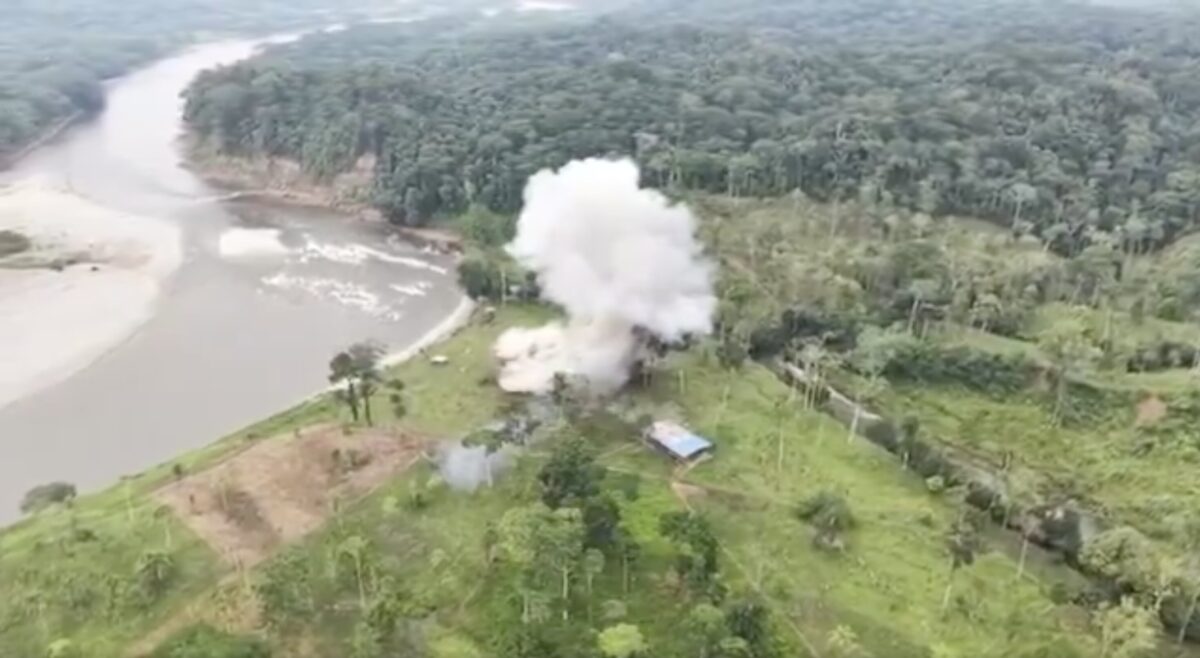
Three days later, assistant to the Secretary of Defense for public affairs Sean Parnell posted a video of another operation that showed a bombing and the decimated remains of a structure. Parnell claimed in his post that “at the request of Ecuador,” the U.S. “executed targeted action.”
Secretary of Defense Pete Hegseth reposted the video on X, writing that the U.S. was “bombing Narco Terrorists on land as well.”
But a new report from The New York Times claims that this site was, in reality, a cattle and dairy farm. The Times interviewed the farm’s owner and employees, as well as residents of the village where the bombing occurred, who described how Ecuadorian soldiers helicoptered in, covered structures in gasoline, burned them, and went on to beat four workers with the butts of their guns. One worker repeatedly passed out after being dunked into a barrel of water.
The workers who spoke to the Times further claimed that they were shocked and subjected to electrical shocks by the soldiers after being flown to a second location for interrogation and held overnight.
Residents of the village said that while the burning had occurred on March 3, helicopters returned to the site three days later and appeared to drop explosives on the destroyed farm. They claimed that this was when Ecuadorian soldiers recorded the footage released by Parnell that day, going on to tell The Times that the farm was not linked to illegal activity.
Though a former director of intelligence for Ecuador’s Army, Mario Pazmiño, claimed that high-ranking officials within the country’s military told him the property was used by the leader of the trafficking group the Commandos, a representative for the group told The Times in a phone interview that the Commandos had not used the farm.
The Ecuadorean military said in a news release that the site was used by drug traffickers, information the Ecuadorean government claimed came in part from U.S. “intelligence and support.”
Ecuadorean officials said soldiers had recovered guns and other “evidence of illicit activity” on the property. The Ecuadorean military did not offer evidence for its claims even though it tends to publicize photos of drugs, weapons and contraband it seizes during operations.
The Ecuadorean military referred questions to President Daniel Noboa, who did not respond to a detailed list of questions.
U.S. officials who spoke to The Times claimed that the U.S. military deployed a helicopter to help with the operation, but that U.S. military personnel were not directly a part of the bombing. Pentagon press secretary Kingsley Wilson said the strike was conducted “jointly” with Ecuador and could not be discussed in detail “due to operations security.”
New: The Mediaite One-Sheet "Newsletter of Newsletters"
Your daily summary and analysis of what the many, many media newsletters are saying and reporting. Subscribe now!





Comments
↓ Scroll down for comments ↓