Florida Bill Requiring Bloggers to Register with Government Won’t Survive Court Challenge, Says UF Law Prof


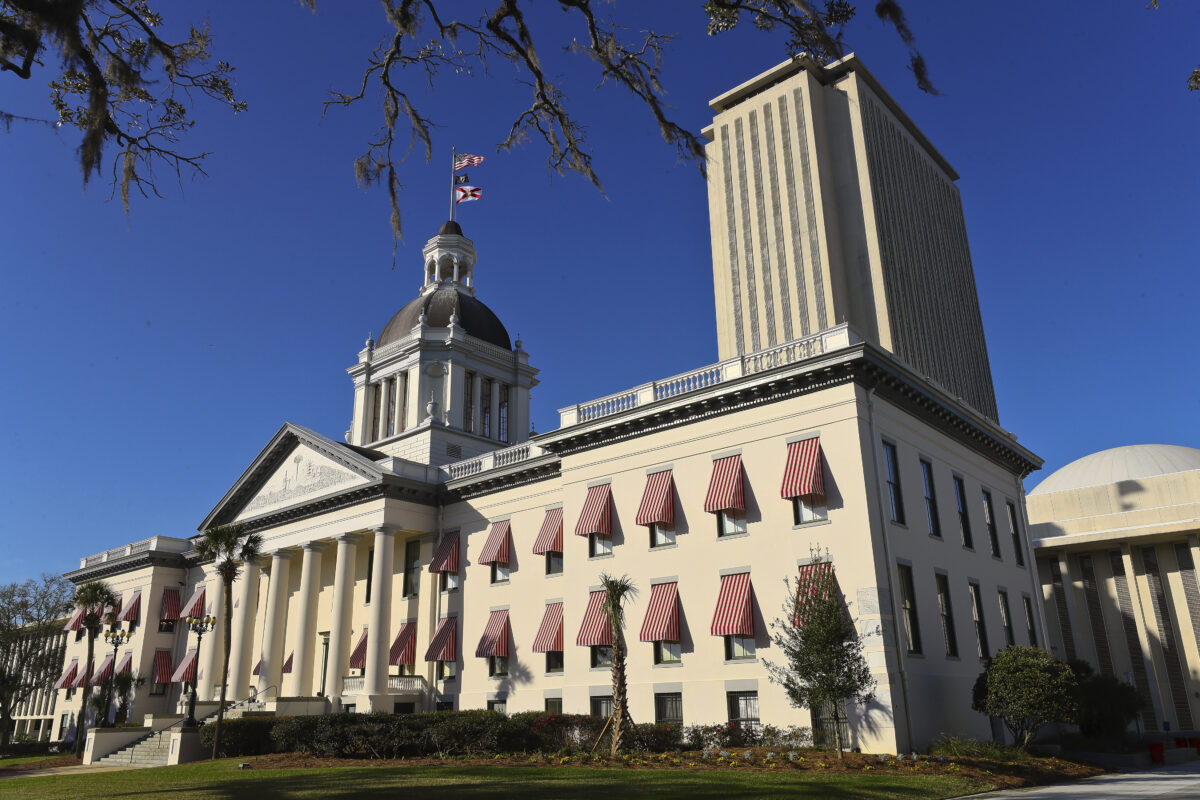
AP Photo/Phil Sears
Remember when conservatives cared about free speech? Pepperidge Farm remembers, or so the 1980s-era ad tagline revived by Reddit says. A bill filed this week by a Florida state senator — one who was active in the same Young Republican circles in which I used to travel, nonetheless — had your friendly neighborhood Mediaite contributing editor taking a seemingly hallucinogenic trip down memory lane, back to when the GOP cared (or at least pretended to care) about basic constitutional rights.
The bill in question, SB 1316, was filed by State Sen. Jason Brodeur (R) and is titled “Information Dissemination.” As always, the devil is in the details, and this nefarious scrap of legislation requires “bloggers” to file a report with the state government if they write a post about Florida’s governor, lieutenant governor, a Cabinet officer, or any member of the Legislature and get any compensation for that post. The reports are required to be filed monthly and disclose what compensation the blogger received.
SB 1316 defines “blogger” as a person who “submits a blog post to a blog which is subsequently published,” defines “blog post” as “an individual webpage on a blog which contains an article, a story, or a series of stories,” and defines “blog” as “a website or webpage that hosts any blogger and is frequently updated with opinion, commentary, or business content,” adding that “[t]he term [blog] does not include the website of a newspaper or other similar publication.”
Failure to comply with the registration demand incurs hefty fines — $25 per day up to $2,500 per monthly report not filed — and the bill also provides that any fines unpaid for more than 100 days “are eligible for recovery through the courts of this state.”
In short, this article — and many, many others that Mediaite has published — would arguably fall under the extremely broad terms of this bill.
While I and the other Mediaite reporters do not call ourselves “bloggers,” we do seem to fall within SB 1316’s terminology, and Mediaite.com is in fact a website that is “frequently updated with opinion, commentary, or business content.” Mediaite does not describe itself as a newspaper, has never published a print edition, and has no plans to do so, so the language exempting “the website of a newspaper or other similar publication” would not protect us. Likewise, many radio and television outlets around Florida maintain websites and social media accounts, without any affiliation to any newspapers (not to mention out-of-state media outlets).
The bill has a provision letting bloggers “request” that requirement to file monthly reports be waived “upon good cause shown based on reasonable circumstances,” but I don’t think I’m being unduly skeptical when I express my doubts that my state government would be generous about granting a waiver to its critics.
Brodeur’s bill, unsurprisingly, met swift and furious backlash from journalists, First Amendment lawyers, and free speech advocates. He attempted to defend the bill to Florida Politics (another online-only publication) reporter Jacob Ogles by saying he was modeling his legislation after similar state laws regulating lobbyists and requiring them to register, arguing that bloggers were just “lobbyists who write instead of talk,” and should also have to “register and report.”
I mentioned above that I’ve known Brodeur for years, through various UF alumni and local political activities. As I told another reporter covering this story earlier today, he’s no idiot but he’s also not a lawyer, and that lack of knowledge of constitutional law is glaring here. The First Amendment’s protections for speech and the press (and the corresponding provisions in the Florida Constitution) are — thankfully! — a massive obstacle to this sort of intrusive government oppression.
The Foundation for Individual Rights and Expression (FIRE), a free speech watchdog group, eviscerated SB 1316 in a statement as “flagrantly unconstitutional,” “fundamentally un-American,” and “an affront to the First Amendment and our national commitment to freedom of the press.”
National Review’s Charlie Cooke was more blunt, dunking on Brodeur as a “moron” and his bill as an “unconstitutional, moronic disgrace.”
As FIRE and other commentators have noted, forcing journalists to register with the government in order to publish is one of the abuses of state power our Constitution was specifically designed to thwart.
Clay Calvert, professor emeritus at the University of Florida’s Colleges of Law and Journalism, agreed with my assessment that Mediaite did seem to fall under SB 1316’s provisions, but cited multiple constitutional weaknesses in the bill’s text.
SB 1316 “is a deeply disturbing and unduly intrusive piece of legislation targeting journalism,” said Calvert, who reviewed the text of the bill prior to our phone conversation Friday. He noted the difficulty in actually distinguishing between a “journalist” and a “blogger” and found the bill’s attempts to establish definitions insufficient.
With it being unclear what online publications would actually constitute a “blog” and who might be a “blogger,” Calvert said, the entire law could be struck down under the “void for vagueness” doctrine, the fundamental principle of constitutional law that decrees laws to be unenforceable if the language is too vague for the average citizen to understand.
Far more worrisome, Calvert said, was the bill’s “highly troubling” efforts to oppress and intimidate the press.
Demanding that bloggers register and file monthly reports with the state government was very close to actually requiring “licensing” of the press — a system imposed by various English monarchs that the Founders intentionally targeted to prohibit with the First Amendment — and the reports themselves violated not just bloggers’ speech rights, but their rights not to speak, by compelling them to disclose their names and compensation when they otherwise would not legally be required to do so.
Anyone deriving compensation from writing, whether at a traditional media outlet or a blog, would be required to disclose the sources of their income to the IRS, the professor said, and “that’s enough.”
Because SB 1316 is a “content-based” restriction, applying only when someone writes about elected state officials, Calvert added, it is subject to “strict scrutiny,” the highest level of review for the constitutionality of a restriction on speech. That means that the state of Florida would have to show a “compelling interest” to justify the law and show that the law, requiring these monthly reports under the threat of large fines, was “narrowly tailored” to meet that interest.
It’s intentionally a very high burden to meet, Calvert said, and he acknowledged the loud outcry since Brodeur filed the bill, predicting that Florida Gov. Ron DeSantis (R) would find it a “tough one” to sign, “because it really does encroach on freedom of the press.” National Review’s Cooke also expressed his confidence that SB 1316 was an example of a “crazy state legislator” bill, and one that’s “not going to pass.”
I wish I shared their optimism, but after DeSantis’ other efforts to dilute free speech and press protections, his enthusiasm for punishing the state’s largest employer for its speech, and other unconstitutional and idiotic bills I’ve seen the Florida Legislature seriously consider and sometimes even pass, I actually don’t think it’s impossible this bill becomes law.
Cooke singled out Brodeur as a “solo moron” and an “embarrassment to the GOP” for Seminole County, but it’s a fact that he’s been heavily involved in county and state Republican party politics since he was in his twenties, is well-connected to GOP leadership around Florida, and I’m skeptical he really thought up this bill all by his lonesome and filed it without at least getting some sort of input from the powers-that-be in Tallahassee.
With that in mind, I asked Calvert about the process for challenging SB 1316, if it passes. The professor said it could be “challenged immediately,” and there would be no need to wait until the state government attempted to impose a fine for noncompliance.
All that would be needed, according to Calvert, would be for someone to say that they had written about Florida elected officials covered by the statute in the past, and this law had a “chilling effect” on the ability to do that in the future; a blogger would not necessarily have to actually write a post, refuse to file the report, and wait to have a fine imposed in order to file a lawsuit and establish standing.
Brodeur did not reply to my attempts to reach him for comment, but I had heard chatter that he was considering “tweaks” to the bill’s language in response to some of the backlash. I asked Calvert about this, whether there were any possible amendments or “language tweaks” to the bill that would make it survive constitutional strict scrutiny.
“No, I don’t really think so,” Calvert replied, because “we’re in the realm of political speech.” The way the bill targeted the content of political speech — writing about elected officials — was distinguishable from commercial speech, he said, like advertising, which the FTC has established an ability to regulate (for example, the #ad or #sponsored hashtags you see on posts by social media influencers to disclose they were paid for their post).
Overall, Calvert predicted, this bill would be struck down as void for vagueness, and for violating the freedoms of speech and press in the U.S. and Florida Constitutions.
I told the Orlando Sentinel’s Steve Lemongello that, on the “rare” (but not impossible) chance this bill passes, I would be “happy” to be a plaintiff for whatever First Amendment organization wishes to challenge this bill in court, so we shall see. I have zero intention of ever complying with a demand from any government agency that I register in order to exercise my free speech rights.
—
This is an opinion piece. The views expressed in this article are those of just the author.
New: The Mediaite One-Sheet "Newsletter of Newsletters"
Your daily summary and analysis of what the many, many media newsletters are saying and reporting. Subscribe now!


Comments
↓ Scroll down for comments ↓