
CBS News Announces ‘We Love America’ — Revealing Lost Authority

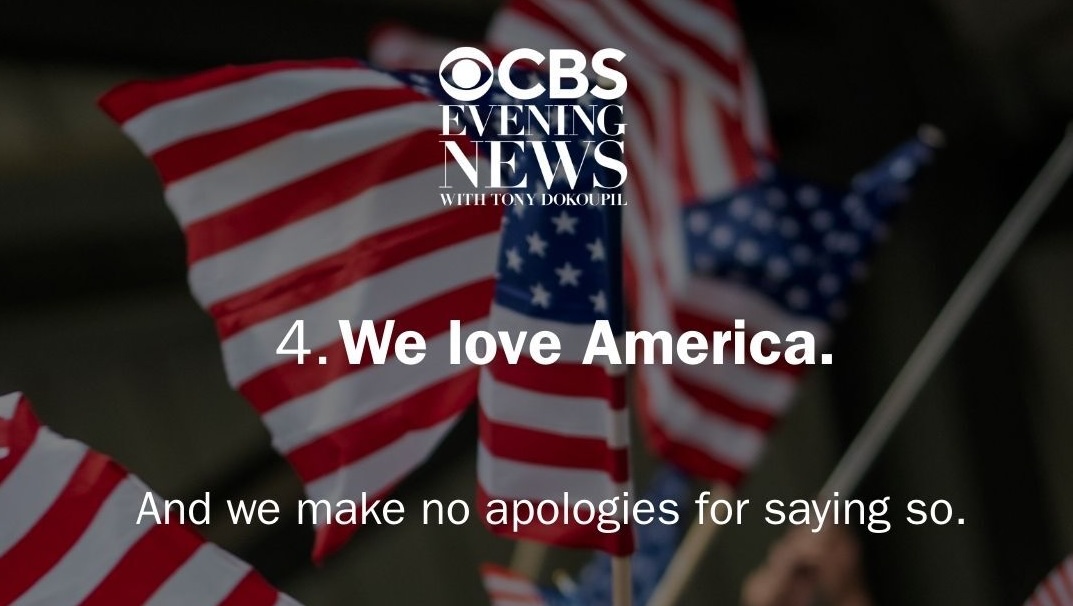
CBS Evening News relaunches Monday with a set of “five simple values” promoted across social media ahead of the debut. One has drawn outsized attention: “We love America. And we make no apologies for saying so.”
That reaction is the story, not the value itself.
For most of broadcast history, such a declaration would have been unnecessary. Patriotism was implied. It lived in the authority of the anchor chair, the cadence of the broadcast, and the institutional confidence of the networks. Love of country was not a value statement. It was the background condition.

So why say it now, and say it this way?
The values rollout follows Paramount’s sale to the Ellison family, Trump-aligned billionaires who have signaled interest in reshaping CBS’s editorial culture. It also comes alongside the involvement of Bari Weiss, brought in to help reframe how CBS News presents itself to an audience that has grown deeply skeptical of legacy media.
Weiss’s diagnosis has been consistent for years: institutional arrogance, ideological homogeneity, and a tone that often reads as condescension. Whether one agrees with her prescriptions or not, that critique maps directly onto the trust problem broadcast news is facing. In that context, this unusually explicit pledge of patriotism reads as a legitimacy play: an attempt to substitute affective alignment for inherited authority.
For decades, network news relied on positional authority. The anchor mattered. The broadcast mattered. There were three networks, limited alternatives, and a shared civic ritual each evening. Trust was structural. Civic duty was not yet saturated with cynicism, ironic detachment, or algorithmically fueled outrage. It did not need to be earned story by story. That authority has collapsed.
Neutral tone no longer signals neutrality. Institutional stature no longer confers credibility. In a fragmented media environment, journalism increasingly feels compelled to explain who it is before it can report what happened.
Seen through that lens, “we love America” functions as an attempt to anchor journalism to the one institution that still carries broad emotional resonance: the country. Not the press. Not expertise. America.
It’s a simple, emotionally resonant message for viewers inclined to believe this solves a deeper problem. Whether the patriotism is genuine or strategic barely matters. Once declared as editorial principle, it creates the same constraint either way.
Once loving the country becomes a stated editorial value, journalism inherits a bias toward institutional legitimation rather than institutional scrutiny. When institutions fail or behave corruptly, reporters face a built-in tension: describe the breakdown fully, or protect the civic identity they have pledged allegiance to.
This tension is familiar. It distorted political journalism between 2016 and 2020, when calling institutional failure what it was often felt destabilizing or irresponsible. Patriotism, once declared, becomes a constraint on description.
Which leads to the deeper question CBS is implicitly grappling with: if inherited authority is gone, what replaces it?
Transparency, demonstrated accuracy, and subject-matter expertise matter, but they don’t recreate mass legitimacy at broadcast scale. They work in niches. They don’t rebuild a civic commons.
That points to the harder conclusion. Broadcast-era authority was structural. It depended on scarcity, shared attention, and institutional dominance. Those conditions no longer exist. Value statements cannot restore them.
Which makes CBS’s move less a solution than a signal. Not of conservatism exactly, but of an institution confronting the limits of what journalism can promise in a media ecosystem that no longer agrees on who gets to speak with authority.
The risk isn’t that CBS says it loves America. The risk is that in trying to borrow legitimacy from the country, it discovers that love is not a reporting standard, and no declaration can replace authority that once came built in.
This is an opinion piece. The views expressed in this article are those of just the author.
New: The Mediaite One-Sheet "Newsletter of Newsletters"
Your daily summary and analysis of what the many, many media newsletters are saying and reporting. Subscribe now!












Comments
↓ Scroll down for comments ↓