Main Character Syndrome: Trump’s Reporter Shush Made the Press the Hero of Its Own Story

Screenshot
The American press has spent the past several days doing its favorite thing: covering itself. Its courage, its resistance, its indispensable role in democracy’s survival — all of it on full display, and all of it performing almost exactly the function the Trump administration needs it to perform. A wartime administration is actively testing the limits of the First Amendment.
The problem isn’t that the press missed it. It’s that the press keeps getting in its own way.
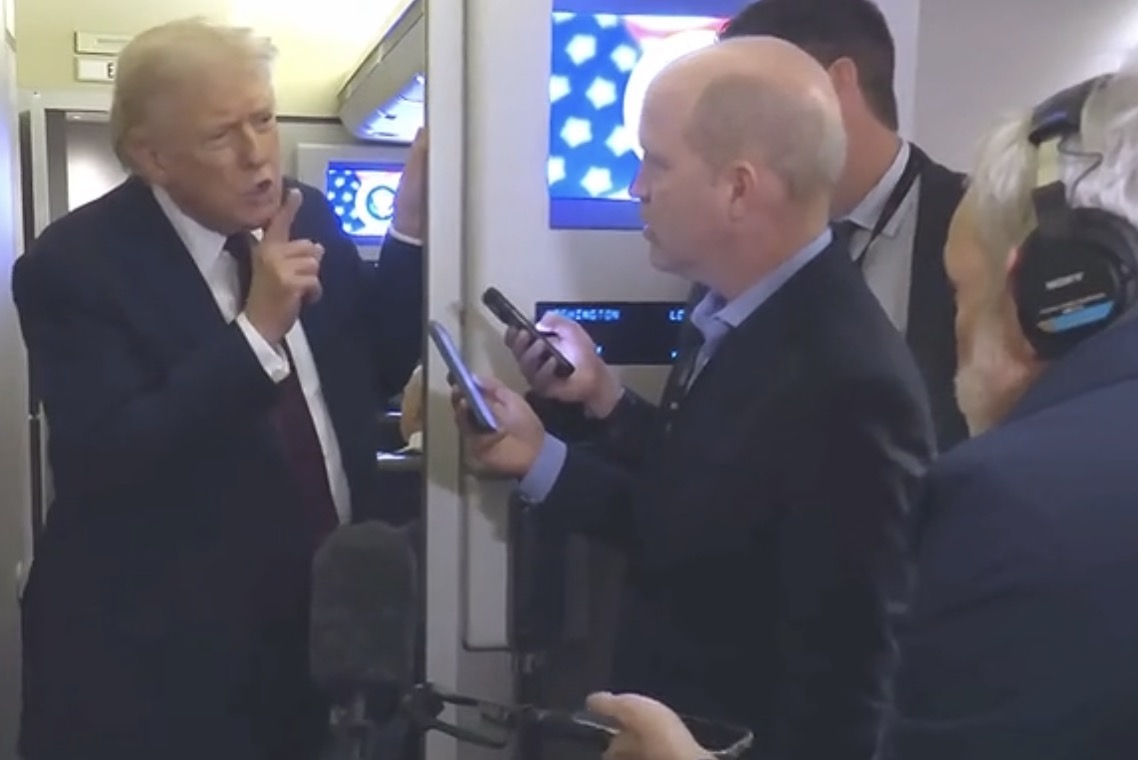
Call it main character syndrome: the instinct to center journalism’s performance in the story rather than examine how that performance interacts with power. The “shush” that launched a thousand takes was tailor-made for it — a clear villain, a steady protagonist, a visual that travels, and a narrative that resolves with professional vindication inside a single news cycle. It is the story the press is most comfortable telling about itself. It is also, in this case, the story that most benefits Trump.
The inciting moment was Donald Trump pressing a finger to his lips at ABC’s Mariam Khan aboard Air Force One. Khan held her ground, continued asking questions after being dismissed, and was widely praised across the media ecosystem for doing so. CNN’s Brian Stelter framed the episode as evidence of a “multi-pronged pressure campaign” and an “attack-the-messenger strategy” playing out across the administration. The diagnosis is sound. The pressure is real.
Stelter’s own telling shows how that pressure is being processed. He praised Khan as “exemplary,” “steady as can be,” and “respectful and persistent,” emphasizing that she “refused to be shushed.” The narrative tracks the exchange beat by beat — who asked what, how Trump responded, how the reporter held her ground — and resolves with professional vindication. It is compelling, clear, and complete on its own terms. What it leaves largely untouched is the broader context in which that moment sits.
Over the same weekend, Trump posted what amounted to a scoreboard of institutional damage: PBS and NPR defunding, layoffs at The Washington Post, declining cable ratings, and the departures of Chuck Todd, Joy Reid, Jim Acosta, and John Dickerson. He grouped them under headings like “Gone,” “Reforms,” and “Winning,” and shared a Guardian headline warning that he was “waging war against the media and winning,” apparently reading a cautionary account of democratic erosion as affirmation.
While the press narrated a confrontation, Trump was cataloging results.
Tom Jones of Poynter focused on that post, noting that Trump now sees the “unrelenting assault on the press” as something to “celebrate.” That framing identified the more revealing development, yet it remained secondary to the dominant focus on the shush and its symbolism. The moment led. The scoreboard didn’t.
Here is what that misplaced emphasis costs. What is actually happening — a sitting president and his appointed regulators using the machinery of government to signal to broadcasters what coverage is and isn’t acceptable during wartime — is one of the more direct tests of First Amendment limits in recent memory. FCC Chairman Brendan Carr, visiting Trump at Mar-a-Lago, posted a direct warning that broadcasters must operate in the “public interest” or risk their licenses, explicitly tying that warning to war coverage Trump has deemed insufficiently patriotic. That is not a temperamental outburst at 30,000 feet. That is a federal regulator using state power to pressure independent journalism at the precise moment the public most needs it — and the chilling effect doesn’t wait for a license to be revoked. It operates in the gap between the threat and the follow-through, in every editorial meeting where someone wonders whether a given framing is worth the exposure.
FCC Commissioner Anna Gomez noted on the record that no broadcast licenses come up for renewal until at least 2028 and that any attempt at early enforcement would likely fail in court. That legal limit is real and important context. But it addresses the mechanism, not the effect. As former Pentagon correspondent Barbara Starr put it, the aim is not necessarily execution but climate: “The risk is the climate they create.” A threat that cannot immediately be legally executed can still reshape coverage if the press treats it as existential — which is precisely what alarmed coverage, without Gomez’s rebuttal foregrounded, tends to produce.
That is the trap, and main character syndrome is what makes the press so vulnerable to it.
When the story becomes about journalism’s courage under fire rather than the specific constitutional ground being contested, the coverage does two things at once: it flatters the press and obscures the threat. The shush becomes the symbol. The regulatory pressure becomes the backdrop. And Trump, who understands this dynamic better than most of his critics, gets to keep score while the press takes bows.
As the Associated Press’s David Bauder reported, the administration is applying pressure to “tell the war’s story the way we see it,” through “lectures, scoldings and outright threats.” That strategy works whether or not a single license is ever touched. It doesn’t need the legal mechanism to function. It needs the press to be loud about its own bravery and quiet about the specific ways power is being restructured around it.
The same pattern appears in how access is treated. Writing for Status, Brian Lowry noted that Trump has taken to calling reporters directly to discuss the war, adding that a White House official suggested journalists who take those calls are “frankly doing themselves a disservice.” Those details appeared in the same coverage that elevated Khan’s refusal to be dismissed into a defining act of resistance. The juxtaposition went largely unexplored. The calls are taken, the comments are written up, and the framing moves with minimal friction.
Access and intimidation operate together. Raising the cost of adversarial coverage while lowering the cost of transmission for favorable or neutral coverage creates a system that does not require overt suppression. It requires continuity. The press keeps doing what it does, while the conditions under which it does it are quietly shaped.
The press is not missing the facts. It is misweighting them. The most narratively satisfying elements — confrontation, defiance, resolution — rise to the top, while the slower, less visible forces settle into the background. The result is coverage that tracks the temperature of the conflict rather than the shape of it.
What makes that maddening is the stakes. This is not a moment when the press can afford to be its own protagonist. The constitutional question on the table — whether a wartime administration can use regulatory threat, rhetorical pressure, and selective access to quietly reshape what journalism looks like — is serious enough to demand coverage that subordinates the drama of the shush to the reality of the squeeze. The press has the facts. Bauder reported them. Gomez stated them on the record. Starr named the dynamic. The pieces are there.
Trump isn’t just attacking the press. He’s keeping score. And the press, busy telling the story of its own resistance, keeps helping him run up the total.
This is an opinion piece. The views expressed in this article are those of just the author.
New: The Mediaite One-Sheet "Newsletter of Newsletters"
Your daily summary and analysis of what the many, many media newsletters are saying and reporting. Subscribe now!





Comments
↓ Scroll down for comments ↓