Republican 2024 Hopefuls Don’t Have an Answer on National Abortion Policy; They Need One

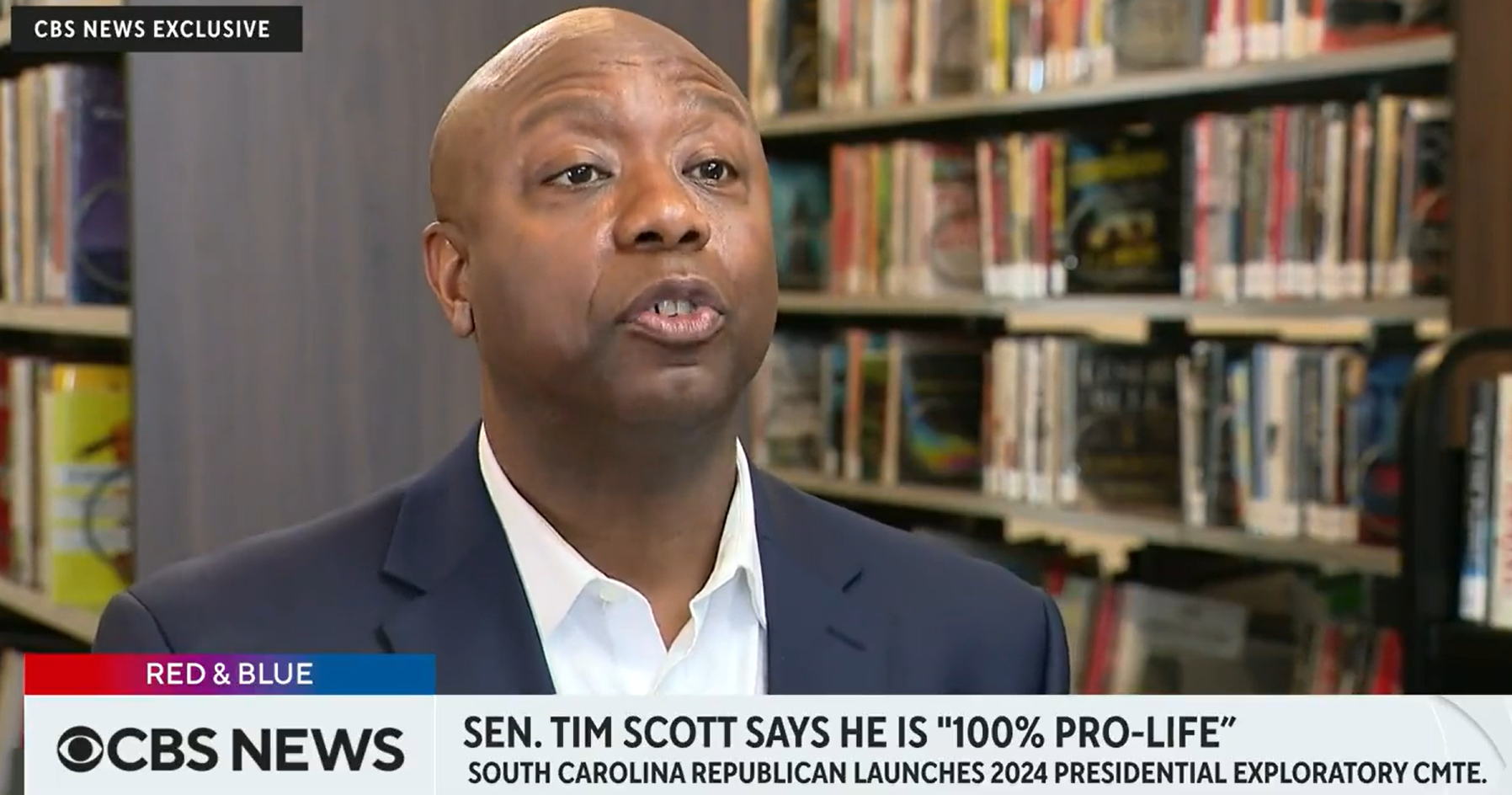
Senator Tim Scott (R-SC) announced that it was his intention to consider running for president on Wednesday.
Why not just dispense with the unnecessary overture and announce a campaign? An interview with CBS News’ Caitlin Huey-Burns might have shown why he isn’t yet ready for such an endeavor.
When Huey-Burns inquired if Scott believed the federal government should be involved in regulating abortion, referring specifically to Senator Lindsey Graham’s (R-SC) bill to forbid abortions from being performed after 15 weeks of pregnancy nationally (with exceptions for rape, incest, and the life of the mother) Scott said he was 100 percent pro-life and speaking to the radicalism of the Democratic Party.
When she repeated the question, Scott again swerved away from the specifics of his position to decry the Democrats’.
Huey-Burns gave him yet another crack at it.
“Yeah, so once again, I am 100% pro-life and I do believe-” began Scott.
“So yes?” interjected Burns.
“No, that’s not what I said,” replied the 2024 hopeful. “I do believe we should have a robust conversation about what’s happening on a very important topic,” before again diverting to pro-choice extremism.
GOP Sen. Tim Scott declines to say whether he supports Sen. Lindsey Graham’s proposed 15-week federal abortion ban.@CHueyBurns: “If you were president, would you advocate for federal limits?”
Scott: “I’m 100% pro-life.”
Huey-Burns: “So, yes?”
Scott: “That’s not what I said.” pic.twitter.com/SjXUP0gqIh
— CBS News (@CBSNews) April 12, 2023
He never did get around to answering the question — although he did endorse a 20-week ban on Thursday — but don’t judge him too harshly: Neither have his prospective competitors.
Another South Carolinian seeking the Republican nomination, Nikki Haley, also failed to offer a specific position on national abortion policy while calling for “consensus,” shortly after announcing her candidacy. She reiterated that call on Tuesday.
Former president Donald Trump, meanwhile, has sidestepped the issue while claiming that “We’re looking at a lot of different things.”
Florida governor Ron DeSantis just signed a restrictive 6-week ban in the Sunshine State, but is not yet an official candidate for the White House and has not commented on what his policy would be if he occupied it.
Much ink has been spilled over the electoral ramifications of the overturning of Roe v. Wade last June. For the first time in a long time, abortion policy will be determined by the voters, not a preposterous, ultra-permissive reading of the Constitution.
Some on the right warn that abortion is a losing issue for Republicans. “Abortion is the only issue Republicans lose BIG — and they won’t shut up about it,” lamented Ann Coulter after sharing a poll showing Republicans with an advantage on most issues and a 10-point disadvantage on abortion.
Her position is clear: “Pro-lifers: WE WON. Abortion is not a ‘constitutional right’ anymore! Please stop pushing strict limits on abortion, or there will be no Republicans left,” tweeted Coulter after Republicans lost a Wisconsin Supreme Court election last week. It’s a take that the aforementioned candidates seem to fear is right.
But regardless of what issues they might emphasize on the campaign trail, abortion will be an important one in 2024. The Republican nominee will have to field questions about what kind of bills they would sign as president, and whoever it is had better have an answer.
Because more than Republicans openness to restrictions relative to Democrats, it’s the opacity of their position that could doom them in a post-Roe era. It is absolutely true that a Republican running on a platform calling for a total ban on abortion from the moment of conception onward, with no exceptions, would be roundly rejected by the general electorate.
No serious contender for the nomination actually holds that position, but refusing to answer direct questions about what they do believe will allow their opponent to portray them as a radical seeking to conceal their position in order to sneak into office.
Polling actually shows that Americans support modest restriction on abortion, including up to 15 week. A Wall Street Journal survey conducted last summer indicated that 48 percent of voters would somewhat or strongly favor as much while 43 percent would somewhat or strongly oppose it.
A Fox News poll conducted last spring demonstrated even greater openness toward restrictions, with 54 percent supporting and just 41 percent opposed to a 15-week ban.
In concert with a defense of an exact national limit — or a principled defense of a state-by-state approach — explanations of Democratic radicalism could prove effective in a general election.
But if Republicans continue to stammer, stumble, and deflect when asked about their own position, they’ll be doing voters a disservice, and suffer the consequences for doing so.
This is an opinion piece. The views expressed in this article are those of just the author.
New: The Mediaite One-Sheet "Newsletter of Newsletters"
Your daily summary and analysis of what the many, many media newsletters are saying and reporting. Subscribe now!








Comments
↓ Scroll down for comments ↓