The Bad Bunny Halftime Show Reveals the Business of Manufactured Outrage

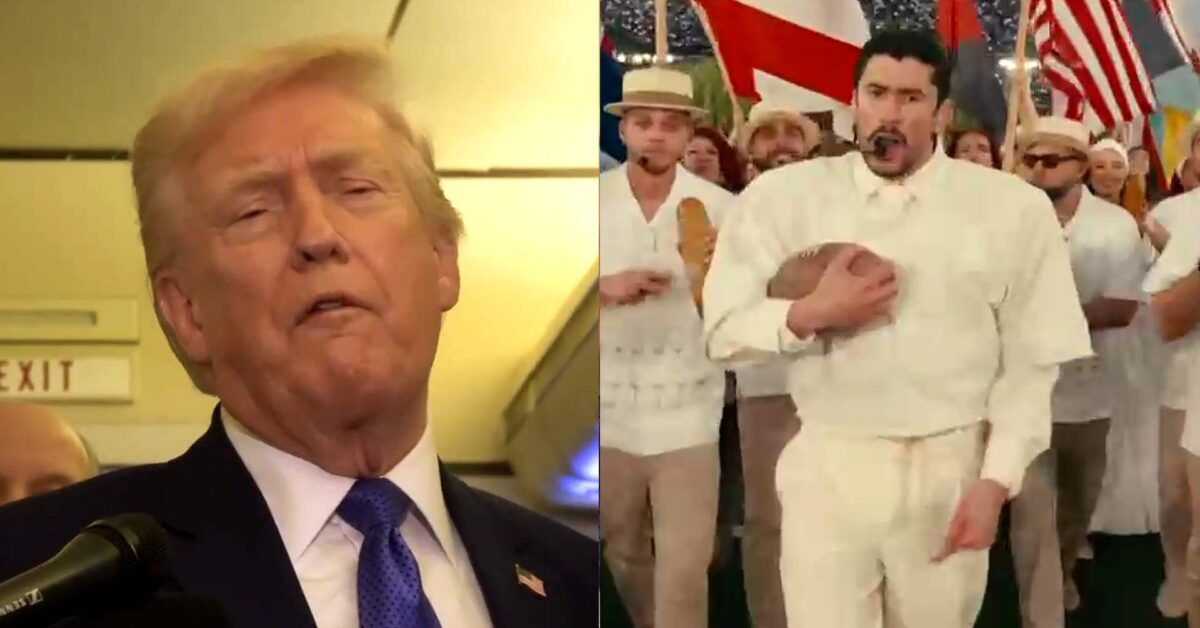
In the highly secure, closed-door meeting that followed the Bad Bunny Super Bowl halftime show, the people who track engagement, outrage, and alignment were not interested in the music. They were interested in the outcome.
Thirteen minutes of entertainment content had produced days of partisan sorting with no policy language, no coordinated messaging, and no meaningful stakes. Nobody in the room had seen numbers this clean since the Bud Light thing, and that one had practically run itself.
The show triggered a familiar, noisy, and largely pointless political meltdown. Conservatives treated it as cultural collapse. Progressives rushed to elevate it as a transcendent moment. The arguments were predictable, the sides preassigned, and the actual performance almost beside the point. The halftime slot had been just sitting there for years, undermonetized from a conflict standpoint, and nobody had thought to run the playbook on it until now. That was the real win.
A digital strategist pulled up the charts. Reaction curves split within minutes. Conservative outrage tracked precisely against prior models (the team liked to call this line the “Mad Men”). Progressive praise slightly outperformed moral sanctimony expectations (colloquially referred to as the “Virtue Signal”).
Counterprogramming appeared quickly. Influencers activated without outreach. The sitting president weighed in on instinct. Links were clicked. Subs were sold. It was frankly a home run.
A slide titled Postmortem Takeaways followed.
The first line was direct: “The controversy had little to do with performance.”
The second line was underlined: “There is an untapped inventory of similarly benign cultural institutions.”
That shifted the conversation.
As if everyone in the room had the same collective thought all at once, the meeting quickly pivoted to untapped opportunities. Someone said the phrase “virgin territory” and no one flinched. There was, it turned out, an enormous amount of American life that had not yet been converted into content conflict. The room found this energizing.
The Macy’s Thanksgiving Day Parade came up first. Massive audience. Nostalgia-rich. Corporate but emotionally protected. One balloon choice framed incorrectly could generate days of cable news and a week of social-media trench warfare, plus at least one statement from a senator who had not watched the parade in decades. Children were involved. Tradition could be invoked. The mechanics were familiar. Someone floated a Snoopy angle and was told to develop it offline.
New Year’s Eve followed. Time itself tested well as a dividing line. Who celebrates. Who is excluded. Who is awake. Who is watching from where. The ball drop already functioned as a metaphor. An alternative broadcast could be assembled cheaply and branded as “real.” That word tested well in every demo.
The Puppy Bowl? A time-honored tradition blissfully free of any controversy, but fortune favors the bold, and top creative minds were assigned the thought experiment on how to make it a wedge issue. Anything is possible with a bit of outrage and algorithmic support. The room agreed the puppies were not going to protect themselves.
Waterparks (yes, waterparks) appeared next. Family leisure. Risk tolerance. Who gets to feel safe while having fun. Insurance language alone could carry weeks of discourse. Visuals would travel well. Children’s joy reliably accelerated engagement when reframed as irresponsibility. A junior strategist pointed out that waterslide injury footage was already performing well organically, and was promoted on the spot.
Cheeseburgers closed the list, more as a challenge than anything else. Regional identity. Class signaling. Environmental framing. Masculinity cues. Preparation preferences already loosely coded. Beef mapped cleanly onto existing cultural fault lines. The item was flagged as scalable, low-effort, and emotionally sticky. The well-done conversation alone could fund a quarter.
The political director reminded the room of the objective. The goal was not outrage, which burned too fast. The goal was alignment. Get people to take sides over things that do not matter. The issue fades. The affiliation remains.
There was brief discussion of scope and saturation. The consensus was procedural. As long as each controversy appeared incidental, audiences would do the work themselves. People resist manipulation. They embrace self-discovered anger.
The meeting ended on schedule. Next steps were assigned. The halftime show did not come up again. The attendees returned to their other jobs, like managing the Epstein files rollout, policing pronoun use, and engineering hangnails.
Outside the room, people were still arguing about Bad Bunny.
That part required no further intervention.
Ed. note — this is satire. For now.
This is an opinion piece. The views expressed in this article are those of just the author.
New: The Mediaite One-Sheet "Newsletter of Newsletters"
Your daily summary and analysis of what the many, many media newsletters are saying and reporting. Subscribe now!





Comments
↓ Scroll down for comments ↓