
Trump’s Bizarre Prime-Time Speech Was an Argument With Observable Reality

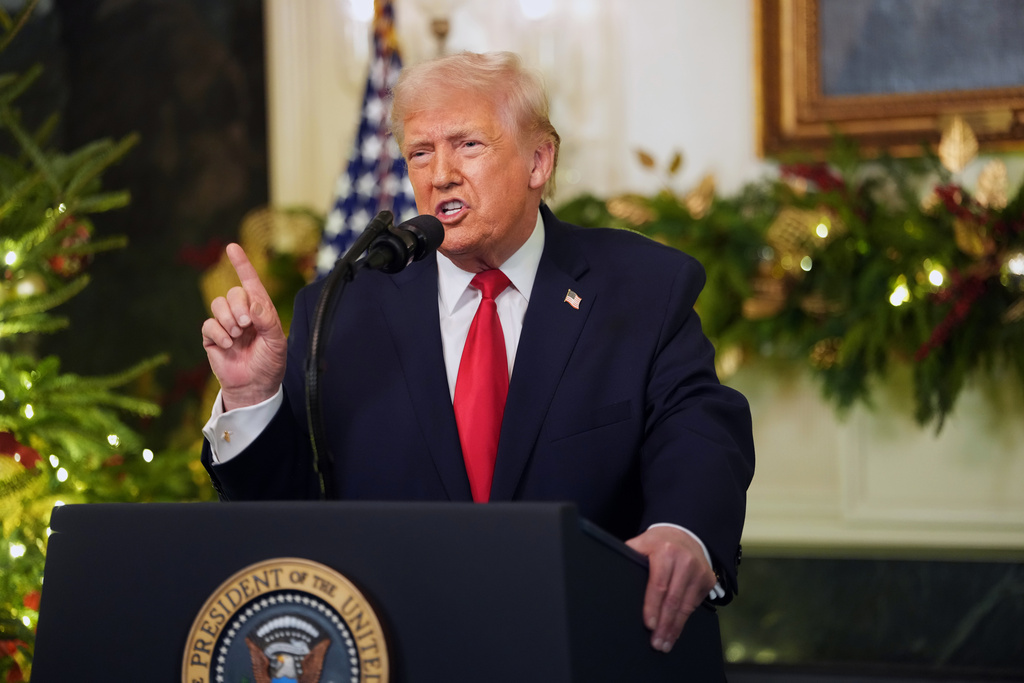
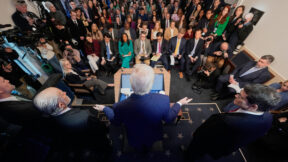
(Doug Mills/The New York Times via AP, Pool)
There is a long-standing, mostly respected convention in American television: when all the major networks cut away from regular programming to carry a president live, something important is about to happen. A national tragedy. A military strike. A resignation. Occasionally, history.
What viewers got Wednesday night was none of those things. Instead, it was a campaign rally speech delivered from the White House, carried live on every major network, with no news to report. It was a president arguing not with political opponents, but with observable reality itself.
That mismatch between format and content immediately made the speech feel strange. President Donald Trump spoke as though he were still on the campaign trail, loudly recycling familiar grievances, blaming former President Joe Biden for nearly everything, and insisting that the economy is roaring even as polls show voters remain unconvinced. The address felt less like an effort to inform the nation than an attempt to argue voters out of their own experience.
It was, in other words, a disorienting performance. A president, one year into his term, shouting as if still campaigning against his predecessor, apparently convinced that the old tonic would finally salve his sagging approval ratings. A chief executive demanding credit for economic progress that voters insist they have not experienced. Most strikingly, a politician once known for reading rooms now seeming genuinely baffled that the room was not reading him back.
The context matters. Trump ran on the promise that he would fix inflation “on Day 1,” a line that was never meant literally but was clearly meant emotionally. Voters expected to feel relief quickly. A year into his presidency, affordability remains the dominant concern, and his approval numbers reflect that frustration. Government data shows inflation has stabilized but not reversed; the Consumer Price Index is roughly where it was when Trump took office, after having fallen significantly in the final months of Biden’s presidency. Prices are no longer surging, but they are still high. For most households, that distinction is academic.
There is a quiet irony here. This is the same trap Trump’s predecessor fell into. Joe Biden spent months downplaying inflation as it was happening, then insisted he had solved it through another major spending bill, even as voters continued to feel squeezed. In both cases, the problem wasn’t the policy details; it was the insistence that voters accept an official narrative over their own experience.
The president’s tone suggested he knows the argument is not landing. He sounded rushed, irritated, and frequently angry, shouting as if sheer volume might bridge the gap between his claims and voters’ lived reality. One of Trump’s many political gifts was his emotional calibration, an instinctive ability to sound aligned with public frustration. On Wednesday night, he sounded angry at the public—a remarkable posture for a president whose approval ratings, less than a year into a second term, already hover near historic lows for an incumbent.
The anger was impossible to miss. Trump spent much of the address shouting, hectoring, insisting.
That reaction came from the right too, which matters. Conservative radio host Erick Erickson, a frequent Trump critic from the right, wrote shortly after the speech, “I assume they thought if he yelled at us tonight, everyone would move on from the Reiner tweet,” (a reference to Trump’s horrifying social media post earlier in the week). “I’m just not sure resetting the conversation one week before Christmas will be memorable.”
Another conservative commentator, Andrew Donaldson, described the speech as “rushing and angry,” and said it “reeked of fear.” Fear is not how incumbents typically project strength.
Fox News’ coverage underscored how insulated the president has become from that kind of feedback. The network followed the address with Sean Hannity’s comfort food affirmation rather than Brit Hume’s candid examination, praising Trump’s “shock and awe” remarks that Biden could never have delivered, without engaging the tone, the exaggerations, or the disconnect viewers had just witnessed. What occasionally functions as Fox News’ friendly scrutiny has hardened into a closed loop that no longer even pretends to check the president’s math.
The evening grew stranger still after CNN’s Brian Stelter reported that the White House had hoped the address would double as a PowerPoint presentation. Trump’s communications team circulated slides to the networks shortly before airtime and encouraged them to put the graphics on screen. NBC, ABC, CBS, and CNN declined, citing the lack of clear sourcing for the data. Fox News alone aired some of the slides, which were clearly labeled “White House graphic.”
That detail is more than a curiosity. Asking networks to carry unsourced charts suggests a belief that independent media should function as visual validators for presidential claims. One of the aired slides, showing gas prices over eight years, even undercut Trump’s own assertion that prices are now under $2 in some places. Most networks quietly declined the role they were being asked to play.
The speech itself trafficked less in outright falsehoods than in systematic overstatement. Trump declared inflation “stopped” and claimed prices were “falling rapidly.” In reality, inflation has cooled but remains persistent, and surveys show Americans continue to feel squeezed. By overselling stabilization as triumph, the president weakened his own case.
Trump once dominated the media by instinctively knowing what worked. Wednesday night suggested a president who no longer trusts that instinct and is trying, loudly and awkwardly, to will belief into existence.
There’s a familiar trope in American storytelling—Fonzie without the leather jacket, the Wizard exposed behind the curtain, Citizen Kane raging in Xanadu—where figures who once seemed effortlessly in command are suddenly reduced to volume and insistence. The magic disappears the moment the audience recognizes the performance as a performance. Wednesday night felt like that kind of moment.
The open question is what happens when that stops working entirely; when performance, repetition, and volume can no longer bend perception, and reality insists on asserting itself anyway. Wednesday night offered a preview: a president yelling at voters for not believing him, networks declining to validate his claims, and a base media apparatus so enclosed it could not see how strange the whole thing looked from the outside.
This is an opinion piece. The views expressed in this article are those of just the author.
New: The Mediaite One-Sheet "Newsletter of Newsletters"
Your daily summary and analysis of what the many, many media newsletters are saying and reporting. Subscribe now!







Comments
↓ Scroll down for comments ↓