
Why Pete Hegseth’s Buffoonery Isn’t a Bug for Trump — It’s the Job

AP Photo/Mark Schiefelbein
In any previous administration, this past week would have ended a secretary of defense’s career. Accountability in the Pentagon has never been perfect, but it has existed. Jim Mattis stepped down when he believed a president had undermined core alliances. Donald Rumsfeld was pushed out when public and congressional trust collapsed under the weight of Iraq. When major failures occurred, someone paid a price.
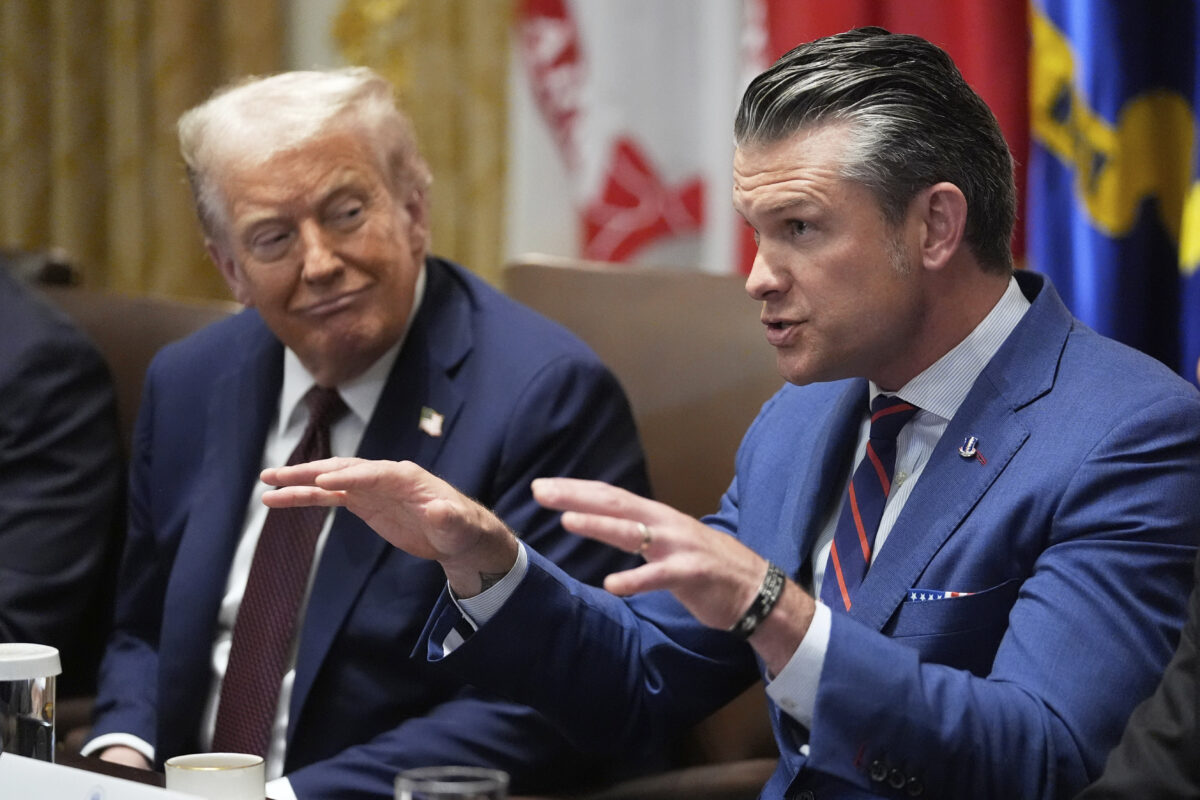
Yet Pete Hegseth remains firmly in control of the Pentagon after a week that included a damning inspector general report, a shifting narrative about a lethal “double-tap” strike in the Caribbean, a public threat to court-martial a sitting senator, and a bizarre cartoon meme of a character named Franklin firing rockets. The question we keep asking — how is this guy still running the Pentagon? —misses the point. Hegseth isn’t enduring chaos despite his conduct. He is thriving because of it.
And in any other administration, a single scandal of this magnitude would trigger immediate calls for resignation. A breach, a lie, a reckless comment—pick one. But President Donald Trump isn’t troubled by Hegseth’s ineptitude; he’s energized by the spectacle of it. He values ratings over standards, controversy over competence. The chaos isn’t a cost of doing business. It’s the business. And that tells you everything about what this Pentagon has become.
The inspector general report revealed that Hegseth shared sensitive operational timelines for Yemen airstrikes in unsecured Signal chats, including one with his family and personal lawyer. When investigators attempted to interview him, he refused. Most defense secretaries treat classification protocols as the backbone of national security; Hegseth treats them like vibes. This isn’t simple carelessness. It’s a deliberate preference for loyalty-based side channels over institutional processes. He’s building a parallel culture of command that runs not on structure, but on familiarity. He’s not ignoring Pentagon norms — he’s replacing them with something looser and far more dangerous.
Hegseth’s Pentagon press briefing this week only reinforced the dysfunction. What should have been a straightforward attempt to clarify the administration’s shifting narrative instead descended into a muddled display of evasions, contradictions, and open irritation with reporters who dared ask basic questions.
At one point, Hegseth appeared unfamiliar with details his own department had already released; at another, he dismissed follow-ups by accusing journalists of “getting lost in technicalities”—the technicalities in question being legality, chain of command, and who authorized a lethal strike. The Pentagon podium is supposed to project competence and clarity. Under Hegseth, it projected chaos and improvisation masquerading as authority.
The Caribbean operation exposes the same pattern. A suspected drug boat was hit with a missile on September 2. Survivors remained; a second strike killed them. Since then, the administration’s account has shifted constantly — less like a developing briefing and more like a cover story being workshopped in real time. First the boat was headed to the United States. Then maybe it wasn’t. Hegseth initially claimed he “watched it live” before acknowledging days later that he only saw the first strike before going to other meetings. This isn’t improvisation; it’s contempt for process elevated into governing doctrine. Act first, justify later. Policy reverse-engineered around politics. It is institutional sabotage through narrative churn.
Then there was Hegseth’s attempt to publicly discipline a U.S. senator. After Sen. Mark Kelly (D-AZ) — a retired Navy aviator — appeared in a short video reminding service members they cannot obey unlawful orders, Hegseth tweeted that Kelly “should be court-martialed,” echoing similar remarks he has made privately. The civilian head of the military was not sounding off; he was expressing a worldview in which dissent is disloyalty, and disloyalty should be punished. What happened next was just as telling: nothing. No formal Pentagon clarification, no Republican rebuke. The message was allowed to stand, unchallenged.
And then there’s the Franklin meme. Yes, it’s absurd: a cartoon character gleefully firing rockets as if a missile strike were Instagram content. But it reveals something the other scandals only hint at—the merging of military action with political entertainment. Hegseth packages war like viral media because this Pentagon increasingly operates as a stage, where spectacle substitutes for seriousness. The meme trivializes lethal force by turning it into a punchline, a shareable joke for the timeline. Institutions express their values through symbols. This one speaks loudly.
Fox News — Hegseth’s former employer and still the unofficial narrative thermostat for Trump’s political universe — has been largely silent on all of this, with a handful of principled exceptions. No breathless chyrons about national-security breaches, no panel discussions questioning his judgment, no outraged segments about the Pentagon’s conduct. It’s a stunning departure from the network’s past fixation on the perceived missteps of previous defense secretaries. And because Trump often seems to process reality through Fox’s coverage decisions, it’s entirely possible he has no real sense of the scale of the controversy surrounding Hegseth. If it’s not on Fox, it doesn’t exist.
So why is Hegseth still running the Pentagon? Because he isn’t the exception. He’s the model. Trump doesn’t want a Mattis-like figure restraining reckless decisions or defending alliances. He wants someone who collapses the distance between political warfare and actual warfare, who sees protocol as outdated, who treats national security like an extension of the campaign trail. Someone valued not for competence but for loyalty over principle.
The danger isn’t that Hegseth is unfit for the job. The danger is that the job has been redesigned around his unfitness. A Pentagon run by group chat, justified after the fact, and refracted through meme culture isn’t just a managerial failure—it’s a structural redefinition. And the real question isn’t how Hegseth remains in command. It’s what happens when a Pentagon built on institutional erosion faces a crisis that demands actual governance.
This is an opinion piece. The views expressed in this article are those of just the author.







Comments
↓ Scroll down for comments ↓