
Trump, CNN and Nicki Minaj Miss The Point: Voter ID Polls Well — With People Who Have ID

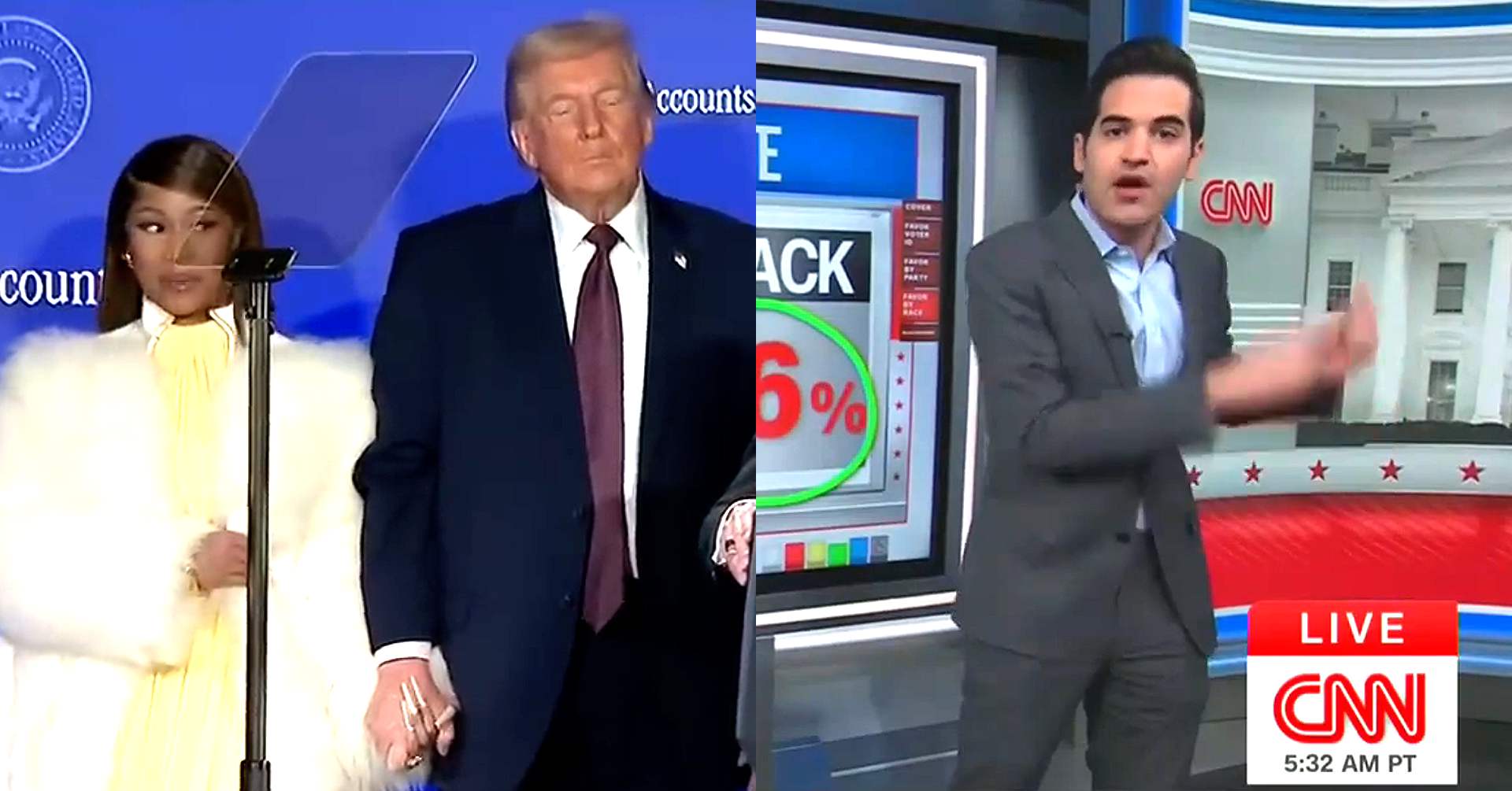
Even as President Donald Trump pushes for some kind of election reform, people like rap superstar Nicki Minaj and CNN data ace Harry Enten are out here rizzing up the popularity of voter ID laws — and it’s giving NOT fire, chat. It is leaving a surfeit of crumbs.
Just to keep it a buck, fam, I low-key love Harry Enten. I don’t mean to put him on blast. Ditto CNN. I bring them up only because I know they want to do the best they can, and they’re just the latest to step in this pile.
Pretty much every poll about voter ID misses the point, and probably a lot of Trump-loving rappers. Even a lot of Trump-hating rappers, folk singers, K-Poppers, Demon Hunters, and everybody in between misses the point.
To set the table: Trump drew criticism across the board on Monday when he said Republicans “should take over” elections in 15 states by “nationalizing” them.
He doubled down in the Oval Office Tuesday when CNN’s Kaitlan Collins asked him to explain himself (before he lost it on her over a question about Jeffrey Epstein survivors).
Most people understand this as the no-holds-barred threat that it really is, but Trump flack Karoline Leavitt tried to re-spin it into an expression of support for voter ID laws. Specifically, the so-called SAVE Act.
Minaj was also tweeting about voter ID this week. On Sunday — while not being at the Grammy Awards — she wrote “What sensible forward thinking cutting edge leading nation is having a DEBATE on whether or not there should be VOTER ID?!?!!!! Like?!?!? They’re actually fighting NOT to have ppl present ID while voting for your leaders!!!!! Do you get it?!?!!!! Do you get it now?!?!!!”
That’s actually, shocker, not true.
Enter Enten. On Tuesday, John Berman brought him in to explain how most Americans — even Democrats and even Black people — support voter ID in polls:
JOHN BERMAN, CNN ANCHOR: All right, new big-time Donald Trump supporter getting a lot of attention for a tweet that she made on the issue of voter I.D. Nicki Minaj wrote, quote, “what sensible, forward thinking, cutting edge leading nation is having a DEBATE,” all caps, “on whether or not there should be voter I.D. Like they’re actually fighting not to have people present I.D. when voting for your leaders. Do you get it? Do you get it now?”
CNN chief data analyst Harry Enten is with me.
So, voter I.D., just so people understand, is the idea that someone shows a photo I.D. when they go to vote, when they go to cast their ballot.
HARRY ENTEN, CNN CHIEF DATA ANALYST: Correct.
BERMAN: Because there’s a separate discussion right now about needing a passport or a birth certificate to register to vote. But the polling is all on voter I.D., showing an I.D. to vote.
ENTEN: Correct. Showing a photo I.D. to vote. And the American people are with Nicki Minaj because what are we talking about here? So, take a look here. Flavor voter I.D. to vote. Look, I got all this polling on the screen going back since 2018. You’ll notice on all of it, it’s all north of 75 percent, 76 percent, 76 percent, 76 percent, 81 percent, and then 83 percent in the last year of Americans. Agree with Nicki Minaj, they favor photo I.D. to be able to vote.
BERMAN: What about by party? What’s the party breakdown?
ENTEN: Yes, normally you might expect, hey, there’d be a big divide by party with Republicans really for it and Democrats really against it. But not really here. I mean just take a look here, favor photo I.D. to vote. You got 95 percent of Republicans, pretty much all of them, but even 71 percent of Democrats favor photo I.D. to vote. So again, Nicki Minaj posting that on X. And what you see is, is that the American people — actually it’s not really all that controversial. The American people are with Nicki Minaj, whether they are Republican or even if they are Democrats. We’re talking about seven in ten Democrats agreeing with Nicki Minaj that you, in fact, should show a voter photo I.D. to vote.
BERMAN: What’s the racial breakdown?
ENTEN: OK, what’s the racial breakdown on this, right, because I think a lot of people make the argument that people of color, nonwhite Americans, have a harder time procuring a photo I.D. to vote. But even here, take a look here, favor photo I.D. to vote. Eighty-five percent of white people favor it. Eighty-two percent of Latinos. Seventy-six percent of black Americans favor it.
So, the bottom line is this, voter I.D. is not controversial in this country. A photo I.D. to vote is not controversial in this country. It is not controversial by party, and it is not controversial by race. The vast majority of Americans agree with Nicki Minaj that, in fact, you should have a photo I.D. to be able to vote.
BERMAN: So, something of a non-troversy in other words.
ENTEN: That’s very good. The alliteration of Mr. John Berman, that Harvard education paying off once.
The polling Enten cites is real, and comes from Pew Research Center polls from the last eight years. Most recently, respondents were asked if they favor “Requiring all voters to show government-issued photo identification to vote.”
But as Berman and Enten fleetingly noted, that’s not what the SAVE Act says — it requires “documentary proof of citizenship.”
And the question fails to consider the many states that already have laws that don’t accept many forms of government photo I.D. What’s interesting is how closely these polls mirror the percentages of people who have or don’t have the necessary I.D.
According to the Campaign Legal Center, almost ten percent of eligible Americans lack the documentation required under the law:
More than 21 million Americans are unable to access the additional documents that would be required to register to vote under the SAVE Act. People of color, married people who have changed their names, as well as young and elderly people are more likely to have difficulty in accessing these documents. For example, married people who have changed their name do not necessarily have a birth certificate with their current legal name on it.
Under the SAVE Act, most voters wouldn’t be able to register to vote with their driver’s license alone, because licenses generally do not indicate citizenship. Instead, they would need another less common form of documentation, like a U.S. passport or birth certificate.
And according to the League of Women Voters, which opposes the law, the impact would be disparate in a number of ways — including by race:
Many communities of eligible voters would be unnecessarily burdened by the requirements of the SAVE Act. Among them are military voters who would be required to present documentation every time they re-register to vote when their family moves. Families who have been impacted by natural disasters may have lost necessary documentation and would be required to jump through hoops to replace these documents to register to vote while also going through the traumatic process of rebuilding their lives. Additionally, Americans who have changed their name, like married women, would also be required to secure updated documentation to register to vote.
Americans do not need MORE obstacles to vote. The SAVE Act would create one more barrier to the voting process, as many eligible voters do not have easy access to the necessary documents. Compared to white US citizens, citizens of color are three times more likely to lack documents such as birth certificates, passports, naturalization certificates, or certificates of citizenship or face difficulties accessing them. For example, while approximately half of all American adults possess a passport, two-thirds of Black Americans do not.
These aren’t esoteric concerns; they are quantifiable with data — data that is not being factored into these poll questions. Someone with a state college I.D. might assume they’re good to go and respond favorably to that poll question, little knowing that ID is no good in their state.
But more fundamentally, there is a flaw to putting civil rights to a popular vote. Civil rights issues arise precisely because people who are numerical minorities need to be protected from practices and offenses that do not affect most people.
Literacy tests were popular, too.
In fact, if you worded the question properly, you could probably get a huge response to literacy tests even today, because it sounds reasonable to most people that you ought to be able to read and write in order to vote.
Such a poll would ignore the fact that literacy was not the point of literacy tests, any more than identifying voters is the point of voter ID laws. 83% of Americans don’t see why producing photo ID is a big deal because they have photo ID.
Polling experts have also criticized these sorts of results because support can change drastically based on the wording of the questions, the people most likely to be negatively affected are least likely to be contacted for these polls, and racial animus has an impact on the racial disparities in support.
One study from the University of Delaware showed that respondents were more likely to support voter ID laws if they harbored racial resentment:
To assess attitudes toward African Americans, all non-African Americans respondents in the poll were asked a series of questions. Responses to these questions were combined to form a measure of “racial resentment.” Researchers found that support for voter ID laws is highest among those with the highest levels of “racial resentment.”
…The survey reveals strong partisan and ideological divisions on racial resentment. Republicans and conservatives have the highest “racial resentment” scores, and Democrats and liberals have the lowest; Independents and moderates are in the middle. In addition, Democrats and liberals are least supportive of voter ID laws, whereas Republicans and conservatives are most supportive. The link between “racial resentment” and support for such laws persists even after controlling for the effects of partisanship, ideology, and a range of demographic variables.
More recently, a 2022 study by the Brennan Center for Justice found that “racial factors were powerful predictors of sponsorship. This is consistent with the theory that ‘racial backlash’ — a theory describing how white Americans respond to a perceived erosion of power and status by undermining the political opportunities of minorities — is driving this surge of restrictive legislation.”
That is obviously not to say that all the people captured in these polls are motivated by racial resentment. Photo ID is an issue that swims upstream from public opinion on other voting laws. Large majorities favor most policies that make it easier to vote and oppose purging voter rolls based on inactivity.
But photo ID evokes competing issues, the desire for everyone to be able to vote and wanting to prevent fraud. Politicians seeking to disenfranchise disfavored voters exploit the latter to override the former.
If you were to ask people if they favored restricting the voting rights of almost 10 million legally registered voters, in order to prevent something that never happens, you’d probably get a different result.
It shouldn’t be that difficult to properly contextualize this issue, even in a three-minute segment. And even if you can’t, do a longer segment.
This is an opinion piece. The views expressed in this article are those of just the author.
New: The Mediaite One-Sheet "Newsletter of Newsletters"
Your daily summary and analysis of what the many, many media newsletters are saying and reporting. Subscribe now!





Comments
↓ Scroll down for comments ↓