CBS News Gave Hegseth the Mic After He Shut Out the Press. That’s Not Journalism.

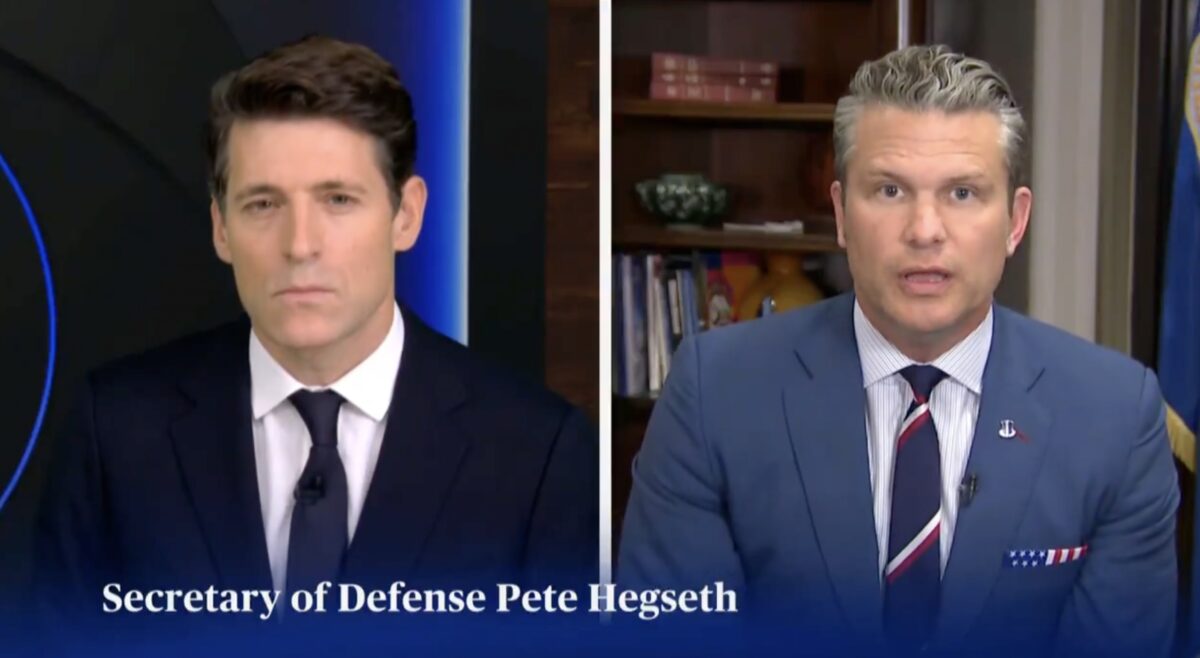
CBS News gave Defense Secretary Pete Hegseth three uninterrupted segments on its flagship evening broadcast days after he effectively expelled the Pentagon press corps, a decision that raises serious questions about why one of the country’s most powerful news organizations chose access at a moment when press freedom inside the Defense Department is under direct attack.
Hegseth’s appearance on CBS Evening News followed the Trump administration’s move to sharply restrict access for credentialed Pentagon reporters, sidelining journalists responsible for independently scrutinizing U.S. military power. Yet CBS not only sat down with Hegseth, it allowed him to define a U.S. military operation in Venezuela as a “law enforcement” action, argue Congress need not be notified, and openly discuss American oil interests, all without confronting the administration’s crackdown on the press itself.
That omission matters because the “law enforcement” label is a legal maneuver with constitutional consequences. Classifying a military operation this way narrows congressional oversight, weakens War Powers constraints, and limits disclosure requirements. By accepting that framing without challenge, CBS allowed Hegseth to redraw the legal boundaries of U.S. force on national television without accounting for what that redefinition permits.
This is not about whether CBS should have interviewed the Secretary of Defense. It is about the terms under which the interview occurred. When an administration punishes reporters and dismantles a press corps, access no longer functions as a neutral journalistic transaction. Interviews conducted under those conditions carry an obligation to address the attack on the press itself.
CBS did not meet that obligation.
Newly appointed Evening News anchor Tony Dokoupil grilled Hegseth about troops on the ground and congressional involvement. Those questions were not just appropriate, but remarkably newsworthy. But the interview environment seemed to protect Hegseth from sustained scrutiny on the most immediate issue affecting public trust: his role in restricting who can report on the Pentagon and under what conditions.
At no point was Hegseth asked to explain why reporters were removed from the building. At no point was he asked why Americans should trust a Defense Department that now controls access more tightly while asking the public to accept its claims at face value. The need for an independent Pentagon Press Association has rarely been clearer than in the days following a major U.S. military action.
The Pentagon press corps exists to prevent senior officials from unilaterally redefining war as policing, oversight as optional, and foreign resources as recoverable assets. When that system is weakened, interviews like this replace accountability rather than reinforce it. CBS treated the interview as routine despite the fact that the infrastructure designed to test Hegseth’s claims had already been damaged.
The most important question CBS could have asked Hegseth had nothing to do with Venezuela. It was straightforward: why were reporters locked out of the Pentagon, and why should the public accept information delivered through a narrowed, controlled channel? Dokoupil never asked it.
That silence is harder to justify given that CBS employs its own Pentagon correspondent and national security reporters whose access has been directly affected by Hegseth’s policies. The omission becomes more striking given that it comes weeks after CBS appointed Bari Weiss as Editor-in-Chief, a move widely interpreted as accommodation toward the Trump administration. Yet the network granted Hegseth the legitimacy of its evening broadcast without acknowledging that conflict or explaining how it reconciles prime-time access with the sidelining of its own journalists.
This is what democratic erosion looks like on television. It unfolds in real time through polished interviews and familiar formats, when attacks on accountability infrastructure are treated as peripheral rather than central. It advances when institutions accommodate power that has already shown it will punish scrutiny, hoping compliance will preserve access.
It never does.
If CBS wants to restore credibility, transparency has to be specific. That means aggressive reporting on the Pentagon’s press restrictions. It means explaining how this interview was negotiated. It means senior CBS figures publicly addressing why Hegseth was given a platform after locking out their colleagues.
When news organizations stop defending the conditions that make accountability possible, they are no longer merely covering democratic decline. They are helping to accelerate it.
This is an opinion piece. The views expressed in this article are those of just the author.
New: The Mediaite One-Sheet "Newsletter of Newsletters"
Your daily summary and analysis of what the many, many media newsletters are saying and reporting. Subscribe now!






Comments
↓ Scroll down for comments ↓